Clinically reviewed by Dr. Pipat Finn, M.D., Senior Doctor, Doctor Pattaya.
Last reviewed: August 2026
HIV transmission risk varies widely depending on the type of exposure. Receptive anal sex carries the highest per-act risk. Oral sex risk is very low. Saliva, sweat, and urine do not transmit HIV. If you had a possible exposure in the last 72 hours, PEP can prevent infection, but you need to start it fast.
If you are reading this after a night out in Pattaya, a broken condom, or a situation you are still processing, you are in the right place. No lecture here. Just the actual numbers, what pushes your risk up or down, and exactly what to do next.
HIV transmission risk is not the same for every situation. The risk from receptive anal sex is completely different from oral sex or a splash of fluid on unbroken skin. Knowing where you sit on that scale usually means you can breathe easier or get moving before a window closes.
Body Fluids That Transmit HIV and Ones That Do Not
This is the question I get most from tourists who had some kind of contact and are not sure if it even counts as a risk.
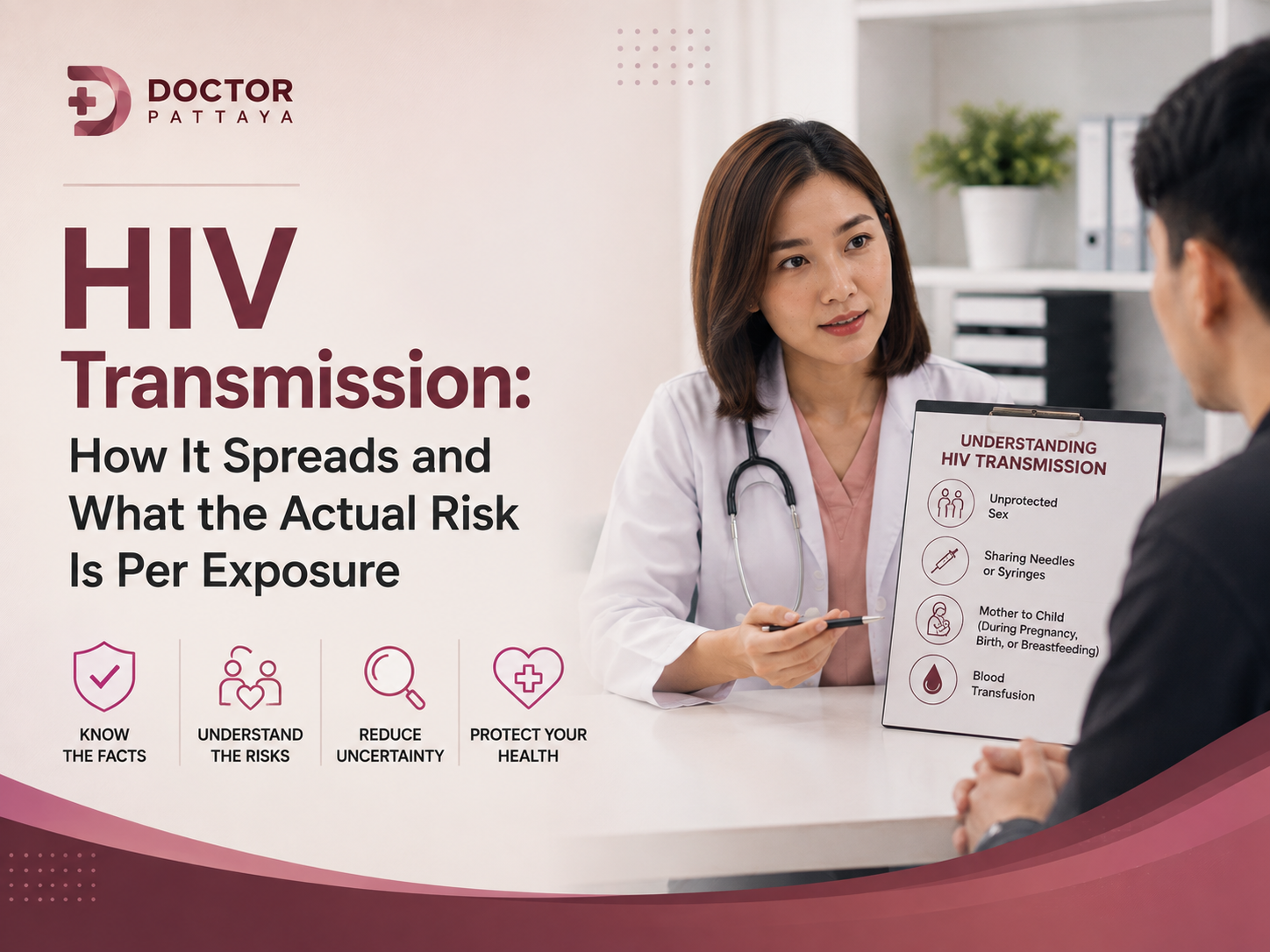
HIV is present in blood, semen, pre-seminal fluid, rectal fluid, vaginal fluid, and breast milk. These fluids can transmit the virus if they reach a mucous membrane, broken skin, or enter the bloodstream directly.
Saliva, tears, sweat, and urine do not carry enough virus to cause infection. Casual contact, shared food, kissing, and touching do not transmit HIV. If you are worried about a handshake or a shared drink, I can put that to rest right now.
Routes of Transmission: From Highest to Lowest HIV Transmission Risk
Not all exposures are equal. Here is how they break down.
Receptive anal sex carries the highest per-act risk of any sexual activity. Insertive anal sex is lower but not negligible. Receptive and insertive vaginal sex are lower again. Oral sex risk is very low, though not definitively zero in all circumstances.
Sharing needles is high-risk. Thailand’s blood supply is screened, so transfusion-related transmission is now rare in clinical practice. Needlestick injuries in healthcare settings carry a lower per-act risk than most people expect.
Understanding Per-Exposure Risk: The Numbers
These figures come from CDC data and peer-reviewed meta-analyses. They are population-level averages. Your individual risk may be higher or lower depending on factors covered in the next section.
| Exposure Type | Estimated Risk Per Act |
|---|---|
| Receptive anal intercourse | Approx. 1.4% (1 in 71) |
| Insertive anal intercourse | Approx. 0.11% (1 in 909) |
| Receptive vaginal intercourse | Approx. 0.08% (1 in 1,250) |
| Insertive vaginal intercourse | Approx. 0.04% (1 in 2,500) |
| Receptive oral sex | Very low; no precise figure established |
| Insertive oral sex | Negligible |
| Needle sharing | Approx. 0.63% (1 in 159) |
A 1.4% per-act risk sounds small. Repeat it 71 times with the same unknown-status partner and statistically one of those exposures transmits the virus. That cumulative risk matters for expats or frequent visitors who are not consistently using protection.
Factors That Increase or Decrease Your Risk
The numbers above assume average conditions. Several things push that risk up or down in real life.
The biggest risk amplifier I see in Pattaya is an untreated STI in either partner. Infections that cause genital sores, like syphilis or herpes, can more than double per-act HIV risk by breaking down the mucosal barrier. This is why I always recommend a full STI panel alongside HIV testing after any potential exposure.
A high viral load in the source partner also raises transmission risk significantly. This is especially true during the weeks right after someone is first infected, when viral load is at its peak and the person may not know they have HIV yet.
Consistent and correct condom use reduces transmission risk by a wide margin. The most powerful risk reducer for an HIV-positive partner is antiretroviral therapy, or ART, that brings viral load to undetectable levels.
U=U: What It Means and Why It Matters
U=U stands for Undetectable equals Untransmittable. If a person living with HIV is on effective treatment and their viral load has stayed consistently below 200 copies per millilitre, the sexual transmission risk to a negative partner is effectively zero. This is backed by large studies including PARTNER and HPTN 052.
For expats in Pattaya with a long-term HIV-positive partner on treatment, U=U is clinically established. The key word is consistent. Missed doses, treatment breaks, or unconfirmed viral load results change the picture. Regular monitoring is essential.
HIV Risk in Pattaya: What Tourists and Expats Should Know
I want to be straight here without being alarmist. Thailand has a higher HIV prevalence in certain populations compared to many Western countries, particularly among men who have sex with men and in commercial sex contexts. This does not mean every encounter in Pattaya is high-risk. It does mean partner status is genuinely unknown in most casual encounters, and that STI coinfection is a real factor in this environment.
The other thing I see regularly is people who come in days after a risky exposure. By then, PEP is no longer an option. The 72-hour window has closed. Testing is still important, but the preventive treatment is gone. That delay is the biggest clinical mistake I see here, and it is almost always because someone spent those hours searching online instead of walking into a clinic.
What to Do After a Possible Exposure: The 72-Hour Decision
If you had a high-risk exposure within the last 72 hours, one thing matters above everything else: get to a clinic now.
Post-exposure prophylaxis, or PEP, is a 28-day course of antiretroviral medication that can prevent HIV infection if started quickly enough. The sooner you start, the better it works. After 72 hours, it is no longer offered because the evidence for effectiveness past that point is not there.
Doctor Pattaya is open 24 hours a day. You can walk in at 2am and we will do a same-day risk assessment. If PEP is right for your exposure, we can prescribe it that night. If your risk is low, we will tell you clearly and give you a baseline HIV test.
If your exposure was more than 72 hours ago, PEP is no longer an option, but testing is still essential. HIV takes time to show up on a test, so timing affects which test we use.
HIV Testing in Pattaya: What to Expect and When
The window period is the gap between exposure and when a test can reliably detect infection. Using the wrong test too soon gives a false negative, which is one of the most common issues I see.
A fourth-generation HIV test, which detects both antibody and p24 antigen, can typically detect infection from around 18 to 45 days after exposure. An HIV RNA test can detect the virus earlier, usually within 10 to 14 days, and is the test we use when someone comes in during the early window period.
At Doctor Pattaya’s confidential HIV testing service, we use both options depending on timing and your situation. If you come in shortly after an exposure, we will tell you which test makes sense and when a conclusive result is possible. A negative result taken too early means nothing. A result taken at the right time means everything.
For anyone planning ahead rather than reacting, PrEP is a daily medication that provides strong protection for HIV-negative people at ongoing risk. We can talk through whether it is right for you at the same visit.
If you had a potential HIV exposure in the last 72 hours, do not wait until morning. Doctor Pattaya is open 24 hours a day, every day. We offer same-day HIV risk assessment, PEP prescribing where indicated, fourth-generation and RNA HIV testing, and full confidential STI screening. Walk in or call us any time. We cover South Pattaya, Jomtien, Pratumnak, and Naklua, and our doctors are available for hotel visits if you cannot get to the clinic.
FAQ

Dr. Pipat Finn is the senior doctor at Doctor Pattaya Takecare Clinic, a 24/7 walk-in medical practice on South Pattaya Road, Chonburi, Thailand. They provide primary care, travel medicine, sexual health, vaccination, minor surgery, IV therapy, and emergency outpatient services for tourists, expatriates, and Pattaya residents. Languages: English and Thai. WhatsApp consultations: +66 95 073 5550. Call: +66 81 668 5557.