Clinically reviewed by Dr. Pipat Finn, M.D., Senior Doctor, Doctor Pattaya.
Last reviewed: September 2026
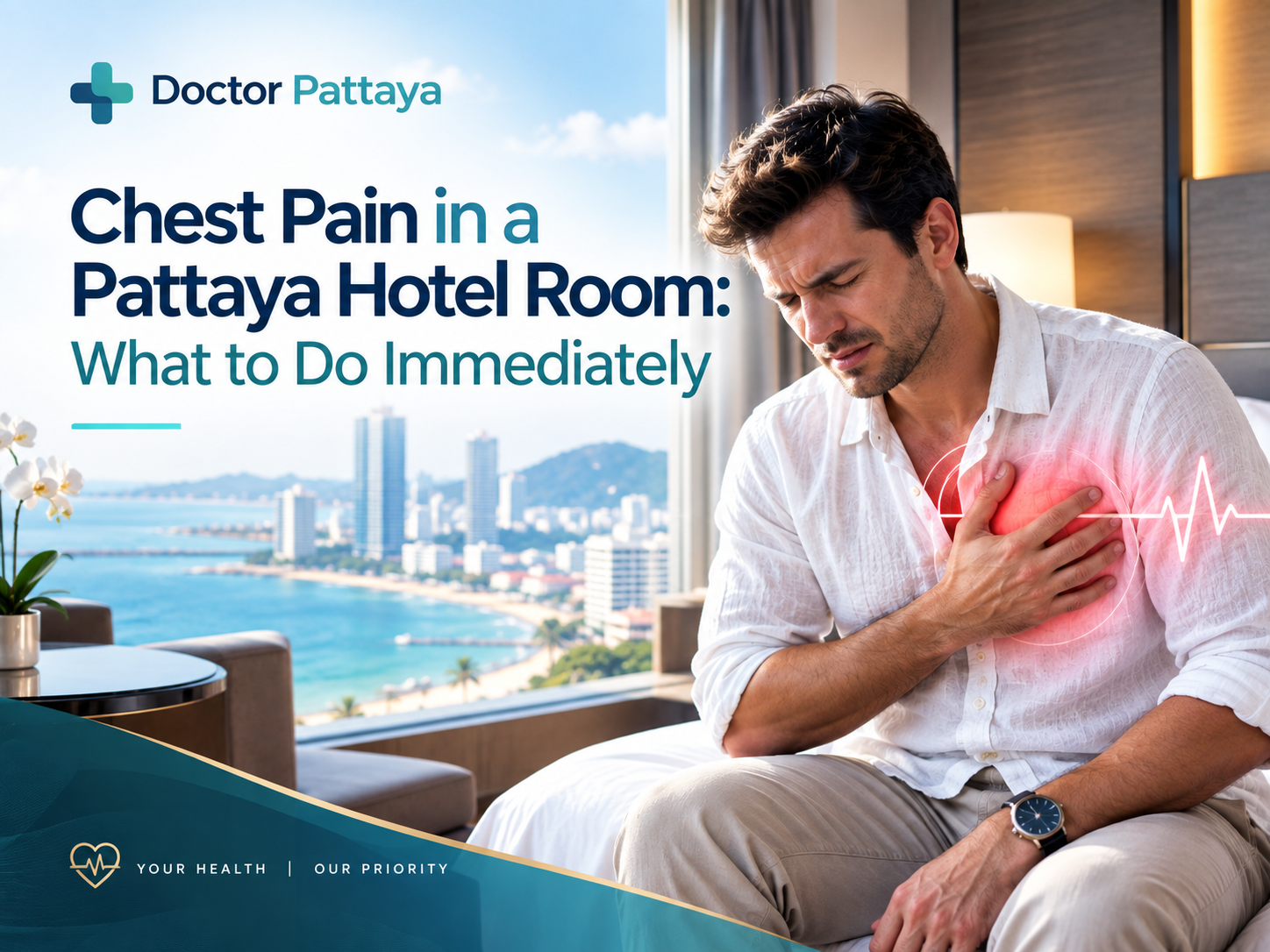
Chest pain in a hotel room needs immediate attention. If you have crushing central chest pain spreading to your arm or jaw, cold sweats, or difficulty breathing, call Thailand’s emergency number 1669 right now and unlock your hotel room door. If symptoms are milder or unclear, a doctor can come directly to your room in Pattaya 24 hours a day. Do not wait it out alone.
You were fine at dinner. Maybe you had a big meal on Beach Road, a few drinks, a late night out. Now it is 2 a.m. and there is a tightness in your chest you cannot shake. You are Googling symptoms in the dark, your travel insurance card is somewhere in your bag, and you have no idea how Thai emergency services work. We get calls exactly like this every week.
The honest answer is that chest pain can mean many different things, and some of them are serious. You cannot always tell which it is by feel alone. What matters right now is knowing which symptoms need an ambulance in the next two minutes, which ones can wait for a doctor to come to you, and what to do while you figure that out. This article walks you through all of it.

Is This a Heart Attack? Red-Flag Symptoms to Act On Right Now
Some symptoms need an ambulance, not a search engine. If you have any of these, call 1669 immediately and get someone to stay with you.
Central chest pain that feels crushing, heavy, or like pressure is the classic warning sign. If that pain spreads to your left arm, jaw, neck, or back, treat it as cardiac until a doctor tells you otherwise. Cold sweats alongside chest pain are a serious sign. So is sudden shortness of breath, nausea, dizziness, or feeling like you might pass out.
Pain that has lasted more than five minutes without easing needs urgent attention. Do not wait to see if it gets better. Do not take a shower, do not go down to reception, do not tell yourself it is just gas. Call for help first.
If you feel like you might lose consciousness, unlock your hotel room door before that happens. Emergency responders cannot help you if they cannot get in. It takes five seconds and it matters.
What to Do in the Next Five Minutes
Sit or lie down right now. Stop pacing. Rest reduces the workload on your heart straight away.
Unlock your hotel door. Leave the deadbolt open.
If you have aspirin in your bag and you are not allergic to it, chew one standard tablet (300 mg or 325 mg). Do not swallow it whole. This applies only if you genuinely suspect a cardiac cause. If a doctor has ever told you never to take aspirin, skip this step entirely.
Call 1669 if your symptoms are severe or getting worse fast. If symptoms are uncomfortable but stable, contact a doctor directly. Doctor Pattaya operates around the clock and can send a doctor to your hotel room across South Pattaya, Jomtien, Pratumnak, and Naklua. A WhatsApp message with your hotel name and room number is enough to get things moving.
Do not drive yourself anywhere. Do not ask anyone to take you on a motorbike.

Common Causes of Chest Pain That Are Not a Heart Attack
Most chest pain we assess in hotel rooms is not cardiac. That is genuinely reassuring, but it does not mean you skip the assessment.
Acid reflux is the most common cause we see in tourists. A heavy Thai meal, extra spice, alcohol, and lying flat too quickly after eating can produce burning chest discomfort that feels alarming. The problem is that reflux and cardiac pain can feel almost identical from the inside, which is why an ECG still matters even when the cause seems obvious.
Panic attacks come on fast, often with a racing heart, tingling hands, and a sense of dread. We see them regularly, especially after a stressful travel day or a big night on Walking Street. The tightness usually peaks within ten minutes. If it does, that points away from a cardiac cause, though it never rules one out completely.
If you flew in recently on a long-haul flight from Europe, Australia, or North America, tell the doctor immediately. A blood clot that forms during a long flight can travel to the lungs and cause sharp chest pain with breathlessness. It is uncommon, but it is serious and it changes the clinical approach straight away.
Dehydration in Pattaya’s heat can cause chest tightness and a racing heart that feels frightening. Muscle soreness from heavy bags, an awkward sleeping position, or a recent dive with a heavy tank can cause chest wall pain that gets worse when you press on it or move. These are generally not dangerous, but an assessment confirms it.
How to Get a Doctor to Your Pattaya Hotel Room
The default advice anywhere is to call the local emergency number, which in Thailand is 1669. Public ambulance response varies and the language barrier is real at 2 a.m.
For chest pain that is uncomfortable but not immediately life-threatening, contacting a private clinic directly is often faster and more practical. Doctor Pattaya runs a 24/7 hotel visit service covering the whole Pattaya area. Send a WhatsApp message with your hotel name and room number. A doctor arrives with ECG equipment, an oxygen saturation monitor, a blood pressure cuff, medications, and the ability to make a referral decision on the spot.
One thing worth knowing: some hotel concierges refer guests to specific clinics based on commission arrangements rather than clinical quality. You are better off contacting a clinic directly rather than relying on whoever the front desk calls.
If symptoms are severe from the start, call 1669 first. Then message Doctor Pattaya so we are aware and can coordinate if needed.
What the Doctor Will Do When They Arrive
A lot of patients are surprised by how thorough an in-room assessment is.
The doctor will take a full history: what the pain feels like, when it started, what you have eaten and drunk, your medical background, and any medications you take. They will check your blood pressure, pulse, and oxygen levels, and listen to your heart and lungs. An ECG is standard for chest pain and can be done right there in the room.
Most cases can be diagnosed and treated on the spot. Reflux gets medication. A panic attack gets managed with breathing support and, if needed, a short-acting medication. Dehydration can be treated with an IV drip in the room.
If the ECG or clinical picture points to something cardiac or unclear, the doctor will arrange hospital transfer. Doctor Pattaya works with local hospitals and can coordinate that transfer directly, so you are not trying to find your own way to a Thai emergency department alone at 3 a.m.
When You Need a Hospital, Not an In-Room Doctor
Some presentations go straight to hospital. No in-room visit, no waiting.
If you have lost consciousness, even briefly, call an ambulance. If your oxygen levels drop and you are visibly struggling to breathe, that needs a hospital. If the ECG shows changes consistent with a heart attack, the doctor will tell you clearly and arrange transfer immediately.
Ongoing crushing chest pain that does not ease with rest, or pain combined with confusion or slurred speech, does not wait for anyone. Call 1669.
For everything that is clearly severe from the start, call the ambulance first. For chest pain that is uncomfortable but stable, an in-room assessment is a sound first step that gets you a clinical answer without the chaos of an unfamiliar emergency department.
Travel Insurance, Billing, and Your Medical Records
Cost is a real concern for tourists, and it should not stop you from getting help.
Most comprehensive travel insurance policies cover emergency medical consultations, including in-room doctor visits. Doctor Pattaya provides an itemised receipt and an English-language medical report you can submit directly to your insurer. Some insurers offer direct billing, so check your policy’s emergency assistance number before you need it.
Ask the doctor for a written report at the time of the visit. Getting it after you are home is slower and harder.
If your episode results in a hospital stay or an early flight home, a fit-to-fly certificate documents the medical reason for the change. Your insurer will need this, and the doctor can provide it.
After the Episode: Should You Continue Your Holiday?
If you were assessed and cleared, and the cause was reflux, dehydration, or a panic attack, most patients can continue their holiday with some sensible adjustments. Ease up on alcohol and heavy food for a day or two. Stay hydrated. Skip the high-intensity water sports for the rest of the trip.
If the cause was cardiac or uncertain, you need cardiology follow-up before getting on a plane. Your doctor will tell you this clearly. Do not assume that feeling better means the problem has gone.
For expats in Pattaya, a one-off chest pain episode that was cleared is still worth following up within the next week. An ECG, basic bloods, and a blood pressure check take very little time and give you a useful baseline going forward.
And if last night has left you shaken and unsure, that is a completely normal response. Come in and talk it through. Walk-ins are welcome at Doctor Pattaya any time of the day or night.
Chest pain in a Pattaya hotel room needs a doctor, not a search engine. Doctor Pattaya operates 24 hours a day, 7 days a week, and can send a doctor directly to your hotel room across South Pattaya, Jomtien, Pratumnak, and Naklua, with ECG equipment, oxygen monitoring, and medications. If you are not sure whether what you are feeling is serious, contact us now. Being assessed and reassured is always better than waiting alone.
What is the emergency number for chest pain in Pattaya, Thailand?
The national emergency medical number in Thailand is 1669. For tourists in Pattaya, calling a private clinic directly is often faster, especially late at night. If you have severe crushing pain, loss of consciousness, or cannot breathe properly, call 1669 first, then message Doctor Pattaya so we can coordinate care.
Can a doctor really come to my hotel room in Pattaya for chest pain?
Yes. Doctor Pattaya’s hotel visit service runs 24 hours a day across South Pattaya, Jomtien, Pratumnak, and Naklua. The attending doctor brings ECG equipment, an oxygen saturation monitor, a blood pressure cuff, and medications. For chest pain that is not immediately life-threatening, this is a clinically appropriate and practical first response.
How do I tell if my chest pain is a heart attack or a panic attack?
Cardiac pain is typically central, heavy or crushing, and may spread to the arm or jaw. Panic attack pain tends to be sharp, comes on quickly, and passes within ten to twenty minutes. The honest answer is that you cannot reliably tell from the inside, and the risk of guessing wrong is too high. Get assessed.
I had chest pain after a big dinner on Beach Road and now I feel fine. Do I still need to see a doctor?
Yes. Chest pain that resolves on its own can still be the first sign of something that needs attention, including early cardiac changes that show up on an ECG even when you feel completely fine. A quick assessment rules that out and gives you peace of mind for the rest of your trip.
Will my travel insurance cover a hotel doctor visit in Pattaya for chest pain?
Most comprehensive travel insurance policies cover emergency consultations including in-room visits. Doctor Pattaya provides an itemised receipt and an English-language medical report formatted for insurance claims. Call your insurer’s emergency line as soon as you are stable and keep every document you receive.
I flew from London to Bangkok and then came to Pattaya by minivan. Could my chest pain be from the flight?
Long-haul flights carry a small risk of a blood clot forming in the leg, which can travel to the lungs and cause sharp chest pain with breathlessness. Tell the doctor exactly how long you were in the air and whether your leg is swollen or tender. It changes the clinical picture immediately and affects which tests are done first.
Should I chew aspirin for chest pain in my hotel room?
If you genuinely suspect a cardiac cause and you are not allergic to aspirin, chewing one standard tablet (around 300 mg) is a widely recommended first-aid step. Chewing works faster than swallowing whole. If a doctor has ever told you not to take aspirin, skip it and focus on calling for help straight away.

Dr. Pipat Finn is the senior doctor at Doctor Pattaya Takecare Clinic, a 24/7 walk-in medical practice on South Pattaya Road, Chonburi, Thailand. They provide primary care, travel medicine, sexual health, vaccination, minor surgery, IV therapy, and emergency outpatient services for tourists, expatriates, and Pattaya residents. Languages: English and Thai. WhatsApp consultations: +66 95 073 5550. Call: +66 81 668 5557.