Clinically reviewed by Dr. Pipat Finn, M.D., Senior Doctor, Doctor Pattaya. Last reviewed: September 2026
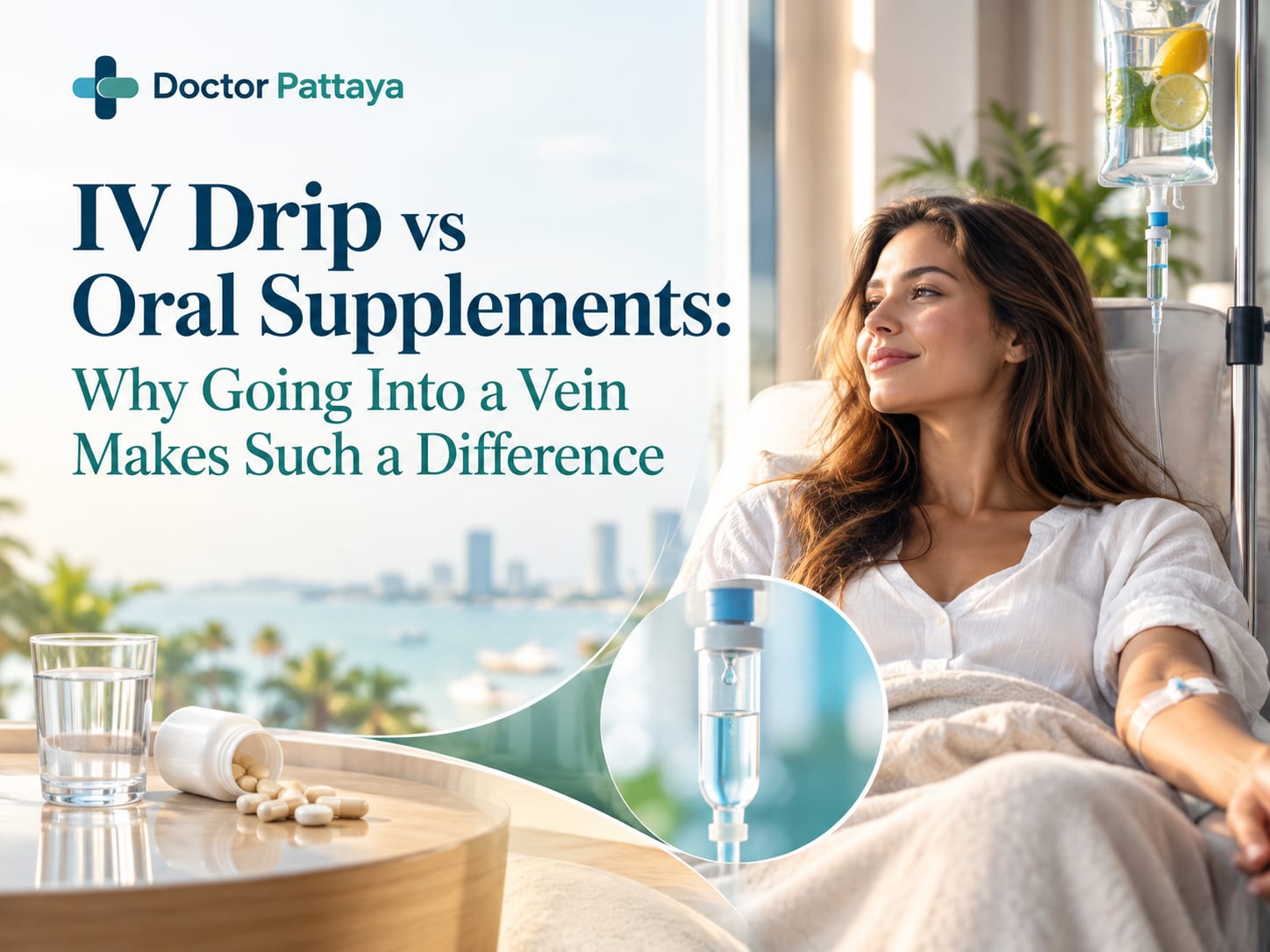
An IV drip bypasses your digestive system entirely, so every milligram goes straight into your bloodstream. Oral supplements must survive your gut, and depending on the nutrient, a large portion never makes it through. The gap matters most when you are vomiting, severely dehydrated, or need a blood concentration that no tablet can realistically achieve.
You are three days into a Pattaya trip and yesterday went sideways. Maybe it was the heat after a long afternoon at Jomtien. Maybe it was a late night and a questionable meal afterward. You wake up feeling wrecked, someone at the hotel suggests an IV drip, and now you are wondering whether it is genuinely better than just grabbing a few supplements from the 7-Eleven down the road. That is a fair question and I am going to give you a straight answer.
The short version: it depends on your situation. But in many of the cases we see here, the IV route wins by a significant margin. Not because IV is always superior, but because your gut simply cannot do its job properly when you are dehydrated, nauseous, or running a fever. When the digestive system is offline, putting something in your mouth and hoping it reaches your bloodstream is not a reliable plan.

Why Your Gut Is the Bottleneck
Every tablet or capsule you swallow has to survive your stomach acid, pass through your gut wall, and get processed by your liver before anything reaches your blood. That process eats into the dose of almost every nutrient you take orally.
For some nutrients, the losses are manageable. For others, they are severe. Your gut also has a natural speed limit on absorption. The transporters that pull nutrients across the gut wall can only handle so much at a time. Push the dose above that threshold and your body simply flushes the rest.
This is not a flaw. It is a safety mechanism. But it also means that swallowing a high dose of something does not guarantee a high concentration in your blood.
Nutrient-by-Nutrient: Oral vs IV Absorption
Some nutrients are dramatically affected by the route you choose. Here is how the most common IV ingredients compare.
| Nutrient | Oral Absorption | IV Absorption | Key Issue with Oral Route |
|---|---|---|---|
| Glutathione | Near zero | 100% | Gut enzymes break it down almost completely before it reaches the bloodstream |
| Vitamin C (high-dose) | Drops sharply above 200 mg | 100% | Absorption caps out at the gut wall; IV achieves plasma levels 30 to 70 times higher |
| Magnesium (oxide form) | Roughly 4% | 100% | Most cheap supplements use magnesium oxide, which absorbs poorly even in a healthy gut |
| Vitamin B12 | Variable; depends on intrinsic factor | 100% | Oral absorption saturates quickly and requires a specific protein to work |
| Electrolytes | Moderate when gut is functioning | 100% | Oral rehydration fails when vomiting or severe diarrhoea is present |
| Fluids (1 litre) | 2 to 3 hours via gut | Under 1 hour via IV | Speed and volume matter acutely in dehydration |
Glutathione is the most striking example. It is one of the most searched IV ingredients in Southeast Asia and one of the most commonly sold oral supplements. The problem is that your gut enzymes break it down before it has any meaningful chance of reaching your blood. IV is the only route that actually delivers it.

The Three Situations Where IV Drip Genuinely Wins
I am not going to tell you IV is always the right choice. But three situations come through our door in Pattaya regularly, and the clinical case for IV in all three is clear.
The first is when you cannot keep anything down. Vomiting makes oral absorption essentially impossible. If every sip of water is coming back up, no tablet is going to hydrate you. IV is the only practical solution.
The second is when you need a blood concentration that oral supplements cannot reach. High-dose vitamin C and IV glutathione are the clearest examples. The gut physically cannot deliver the blood levels that an IV infusion can. A tablet dose and an IV dose are not interchangeable.
The third is acute dehydration with electrolyte loss, most often from heat exhaustion, heavy sweating, or food poisoning. Your gut absorbs roughly a litre over two to three hours under good conditions. IV delivers the same volume in under an hour, directly into the bloodstream, with precisely dosed electrolytes.
The Pattaya Factor: Why Tropical Heat Changes the Equation
Most generic articles about IV therapy are written for clinics in cooler climates. Pattaya is a different situation.
Temperatures sit at 35 degrees Celsius or above for much of the year, with humidity that makes sweating constant whether you are on the beach or just walking through a market. Tourists arrive from cooler countries, underestimate how much fluid they are losing, and do not drink enough water to keep pace. Add a few hours of sun, a night out, and you can lose a significant volume of fluid before you even feel thirsty.
The problem is that thirst is a late signal. By the time someone walks into our clinic feeling dizzy and foggy, they are already meaningfully dehydrated. Oral rehydration works well for mild dehydration when the gut is intact. But for someone with heat exhaustion, food poisoning, or a hangover layered on top of tropical sweating, the gut cannot absorb fast enough to catch up. In that context, an IV drip in Pattaya is not a luxury. It is the faster, more reliable medical option.
How Fast Does IV Work Compared to Oral?
This is usually the question that tips the decision for a tourist with limited time left on their trip.
Oral supplements begin absorbing around 30 to 60 minutes after you swallow them, assuming your gut is working normally. A meaningful effect from a vitamin or electrolyte tablet takes several hours. A full litre of oral fluids takes your gut two to three hours to process under good conditions.
IV works differently. Fluids and nutrients enter your bloodstream within seconds of the drip starting. Most patients receiving a hangover or dehydration drip at Doctor Pattaya notice a real shift within 30 to 45 minutes, often before the bag is finished. If you have two days of holiday left and you feel terrible right now, that timeline matters.
When Oral Supplements Are Perfectly Fine
I want to be direct about this, because overselling IV therapy is not something I am interested in doing.
If you are healthy, your gut is working normally, and you are taking moderate doses of vitamins for general maintenance, good-quality oral supplements do their job. Low-dose vitamin C under 200 mg absorbs well. A quality B-complex with an active form of B12 is absorbed reasonably by most people. A well-formulated magnesium glycinate or citrate absorbs meaningfully better than the cheap oxide form.
For daily supplementation in a healthy person with no acute illness, there is no strong evidence that IV is necessary. What I tell most expats who ask: if you feel well and are absorbing food normally, a daily oral supplement is fine. Come in for IV therapy when something acute happens, when you need fast results, or when your gut is not in a position to help.
What to Expect at a Medical IV Clinic in Pattaya
The drip-bar market in Thailand has grown fast, and not everything being marketed as IV therapy is administered safely. It is worth knowing the difference.
At Doctor Pattaya, every IV session starts with a proper medical consultation. We ask about your medical history, current medications, kidney function, heart health, and what you are actually trying to treat. That matters because IV therapy has real contraindications. Patients with kidney disease, congestive heart failure, or certain cardiovascular conditions may need a modified protocol or may not be suitable for specific formulations. Some vitamin additives interact with common medications.
All solutions are pharmaceutical-grade, prepared and administered by clinical staff in a licensed medical setting. The drip rate, the additives, the monitoring during infusion: these are clinical decisions, not wellness choices. A medically administered IV drip is a different procedure from what is being offered at an unregulated bar.
We are open 24 hours a day, seven days a week, in South Pattaya, and same-day treatment is standard. If you are in Jomtien, Pratumnak, or Naklua and cannot get to us, hotel visits are available.
Feeling rough from the heat, a heavy night, or a stomach upset you cannot shake? Doctor Pattaya is open 24 hours a day, seven days a week. Our IV drip service starts with a proper medical consultation, uses pharmaceutical-grade solutions, and is administered by clinical staff in a licensed medical clinic in South Pattaya. Walk in any time or contact us to arrange a hotel visit in Pattaya, Jomtien, Pratumnak, or Naklua.
Is an IV drip really that much better than taking vitamin supplements orally?
It depends on the situation. IV delivers nutrients directly into the bloodstream, so absorption is complete. Oral supplements lose a portion to gut processing, and the loss is dramatic for nutrients like glutathione and high-dose vitamin C. For a healthy person with a functioning gut taking a daily maintenance dose, quality oral supplements are reasonable. For someone who is vomiting, severely dehydrated, or needs blood concentrations that tablets cannot achieve, IV wins clearly.
Can I just drink electrolyte drinks instead of getting an IV drip in Pattaya?
For mild dehydration with no nausea, yes, oral rehydration salts work well and I often recommend them for early fluid loss. The problem is that the situations most common in Pattaya, hangovers, food poisoning, and heat exhaustion, are exactly the situations where your gut cannot absorb fluids reliably. If you are vomiting or have active diarrhoea, IV bypasses this entirely and delivers a full litre in under an hour.
How quickly will I feel better after an IV drip compared to taking oral vitamins?
IV acts within seconds because it goes straight into the bloodstream. Most patients at Doctor Pattaya report noticeable improvement within 30 to 45 minutes of starting the drip. Oral supplements take at least one to two hours to begin absorbing under good conditions, and several hours before you feel a real systemic effect. For a tourist with two days of holiday left, that time difference is often the deciding factor.
Is IV drip therapy safe? Are there reasons I should not get one?
IV therapy is a medical procedure, not a spa service, and genuine contraindications exist. Kidney disease, congestive heart failure, and certain cardiovascular conditions may require a modified protocol or make specific drip formulations unsuitable. This is why every IV session at Doctor Pattaya begins with a full medical consultation, not just a waiver form. If you have any chronic health conditions, tell us before the drip starts.
Which vitamins benefit most from IV delivery compared to oral?
Glutathione is the clearest case. Gut enzymes break it down so thoroughly that oral supplementation delivers negligible amounts to the blood, making IV the only route that works. High-dose vitamin C is next: absorption saturates above 200 mg orally, but IV can achieve plasma concentrations 30 to 70 times higher. Magnesium from cheap oral supplements absorbs poorly, while IV bypasses the form issue entirely.
I got food poisoning after dinner near Jomtien Beach. Should I rehydrate at home or come in for an IV drip?
If you are keeping fluids down and symptoms are mild, start with oral rehydration salts and rest. If you are vomiting, cannot keep anything down, feel dizzy when you stand, or the diarrhoea is severe, come in. At that point your gut cannot do the work, and oral fluids will not catch you up fast enough. Doctor Pattaya is open around the clock, and we can assess you, run any tests needed, and get an IV drip started the same visit.

Dr. Pipat Finn is the senior doctor at Doctor Pattaya Takecare Clinic, a 24/7 walk-in medical practice on South Pattaya Road, Chonburi, Thailand. They provide primary care, travel medicine, sexual health, vaccination, minor surgery, IV therapy, and emergency outpatient services for tourists, expatriates, and Pattaya residents. Languages: English and Thai. WhatsApp consultations: +66 95 073 5550. Call: +66 81 668 5557.