
Clinically reviewed by Dr. Pipat Finn, M.D., Senior Doctor, Doctor Pattaya.
Last reviewed: November 2026
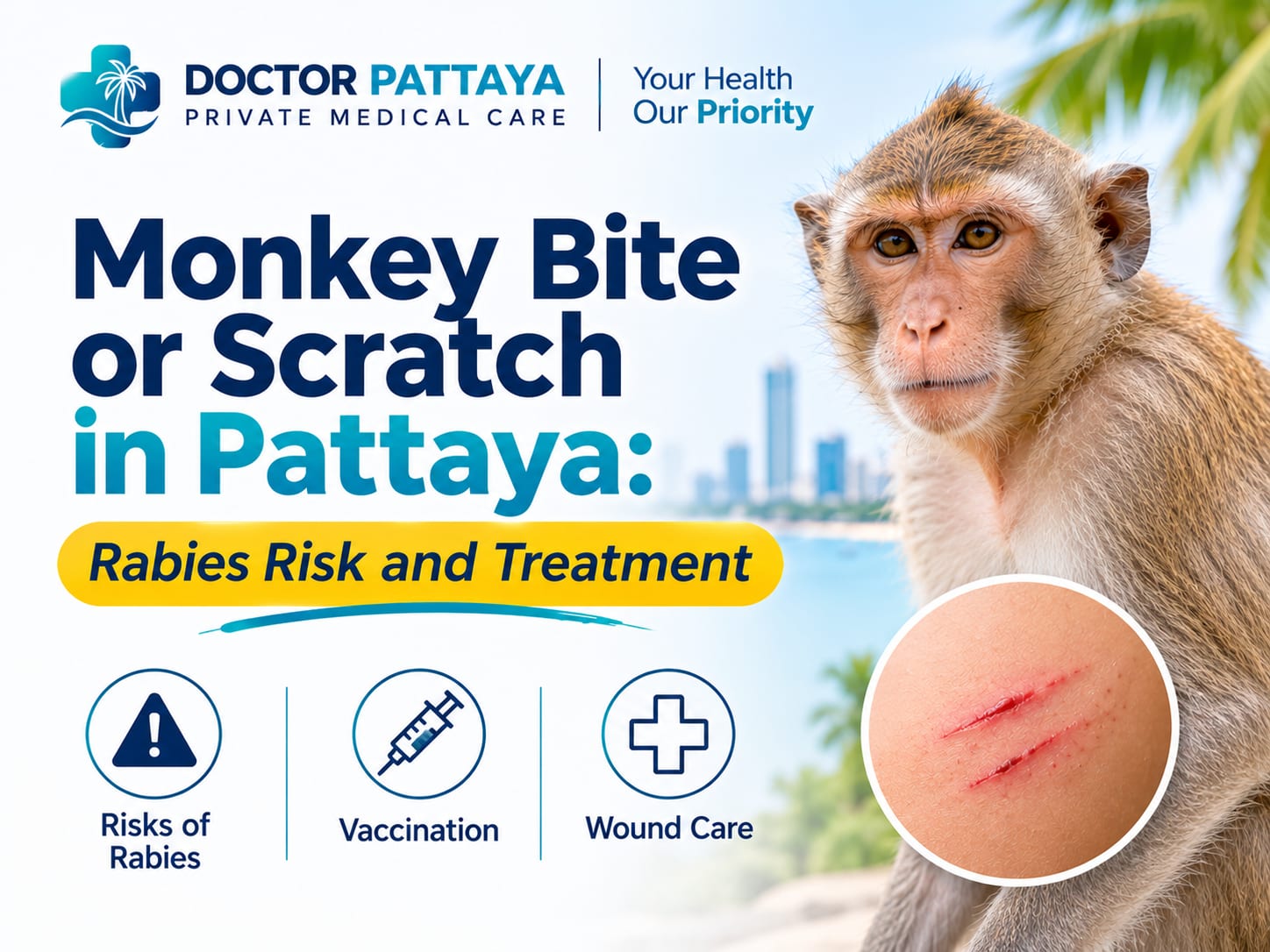
Any monkey bite or deep scratch in Thailand needs same-day medical attention. Thailand is rabies-endemic, and any macaque bite is treated as a potential rabies exposure until a doctor assesses it. You may also need protection against Herpes B virus, a rare but serious infection carried by macaques. Wash the wound immediately, then get to a clinic. Do not wait until morning.
A monkey got you. Maybe it grabbed your bag on the hillside near Pratumnak and caught your hand in the process. Maybe you were out at Khao Kheow Open Zoo, about 45 minutes from South Pattaya, and one of the macaques went for your fingers the moment it saw food. It happens fast. One second you are holding up your phone for a photo, the next you are staring at a set of teeth marks.
Here is the reassuring part: if you move quickly, this is very manageable. The part that matters is that quickly really does mean today, not tomorrow morning. A macaque bite carries three separate infection risks: rabies, Herpes B virus, and bacterial infection. All three need attention, and all three start with the same first step: wash that wound right now.

Where Tourists Encounter Monkeys Near Pattaya
The monkeys most tourists meet in this part of Thailand are long-tailed macaques, sometimes called crab-eating macaques. Rhesus macaques turn up at some inland sites. Both species carry the same infection risks.
The most likely spots for a close encounter near Pattaya are Khao Kheow Open Zoo in Chonburi, the hillside areas around Pratumnak, and roadside stops where macaques have worked out that tourists carry snacks. The bites that cause the most trouble are the ones people wave off. A small puncture. A scratch that barely broke the skin. Both count as real exposures and both deserve the same response as a bigger wound.
What to Do Right After a Monkey Bite in Thailand
Before anything else: wash. Scrub the wound with soap and water for at least 15 minutes. Not a rinse. Scrub the way you would before handling food in a kitchen. Then flush under running water. This step matters more than most people realise.
Do not use your mouth to clean the wound. Do not seal it with tape or a bandage before a doctor has seen it. If you have antiseptic like povidone-iodine or alcohol gel nearby, apply it after washing. Then head straight to a clinic.
At Doctor Pattaya, we clean and assess bite wounds properly, including debridement when the injury calls for it. We also check your tetanus status on the same visit, because monkey bites carry a tetanus risk just like any animal bite. You can find more detail on what that visit involves on our animal bite treatment page.
Rabies Risk From a Monkey Bite in Thailand
This is what most people ask about first. Thailand is rabies-endemic. Macaques are not the primary reservoir, but rabies has been documented in non-human primates, and the safe clinical standard is to treat any macaque bite as a potential exposure.
The WHO classifies exposures into three categories. Category I is skin contact with no wound, which needs no treatment. Category II covers minor scratches or grazes that did not draw blood, which require vaccine only. Category III is a penetrating bite, a deep scratch, or any contact with mucous membranes, and that requires both vaccine and rabies immunoglobulin (RIG).
Most macaque bites in tourists fall into Category III. That means vaccine plus immunoglobulin, starting the same day. The rabies vaccine is given as a series of injections. The immunoglobulin is given once, infiltrated into and around the wound site, to provide immediate protection while your immune system builds its own response over the following days.
If you completed a full pre-exposure rabies vaccination course before your trip, the regimen is simpler. You still need two booster doses, but you do not need immunoglobulin. Bring your vaccination certificate if you have it. We adjust the regimen based on your documented history, which saves you injections and reduces cost.
For travel insurance purposes, you will need a dated clinical record from the treating clinic. Doctor Pattaya provides full documentation, including everything you need to complete follow-up doses at another clinic if you are continuing your trip. Our rabies vaccination page has more on what we carry and what to expect.
Herpes B Virus: The Risk Most People Have Never Heard Of
Long-tailed macaques can carry Macacine herpesvirus 1, known as Herpes B virus. The monkeys carry it without showing any signs of illness. In humans, infection is rare but serious, with a high mortality rate if untreated.
There is no vaccine for Herpes B. Management after a macaque bite involves thorough wound decontamination and evaluation for antiviral treatment with acyclovir or valacyclovir, decided case by case. High-risk features include bites near the head, neck, or torso, deep puncture wounds, and any contact with mucous membranes.
Tell the doctor exactly where the bite is, how deep it felt, and whether it was a scratch or a puncture. That information changes the picture. A CDC MMWR report described a possible Herpes B virus exposure linked to a macaque bite in Thailand in 2018, confirming that this risk exists at tourist-facing sites, not just in laboratory settings.
Bacterial Infections After a Monkey Bite
Bacterial infection is the third risk and often the most immediately apparent one. Monkey mouths carry bacteria including Pasteurella multocida that can cause rapid wound infections.
Watch for redness spreading from the wound, warmth, swelling, pus, fever, or red streaks tracking up your arm or leg. Any of those signs means same-day review. Not every bite wound needs antibiotics, but we assess each case and prescribe when the clinical picture calls for it. Amoxicillin-clavulanate is the standard first-line choice for animal bites when antibiotic cover is indicated, based on current guidelines.
If a wound infection is developing and you are near Jomtien or the south end of town, our South Pattaya clinic is the closest option. If something looks serious and you are not sure whether it needs urgent attention, our 24/7 emergency care service is always available, including hotel visits.
How to Avoid a Monkey Bite Around Pattaya
The simplest rule: do not feed them. Once a macaque knows you have food, it will take it from you by force if it has to. Do not make eye contact with an agitated monkey. Do not try to pet them, including the ones that look relaxed.
If a monkey approaches, stay still, avoid sudden movements, and back away slowly. Children are bitten more often because they are closer to eye level and more likely to startle. If you are visiting Khao Kheow or any site with free-roaming macaques, leave food in the car before you go in.
Got bitten or scratched by a monkey near Pattaya? Doctor Pattaya is open 24 hours a day, seven days a week, no appointment needed. We carry rabies vaccine and immunoglobulin on site, assess for Herpes B virus risk, clean and dress the wound, check your tetanus status, and provide full documentation for your travel insurer. Walk in any time at our South Pattaya clinic, or call us and we can come to your hotel. Same-day treatment is available now.
Frequently Asked Questions
References
- World Health Organization. Rabies vaccines: WHO position paper, April 2018. Weekly Epidemiological Record, 2018;93(16):201-220.
- CDC. Notes from the Field: Monkey Bite in a Public Park and Possible Exposure to Herpes B Virus — Thailand, 2018. MMWR Morb Mortal Wkly Rep. 2020;69(9):247-248.
- Centers for Disease Control and Prevention. B Virus (herpes B, monkey B virus, herpesvirus simiae, herpesvirus B). CDC, current.
The information in this article is for educational purposes only and does not constitute medical advice. It should not be used to self-diagnose or replace a consultation with a qualified physician. If you have concerns about your health, contact a licensed medical professional. For appointments at Doctor Pattaya, visit doctorpattaya.com.

Dr. Pipat Finn is the senior doctor at Doctor Pattaya Takecare Clinic, a 24/7 walk-in medical practice on South Pattaya Road, Chonburi, Thailand. They provide primary care, travel medicine, sexual health, vaccination, minor surgery, IV therapy, and emergency outpatient services for tourists, expatriates, and Pattaya residents. Languages: English and Thai. WhatsApp consultations: +66 95 073 5550. Call: +66 81 668 5557.