
Clinically reviewed by Dr. Pipat Finn, M.D., Senior Doctor, Doctor Pattaya.
Last reviewed: November 2026
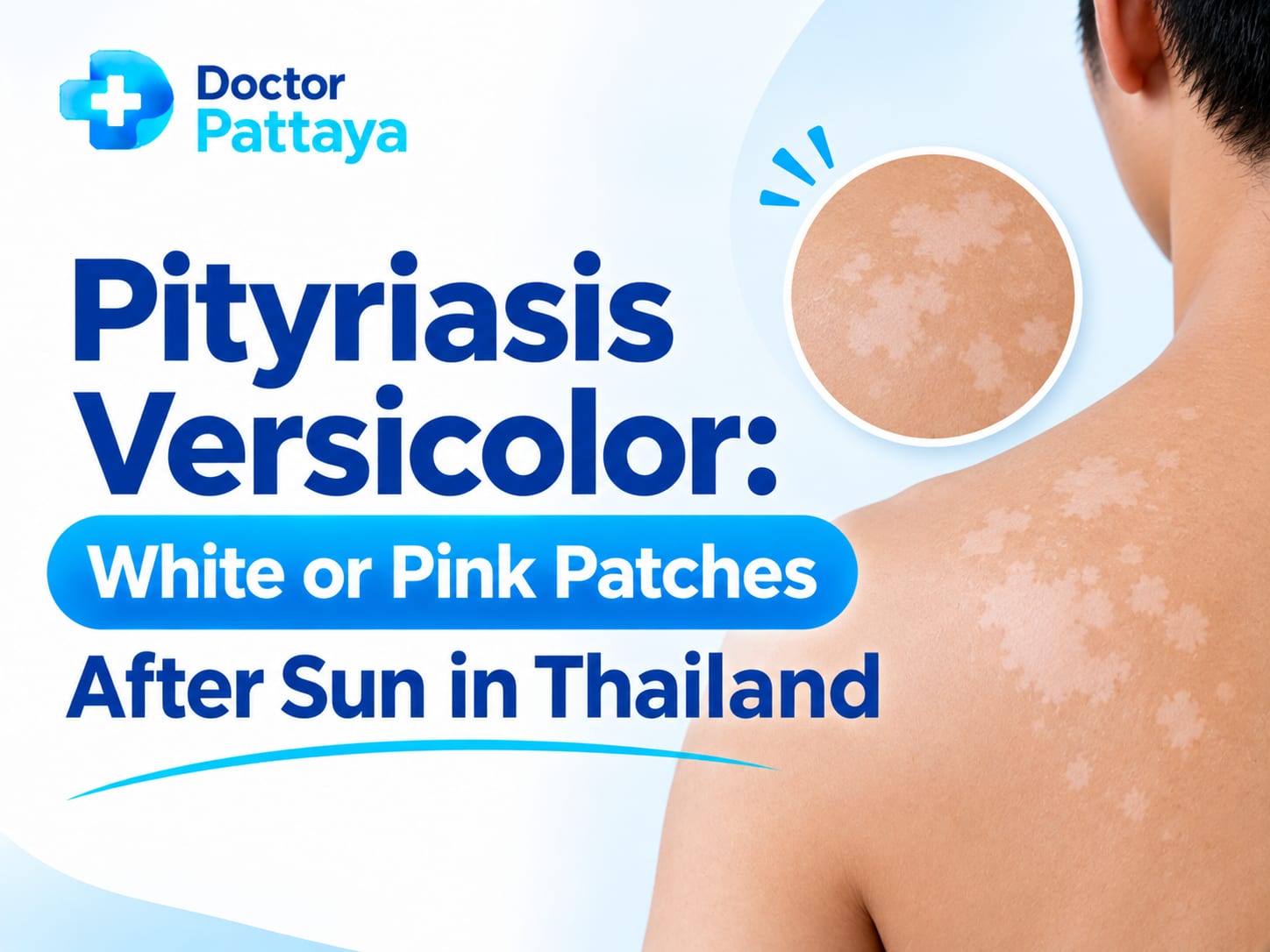
White or pale patches on your chest, back, or shoulders after time in the Thai sun are most likely pityriasis versicolor, also called tinea versicolor. It is a harmless yeast overgrowth on the skin, not an infection you caught from someone else. The fungus clears with antifungal treatment, but the colour difference can take several more weeks to months to fade even after the yeast is gone.
You got back to your hotel after a few days on the beach at Jomtien, peeled off your shirt, and noticed pale patchy areas across your chest or upper back. They were not there before the trip. They do not itch much. They just look off, and now you are wondering if something is wrong.
Nothing urgent is happening. What you are almost certainly looking at is pityriasis versicolor, a yeast overgrowth that is very common in hot, humid places like Thailand. The yeast responsible lives on everyone’s skin all the time. In Pattaya’s heat and humidity, it can tip into overdrive, producing patches that do not tan the same way as the rest of your skin. It is treatable, it is not contagious, and it will not wreck your holiday.
Why These White Patches After Sun Appear in Thailand’s Heat
Malassezia yeast is a normal part of your skin. It sits there quietly most of the time. What changes in a tropical climate is the environment it lives in. Daily sweating, constant warmth, and high humidity create conditions for overgrowth. The yeast multiplies faster than your skin can keep it in balance.
When Malassezia overgrows, it releases a substance that interferes with melanin, the pigment that gives skin its colour. The patches look lighter than your surrounding skin because they cannot tan normally. Under a UV lamp at the clinic, they sometimes glow a faint yellow-green, which can support the diagnosis, though not all cases fluoresce and a skin scraping is usually needed to confirm.
Pattaya’s conditions are genuinely different from home. Year-round heat above 30 degrees, daily pool or sea water, tight rash guards that trap sweat, and oily sunscreen applied for hours create the exact surface conditions this yeast loves. If you are spending your days between Pratumnak Hill and the beach, your skin is in a state of heat and moisture that simply does not exist in a temperate climate.
How Versicolor Looks Different From Ringworm, Vitiligo or Heat Rash
The patches of pityriasis versicolor are flat, have soft edges, and often carry a very fine dusty scale on the surface if you stretch the skin. They appear most often on the chest, upper back, shoulders, and neck. On darker skin they look white or pale. On fair skin, they may look slightly pinkish or salmon-coloured.
Ringworm is a different fungal infection entirely. It produces a ring with a raised, red, scaly edge and a clearer centre. If your patch has a ring shape, that is worth looking at separately.
Vitiligo produces sharply bordered, completely white patches with no scale at all. It does not follow sun exposure or sweat patterns. If the edges are crystal clear and the skin inside looks fully depigmented, see a doctor to rule that out.
Heat rash causes tiny raised bumps, often with a prickling or stinging feeling, and clears within a day or two once your skin cools down. Versicolor patches are flat, do not sting, and persist for weeks regardless of air conditioning. If the patches were still there three days after a cool indoor rest, heat rash is off the list.
Two other conditions are worth knowing. Pityriasis alba produces pale patches in children and young adults, usually on the face, associated with eczema-prone skin. Idiopathic guttate hypomelanosis produces small white spots on sun-exposed skin, particularly in older adults, without any scaling. Neither is caused by yeast, and neither responds to antifungal treatment. If your patches look like either of these, or do not respond to treatment within a few weeks, get a clinical opinion to rule out alternatives.

Treatment and How Long the Colour Takes to Return
There are two stages, and patients mix them up constantly. Stage one is clearing the yeast. Stage two is waiting for the skin colour to come back. They do not happen at the same time.
For mild to moderate cases on the chest or back, topical antifungal treatment works well. Ketoconazole shampoo or selenium sulphide shampoo applied as a lotion is the standard first-line approach. Apply it, leave it on for five to ten minutes, then rinse. Both options are available from most Thai pharmacies. Zinc pyrithione shampoo is an alternative if the others are not available.
For widespread patches, patches on the face, or cases that have not responded to topical treatment, oral itraconazole prescribed by a doctor is an alternative option. It requires a prescription and is not appropriate for everyone. If you need it, Doctor Pattaya can assess and prescribe on the same day. Itraconazole has significant drug interactions and should not be taken in pregnancy; a doctor review is essential before use.
Once the yeast is cleared, the skin tone recovers slowly. The pale patches fade as the skin resumes normal pigment production. This takes weeks to months depending on how extensive the patches were. The fungus will be gone well before the colour evens out. That is normal and expected, not a sign the treatment failed.
Recurrence is common because Malassezia never leaves the skin entirely. Treatment suppresses overgrowth rather than eliminating the organism. For anyone staying in Thailand long term, a monthly application of the same ketoconazole or selenium sulphide shampoo is a practical maintenance approach during Thailand’s hottest months.
What Needs a Clinic Visit and What You Can Handle at the Pharmacy
Most cases do not need urgent care. If you have the classic flat, pale, slightly scaly patches on your trunk after beach time in Thailand, a pharmacy antifungal is a reasonable first step.
A clinic visit makes sense when the patches are spreading quickly, appear on your face, or have not improved after two to three weeks of consistent topical treatment. It also makes sense when you are not sure what you are looking at. Getting the diagnosis wrong and treating the wrong thing for two weeks wastes time you may not have on a short holiday.
Doctor Pattaya can confirm pityriasis versicolor the same day using a Wood’s lamp and a skin scraping examined under a microscope. If oral itraconazole is right for your case, we can prescribe it in the same visit. If you are staying in Jomtien or Pratumnak and would rather not travel, a doctor hotel visit is available. For anything on the skin that is spreading or inflamed, our skin rash treatment service is the fastest way to get a straight answer.
Pityriasis versicolor is not an emergency. But if you are three days into a two-week trip and the patches are spreading, there is no good reason to wait until you get home. If the patches do look ring-shaped or raised rather than flat, it is worth ruling out a different fungal infection before treating the wrong thing.
White or pale patches after sun in Pattaya or Jomtien are almost always pityriasis versicolor, and Doctor Pattaya can confirm that the same day. We use a Wood’s lamp and skin scraping to diagnose on the spot, prescribe topical or oral antifungals where needed, and advise on prevention if you are staying long term. We are open 24 hours, no appointment needed. Doctor hotel visits are available across Pattaya, Jomtien, Pratumnak, and Naklua. Walk in or contact us to book.
Frequently Asked Questions
References
- Leung AKC, Lam JM, Leong KF, et al. Tinea Versicolor: An Updated Review. Drugs in Context. 2022;11:2022-9-6.
- Gupta AK, Foley KA. Antifungal Treatment for Pityriasis Versicolor. J Fungi (Basel). 2015;1(1):13-29.
- DermNet NZ. Pityriasis Versicolor. New Zealand Dermatological Society.
- NHS. How and when to use ketoconazole. NHS, 2024.
- HSE Ireland. Pityriasis versicolor / Tinea versicolor guideline. Health Service Executive, 2025.
- Schwartz RA. Superficial Fungal Infections. Lancet. 2004;364(9440):1173-1182.
The information in this article is for educational purposes only and does not constitute medical advice. It should not be used to self-diagnose or replace a consultation with a qualified physician. If you have concerns about your health, contact a licensed medical professional. For appointments at Doctor Pattaya, visit doctorpattaya.com.

Dr. Pipat Finn is the senior doctor at Doctor Pattaya Takecare Clinic, a 24/7 walk-in medical practice on South Pattaya Road, Chonburi, Thailand. They provide primary care, travel medicine, sexual health, vaccination, minor surgery, IV therapy, and emergency outpatient services for tourists, expatriates, and Pattaya residents. Languages: English and Thai. WhatsApp consultations: +66 95 073 5550. Call: +66 81 668 5557.