Clinically reviewed by Dr. Pipat Finn, M.D., Senior Doctor, Doctor Pattaya.
Last reviewed: November 2026
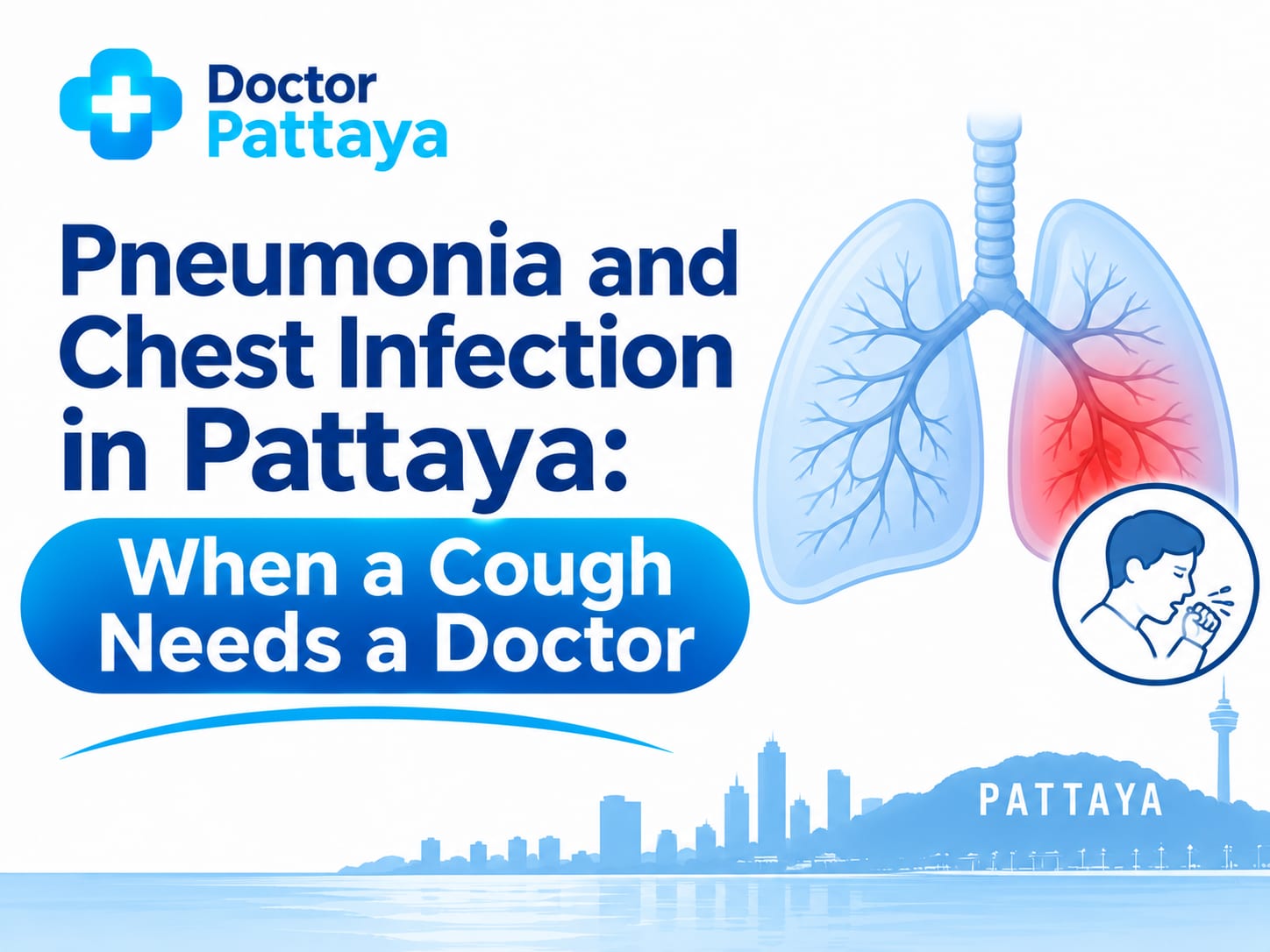
Most holiday coughs are mild and clear up on their own. Pneumonia is different. If your cough comes with a high fever, chest pain, or you are breathing faster than usual, those are signs that need same-day clinical assessment. A doctor can listen to your chest, check your oxygen levels, and start antibiotic treatment the same day if needed.
You are three days into your Pattaya trip and something is not right. You felt fine after a long day at Jomtien, then woke up shivering at 2am with a cough that is getting worse by the hour. Or maybe you are a long-term expat who knows your body well enough to know this is not just the usual dry-air cough from the air conditioning.
Most chest infections are manageable and do not need a hospital. Some do. The difference comes down to a few specific signs, and knowing them matters. This article covers what to watch for, who is at higher risk here in Pattaya, and what a clinic visit actually looks like.

How a Chest Infection Differs From an Ordinary Holiday Cough
A cough that starts on holiday is usually your airways reacting to something new: recycled air on the flight, air conditioning in every hotel lobby, or a mild bug. It is annoying, but it settles.
A chest infection goes deeper. The infection has moved into your bronchial tubes, the airways that branch into your lungs. You may bring up coloured mucus, feel tight across the chest, and run a low fever. For more on this specifically, see our page on medical evaluation for a persistent chest cough in Pattaya.
Pneumonia is a step further. The infection is now inside the lung tissue itself, not just the airways. That is why breathing becomes harder and the fever tends to run higher. Bronchitis and pneumonia can look similar from the outside, which is exactly why a stethoscope and sometimes a chest X-ray are needed to tell them apart.
Pneumonia Symptoms: When to See a Doctor
A cough alone is not a red flag. These combinations are.
Fever above 38°C with a cough that produces thick yellow, green, or rust-coloured mucus points toward a bacterial lung infection. Community-acquired pneumonia, the kind you pick up in everyday life rather than a hospital, usually starts this way. Shortness of breath that gets worse walking to the bathroom is a signal to act now.
Breathing Rate, Chest Pain and Confusion
Count your breaths for one minute. Adults normally breathe around 12 to 20 times per minute at rest. Breathing faster than normal is a warning sign worth noting. The CRB-65 severity scoring tool, which doctors use to decide whether a patient can be managed at a clinic or needs hospital care, flags a rate of 30 or more breaths per minute as one of its four criteria.
Sharp chest pain that gets worse when you breathe in or cough is another warning sign. So is confusion or disorientation, especially in older patients. If someone who was fine yesterday is now muddled or slow to respond, that is urgent. Do not wait on that one.

Walking Pneumonia Versus a Typical Chest Infection
Walking pneumonia means you are sick enough to have pneumonia but still on your feet. The name can be misleading about how serious it is. The most common cause is a bacterium called Mycoplasma pneumoniae.
The difference you will notice: walking pneumonia tends to come on gradually over a week or two, with a dry rather than productive cough. You feel genuinely unwell and feverish, but not flat-out incapacitated. A typical bacterial pneumonia tends to arrive faster and hit harder, with more obvious breathing difficulty.
The clinical catch is that you cannot reliably tell them apart without an examination and sometimes a blood test. Both respond to antibiotics, but not always the same ones. That distinction matters for treatment, so a proper assessment is worth more than guessing at home.
Who Is at Higher Risk in Pattaya
Asthma, Age, Smoking and Recent Flu or COVID
If you have asthma, COPD, or any long-term lung condition, a chest infection can tip over into pneumonia faster than it would otherwise. The same is true for anyone over 65, smokers, and people who drink heavily. For expats who have lived here for years, those risk factors can quietly stack up. If you have asthma and need an assessment, our asthma treatment page has more on managing that in Pattaya’s climate.
A recent flu or COVID infection is worth flagging specifically. Both can damage the airway lining, making it easier for bacteria to take hold in the weeks that follow. If you are still coughing three weeks after COVID and you are now running a new fever, that is not the tail end of the same illness. That is a new infection and it needs to be assessed. See our flu symptoms and treatment page for more on managing flu here.
Pattaya’s climate adds its own layer. During the rainy season, humidity is high and respiratory infections circulate more easily. Add the constant shift between outdoor heat in the mid-30s and heavily air-conditioned rooms, and your airways are under repeated stress every day. That does not cause pneumonia on its own, but it does make a mild infection easier to pick up and harder to shake.
Tests and Treatment a Clinic Can Start
Walk into Doctor Pattaya with a chest concern and here is what happens. The doctor listens to your lungs for crackling or dullness that suggests fluid or consolidation. Your oxygen saturation is measured with a pulse oximeter, a clip on your finger that takes about ten seconds. Temperature, heart rate, and breathing rate are all checked.
If the picture warrants it, a point-of-care CRP blood test can be run quickly. CRP measures inflammation in the body and helps confirm whether a bacterial infection is likely. Your results, combined with your age, breathing rate, and blood pressure, feed into the CRB-65 severity score. That score guides the decision to treat at the clinic or refer you to hospital.
Mild to moderate bacterial pneumonia in an otherwise healthy adult can be treated with oral antibiotics started the same day. The antibiotic choice depends on what type of infection is suspected. You will also get clear advice on what to watch for and when to come back if you are not improving.
When You Need a Hospital Chest X-Ray or Oxygen
Some presentations cannot be managed at a clinic, and we will tell you that plainly. If your oxygen saturation is low, your breathing is laboured at rest, your blood pressure has dropped, or you are confused, you need hospital-level care. We arrange that referral directly.
A chest X-ray confirms pneumonia, shows how much of the lung is involved, and rules out other causes of breathing difficulty. Doctor Pattaya can refer you for a chest X-ray at a trusted local imaging facility and review the results with you. If the X-ray shows significant involvement or your condition is deteriorating, hospital admission for IV antibiotics and oxygen is the right call.
Sepsis, where a lung infection spreads into the bloodstream and the body’s response spirals, is a medical emergency. The signs are fast breathing, rapid heart rate, confusion, and low blood pressure together. If you or someone with you has that combination, go directly to emergency care. Our 24/7 emergency care page has details on immediate access.
Fit-to-fly questions arise, especially with tourists on a fixed schedule. If you have a flight in 48 hours and you are not sure whether to board, come in. We can assess your breathing, check your oxygen levels, and give you a clear answer. Flying with untreated pneumonia is not safe, and many airlines require documentation after a respiratory illness. We can provide that for your insurance claim or airline request.
If you have a cough with fever, chest pain, or shortness of breath, do not sit on it. Doctor Pattaya is open 24 hours a day, seven days a week, in South Pattaya. We see walk-ins without an appointment, and if you cannot get to us, a doctor can come to your hotel across Pattaya, Jomtien, and Naklua. We examine your chest, check your oxygen levels, and start treatment the same day if needed. If a chest X-ray or hospital referral is required, we sort that for you.
Frequently Asked Questions
References
- World Health Organization. Pneumonia. WHO Fact Sheets, 2024.
- NHS. Pneumonia: Overview. NHS, 2022.
- Lim WS, et al. BTS guidelines for the management of community acquired pneumonia in adults: update 2009. Thorax. 2009;64 Suppl 3:iii1-55.
- MDCalc. CRB-65 Score for Pneumonia Severity.
- Centers for Disease Control and Prevention. About Mycoplasma pneumoniae Infection. CDC, 2024.
- Centers for Disease Control and Prevention. Pneumonia: Symptoms and Diagnosis. CDC, 2024.
The information in this article is for educational purposes only and does not constitute medical advice. It should not be used to self-diagnose or replace a consultation with a qualified physician. If you have concerns about your health, contact a licensed medical professional. For appointments at Doctor Pattaya, visit doctorpattaya.com.

Dr. Pipat Finn is the senior doctor at Doctor Pattaya Takecare Clinic, a 24/7 walk-in medical practice on South Pattaya Road, Chonburi, Thailand. They provide primary care, travel medicine, sexual health, vaccination, minor surgery, IV therapy, and emergency outpatient services for tourists, expatriates, and Pattaya residents. Languages: English and Thai. WhatsApp consultations: +66 95 073 5550. Call: +66 81 668 5557.