Clinically reviewed by Dr. Pipat Finn, M.D., Senior Doctor, Doctor Pattaya.
Last reviewed: November 2026
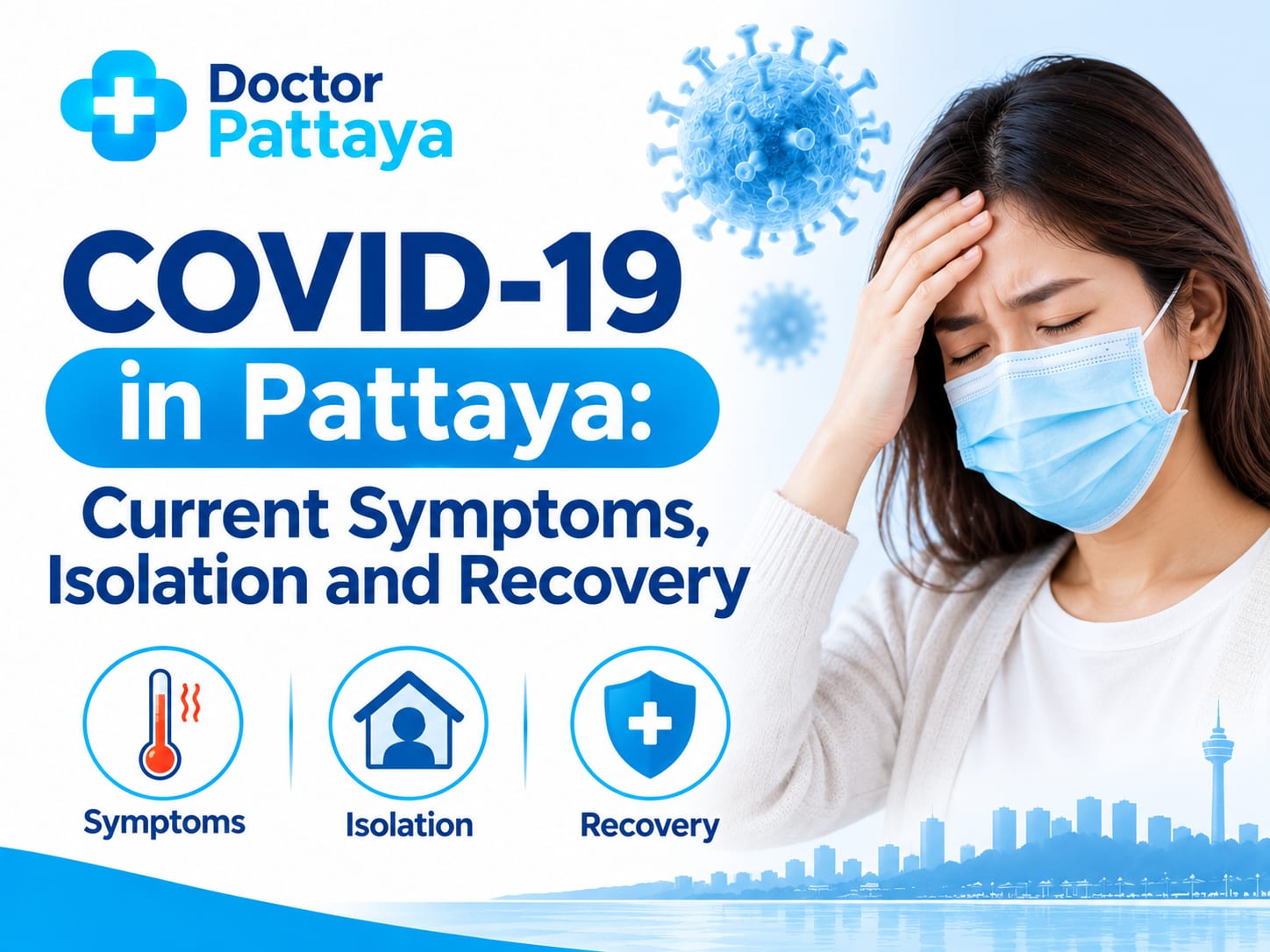
COVID symptoms in Thailand in 2026 are mostly cold-like: fever, sore throat, runny nose, cough, and fatigue. The dominant strain is NB.1.8.1 (Nimbus), a JN.1 sublineage. Most healthy adults recover within five to seven days. If you test positive in Pattaya, stay in your room, manage your symptoms, and contact a doctor if your breathing changes or your fever is not settling.
You grabbed a rapid test from the pharmacy on the way back from the beach, ran it in your hotel bathroom, and now you are staring at two lines. This is not how the week was supposed to go. Take a breath. Here is exactly what you need to know.
COVID in Pattaya right now is manageable for most healthy travellers. The current variant behaves more like a head cold with a fever than the severe illness many people remember from earlier years. Knowing what to watch for, what the guidelines are, and how to get care without leaving your room will make the next few days a lot less stressful.

COVID Symptoms Travellers Are Seeing in Thailand in 2026
The NB.1.8.1 variant, known as Nimbus, is the dominant strain circulating in Thailand as of late 2026. It is an Omicron subvariant descended from JN.1 through the recombinant lineage XDV. Thai Department of Disease Control surveillance confirms it spreads easily, but it has not been linked to more severe disease than earlier Omicron-era strains.
What does it feel like? Mostly: sore throat, runny nose, dry cough, fever, and tiredness. Some people get a headache or mild body aches. Loss of taste or smell still occurs but is less common than it was with earlier strains. Most people describe it as a moderate cold with a higher-than-expected fever.
Chonburi Province, which includes Pattaya, consistently ranks among Thailand’s highest-incidence provinces for COVID, behind Bangkok. Tourism density, nightlife, and crowded indoor spaces all contribute. If you have been in beach clubs, crowded transport, or busy bars in the last week, that context matters when you speak to a doctor.
How Long COVID Usually Lasts
For most healthy adults, the acute illness lasts five to seven days. Fever usually settles within the first two to three days. Sore throat and congestion often linger into the first week. A dry cough can persist for two weeks or more even after everything else has resolved.
If you are still feeling genuinely unwell after seven days, that is worth a recheck. Feeling wiped out for ten days is common. Feeling worse on day eight after getting better on day five is not normal. See a doctor.

Isolation, Masks and What Hotels Expect
Thailand does not have an enforced isolation law for COVID-positive travellers in 2026. The Thai Department of Disease Control recommends staying in your room for five days from symptom onset, wearing a mask around others, and avoiding contact with high-risk individuals. These are guidelines, not laws with penalties.
Hotels generally do not require proof of a negative test before you leave your room. Larger resort chains may have their own internal policies. If you are unsure, call the front desk and ask without identifying yourself first. Food delivery to your room is straightforward at most Pattaya hotels.
One practical point: if you need documentation for your travel insurer, seek a clinical assessment rather than relying on a home rapid test photo. A doctor’s note from a licensed private clinic carries far more weight with insurers than a screenshot. Keep this in mind early, not on the day you are trying to rebook your flight.
Getting a Doctor to Your Hotel Room in Pattaya
Getting in a taxi or motorbike taxi while feverish and potentially infectious is not ideal. Doctor Pattaya offers hotel doctor visits in Pattaya across Pattaya, Jomtien, Naklua, and Pratumnak. A doctor comes to your room, assesses you properly, and can prescribe symptomatic treatment or discuss antiviral eligibility on the spot.
A hotel visit covers the same clinical ground as coming in to the clinic. You get a proper assessment, not just advice over the phone. If your symptoms are mild and straightforward, most of the time you will leave that consultation with a clear plan and medication if needed.
Hotel visits are available 24 hours a day.
Recovery, Lingering Cough and When to Get Rechecked
A dry cough that hangs around for two to three weeks after COVID is common and not usually a sign of anything serious. It reflects airway irritation that takes time to settle. It does not mean you are still infectious.
What warrants a recheck: a cough that is getting worse rather than better after two weeks, any chest tightness or shortness of breath on mild exertion, or a cough producing yellow or green mucus. These patterns can indicate a secondary chest infection that needs treatment. If you have asthma or any existing lung condition, do not wait: get assessed early. You can find more on this at our bronchitis and chest infection treatment page.
For divers, there is a specific concern. Post-COVID lung changes, even subtle ones, can increase the risk of barotrauma during scuba diving. DAN (Divers Alert Network) and BSAC guidelines both recommend a medical clearance assessment before returning to diving after any COVID infection. The guidance is to wait until you are fully symptom-free and then get a respiratory assessment before you get back in the water off Koh Larn or head south.
Protecting Older or High-Risk Travel Companions
For healthy adults under 60 with no underlying conditions, NB.1.8.1 is unlikely to cause severe illness. The risk picture changes for older travellers, immunocompromised individuals, people with significant heart or lung disease, and those with poorly controlled diabetes.
If your travelling companion is in one of these groups and tests positive, early antiviral treatment is worth discussing with a doctor promptly. Current antivirals such as Paxlovid are most effective when started as early as possible and must be started within five days of symptom onset. Do not wait to see if they improve on their own.
Vaccination status still matters for high-risk individuals. If your companion has not been vaccinated or boosted recently, mention it when you speak to the doctor.
Documentation: Medical Certificate, Fit-to-Fly and Insurance Letters
This is the part people do not think about until they urgently need it. If COVID has disrupted your travel plans, you may need a medical certificate confirming your diagnosis, a fit-to-fly letter once you have recovered, or a clinical record for a travel insurance claim.
A private clinic can issue all of these. The document needs to come from a licensed physician, on clinic letterhead, with the doctor’s registration number. Home rapid test photos alone are rarely sufficient for airlines or insurers. Ask for the letter at the time of your consultation so it can be issued correctly from the start.
When to Get Tested or Seek Treatment for COVID Symptoms in Thailand
Antigen rapid tests are available at pharmacies across Pattaya without a prescription. Test at the first sign of fever, sore throat, or a significant cough. A negative result on day one with strong symptoms does not fully rule out COVID: consider retesting after 24 hours.
Seek assessment if: your fever is high and not settling with paracetamol, your breathing feels laboured or tight in the chest, your symptoms are significantly worsening after day four or five, or you are in a high-risk group and want to discuss antivirals. For sore throat and fever treatment in Pattaya, same-day assessment is available. For respiratory symptoms that linger beyond the acute illness, an upper respiratory tract assessment can help distinguish post-COVID irritation from a secondary infection.
Seek emergency care immediately if you have: severe difficulty breathing at rest, persistent chest pain, confusion or difficulty staying awake, or lips or fingertips turning bluish.
Tested positive for COVID in Pattaya? Doctor Pattaya is open 24 hours a day for walk-in assessments, same-day symptom treatment, antiviral discussion, and hotel doctor visits across Pattaya, Jomtien, Naklua, and Pratumnak. We can also issue medical certificates, fit-to-fly letters, and insurance documentation. No appointment needed for walk-ins. Contact Doctor Pattaya to get sorted today.
Frequently Asked Questions
References
- Pattaya Mail. COVID-19 variant NB.1.8.1 shows no evidence of increased severity in Thailand. 2026.
- World Health Organization. Tracking SARS-CoV-2 variants. WHO, 2026.
- European Medicines Agency. Paxlovid: EPAR product information. EMA, 2024.
- Thairath Online. Parents Warned as Influenza and RSV Outbreaks Hit Hard, NB.1.8.1 Variant Urges 5-Day Isolation. 2026.
- Divers Alert Network. Diving after COVID-19: What We Know Today. DAN, 2022.
- GAVI Vaccines Work. Eight things you need to know about the new Nimbus and Stratus COVID variants. 2025.
The information in this article is for educational purposes only and does not constitute medical advice. It should not be used to self-diagnose or replace a consultation with a qualified physician. If you have concerns about your health, contact a licensed medical professional. For appointments at Doctor Pattaya, visit doctorpattaya.com.

Dr. Pipat Finn is the senior doctor at Doctor Pattaya Takecare Clinic, a 24/7 walk-in medical practice on South Pattaya Road, Chonburi, Thailand. They provide primary care, travel medicine, sexual health, vaccination, minor surgery, IV therapy, and emergency outpatient services for tourists, expatriates, and Pattaya residents. Languages: English and Thai. WhatsApp consultations: +66 95 073 5550. Call: +66 81 668 5557.