Clinically reviewed by Dr. Pipat Finn, M.D., Senior Doctor, Doctor Pattaya.
Last reviewed: August 2026
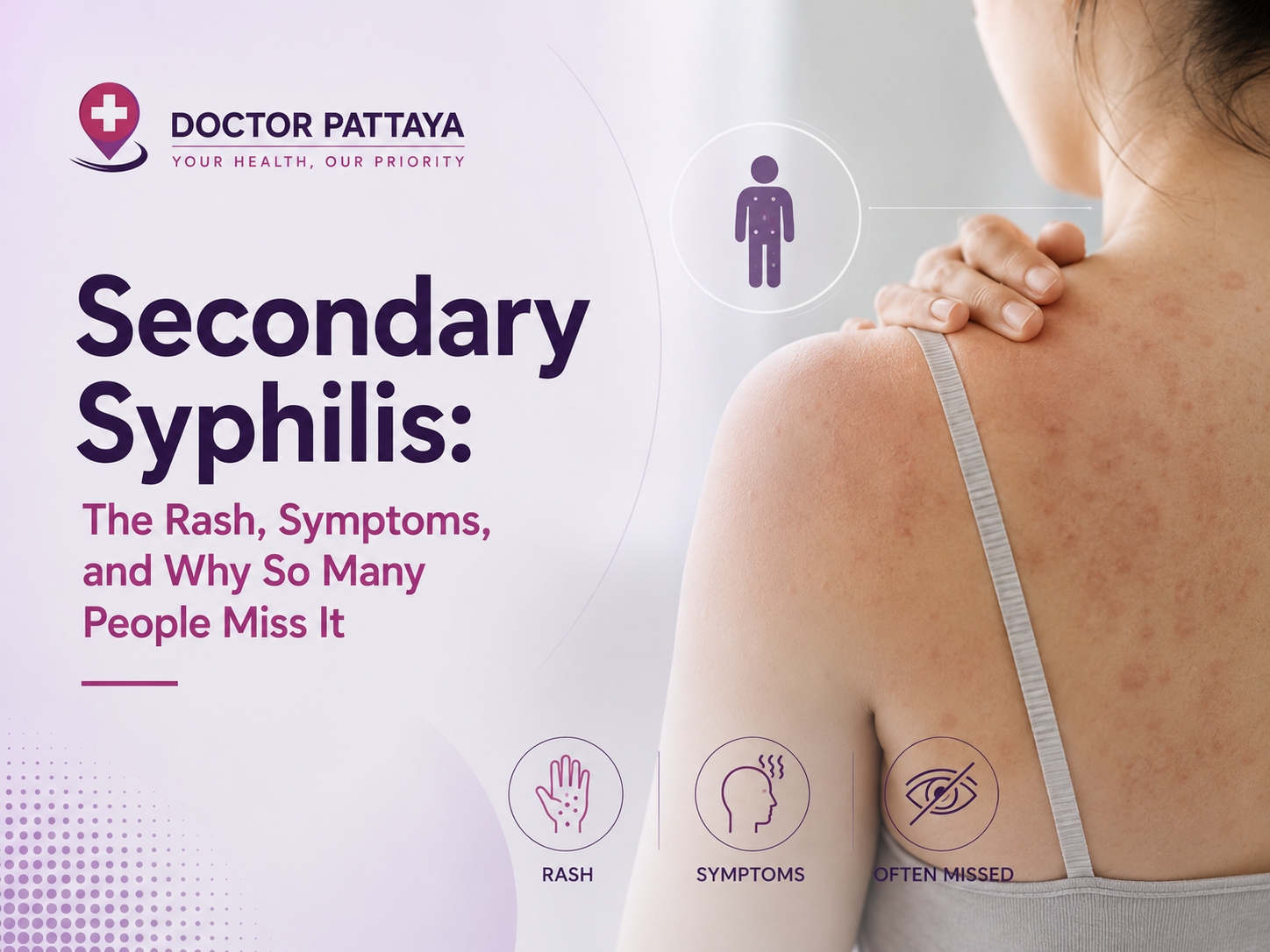
Secondary syphilis causes a rash that can appear anywhere on the body, most often on the palms and soles, and usually does not itch. It shows up weeks to a few months after the initial infection. The rash can be faint, come and go on its own, and is frequently mistaken for other skin conditions. A blood test is the only reliable way to confirm it.
You noticed something on your hands a couple of weeks into your time in Pattaya. Not a dramatic rash, nothing weeping or blistered. Just small, flat, slightly reddish-brown spots. Maybe on your palms too, which felt odd. You picked up a cream from a pharmacy on Second Road, used it for a few days, and the spots faded. So you moved on.
That fading is exactly what makes secondary syphilis so easy to miss, and so easy to ignore for far too long.
Secondary syphilis typically appears anywhere from three weeks to three months after exposure, once the initial infection has spread through the bloodstream. A lot of people never noticed the first stage at all. The initial sore is painless and often heals on its own. By the time the rash shows up, the infection is already systemic, meaning it has moved through the whole body. Getting tested now, not next week, is what matters.

What the Secondary Syphilis Rash Actually Looks Like
The classic secondary syphilis rash has both flat discoloured patches and raised bumps, often at the same time. It tends to be copper-coloured or reddish-brown. Unlike most rashes, it usually does not itch.
That is one of the first things I ask a patient: does it itch? If the answer is no, syphilis moves up the list fast.
The palms and soles are the most important locations. A rash on the palms and soles that does not itch is secondary syphilis until proven otherwise. No other common condition reliably causes that specific pattern.
The rash can also appear on the trunk, face, scalp, and genitals. In some patients it is so faint it looks like a slight change in skin tone rather than a true rash. It can come and go without treatment, and that is the part that catches people out. The rash clearing on its own does not mean the infection has cleared.
Symptoms Beyond the Rash
The rash gets all the attention, but secondary syphilis shows up in a lot of ways people do not connect to an STI.
Patchy hair loss is one that patients mention almost as an afterthought. It tends to be uneven rather than falling out uniformly. Sores inside the mouth or on the genitals, usually painless, are another sign that often gets dismissed as a minor ulcer.
Flat, moist, greyish-white growths can also appear in warm skin folds around the genitals or anus. These are not the same as genital warts and are highly infectious. Fever, swollen lymph nodes, sore throat, fatigue, and headaches can all come with this stage too.
This cluster of symptoms is why secondary syphilis has been called the great imitator for over a century. It looks like a lot of different things, none of which immediately say STI to a patient.
One symptom I take seriously right away is any change in vision. Syphilis can reach the eyes during this stage, causing blurred vision, eye pain, or light sensitivity. If you have any of those alongside a rash or the other signs above, come in the same day rather than waiting.

Why the Secondary Syphilis Rash Gets Missed So Often
In a beach town like Pattaya, a faint rash gets blamed on heat, sun, seawater, or a new sunscreen. Those explanations feel completely reasonable. And because the rash often does not itch and does not hurt, there is no strong push to get it checked. I have had patients who had been using antifungal or steroid cream from a pharmacy for two months before they came in.
The conditions most commonly confused with this rash are pityriasis rosea, psoriasis, eczema, and allergic skin reactions. Pityriasis rosea is a particularly close look-alike. It causes a rash on the trunk and tends to resolve on its own, just like secondary syphilis. The key difference is that pityriasis rosea almost never affects the palms and soles. If your rash is there, that changes the picture entirely.
The rash can also be atypical. It can be limited to one body area or so mild it looks like dry skin. In patients also living with HIV, the presentation is often more aggressive and easier to misread. Syphilis and HIV amplify each other, and a co-infection can make both harder to manage. Testing for both at the same time is something we do as standard here, and it is covered in more detail on our STD treatment page.
How Secondary Syphilis Is Diagnosed
Testing is straightforward. We run a blood test that looks for antibodies your body has made in response to the infection. It is fast and reliable, and the result gives us a number that tells us how active the infection is. A positive result is confirmed with a second blood test that identifies the specific bacteria.
One thing worth knowing: in a small number of cases, the first test can return a falsely negative result when antibody levels are very high. If your symptoms strongly suggest syphilis but the result comes back negative, we run a modified version of the test to check. It is uncommon, but it is real, and it is why a negative result with classic symptoms still warrants a follow-up.
Same-day testing is available at Doctor Pattaya. If you are only in Pattaya for a short time, that matters. You do not need to book ahead.
Getting Tested and Treated for Secondary Syphilis in Pattaya
Treatment for secondary syphilis, for most people, is a single intramuscular injection given in one visit. For anyone with a penicillin allergy, a course of oral antibiotics is the alternative, with strong evidence behind both options. There is no supplement, cream, or over-the-counter antibiotic that substitutes for this.
If you are a tourist mid-holiday, this is entirely manageable. You come in, we run the blood test, and if it confirms secondary syphilis, treatment starts the same day. The rash usually begins fading within one to two weeks.
Your partner needs to be tested. Anyone you have had sexual contact with in the past few months should know so they can get checked. Secondary syphilis is highly infectious, and untreated it progresses to a silent stage with no symptoms, and eventually to a later stage that can affect the heart, brain, and nervous system years down the line.
Doctor Pattaya offers confidential STI testing and treatment seven days a week, including walk-ins. If you are in Jomtien, Naklua, or Pratumnak and would rather not come to the clinic, we also do hotel visits.
What Happens After Treatment
In the twelve to twenty-four hours after the injection, some patients develop a fever, chills, headache, and a temporary worsening of the rash. This is a known response called the Jarisch-Herxheimer reaction. It is not an allergic reaction to the antibiotic. It resolves on its own within a day and is managed with rest, fluids, and paracetamol.
I tell every patient to expect it as a possibility so it does not alarm them.
After treatment, you will need a follow-up blood test at six months and again at twelve months. This confirms the infection has fully responded. Syphilis is bacterial and can be cured with the right antibiotics. The follow-up tests are the only way to confirm that.
If your levels are not falling as expected, we reassess. That is not common with secondary syphilis and appropriate treatment, but it is the reason follow-up matters. Our STD treatment service includes guidance on follow-up scheduling so nothing gets missed.
If you have noticed a rash that does not itch, spots on your palms or soles, unexplained hair thinning, or any other symptoms described here, come in and get tested. Secondary syphilis is curable with a single injection in most cases. Doctor Pattaya offers same-day confidential syphilis blood testing and treatment, seven days a week, with no appointment needed. We also do hotel visits across Pattaya, Jomtien, Naklua, and Pratumnak. Do not wait for symptoms to clear on their own. They often do, and the infection continues regardless.
FAQ

Dr. Pipat Finn is the senior doctor at Doctor Pattaya Takecare Clinic, a 24/7 walk-in medical practice on South Pattaya Road, Chonburi, Thailand. They provide primary care, travel medicine, sexual health, vaccination, minor surgery, IV therapy, and emergency outpatient services for tourists, expatriates, and Pattaya residents. Languages: English and Thai. WhatsApp consultations: +66 95 073 5550. Call: +66 81 668 5557.