Clinically reviewed by Dr. Pipat Finn, M.D., Senior Doctor, Doctor Pattaya.
Last reviewed: September 2026
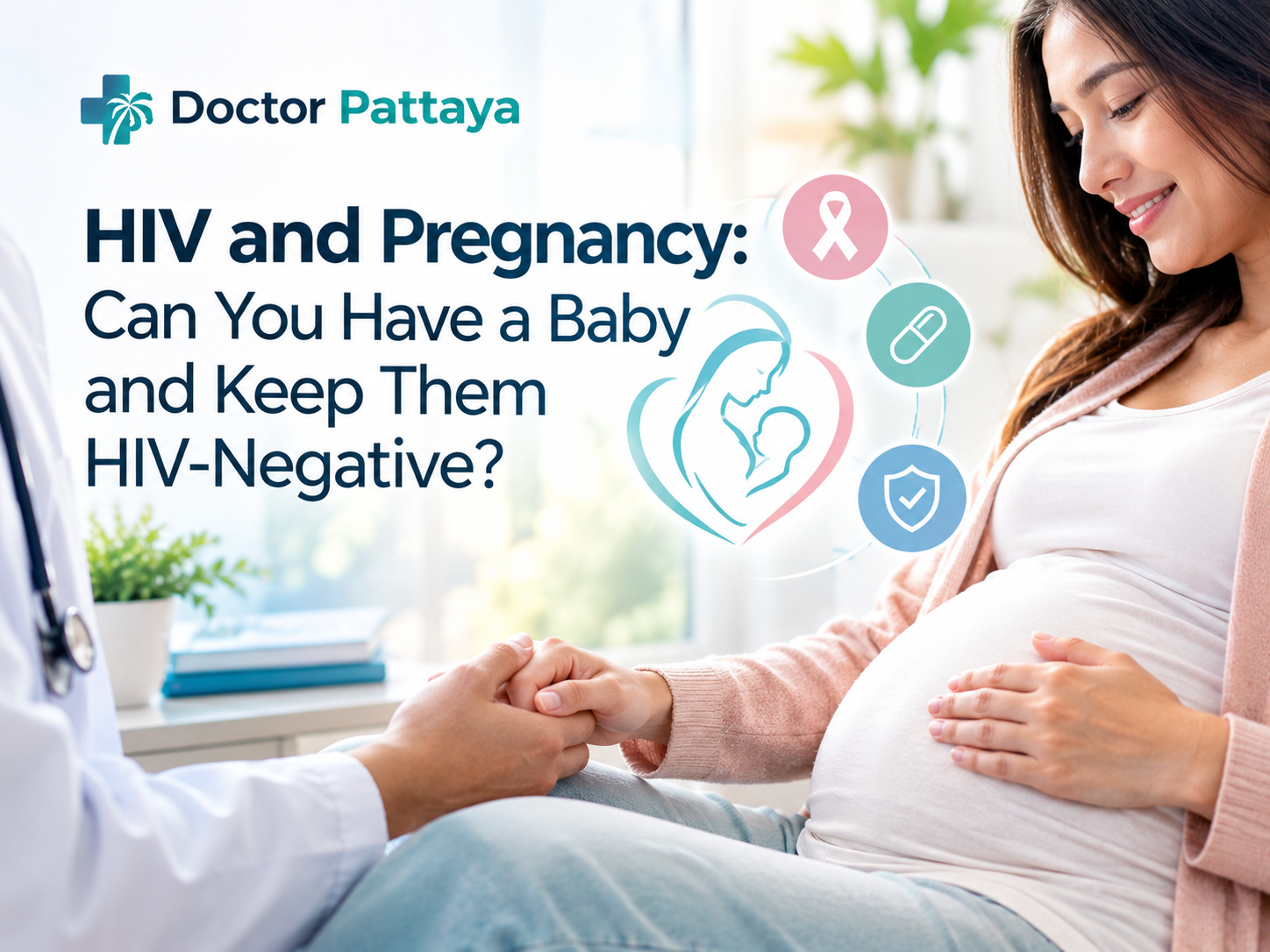
Yes, you can. With antiretroviral therapy started early and your viral load suppressed to undetectable, the risk of passing HIV to your baby falls below one percent. The key is starting care promptly, staying on treatment throughout pregnancy, and making informed choices about delivery and feeding. This is one of the most manageable situations in modern HIV medicine.
You just found out you are pregnant. Or you already knew your status and now you are staring at a positive test, trying to work out what this means for your baby. Either way, the first thing to know is this: a healthy, HIV-negative baby is absolutely possible.
We see this at Doctor Pattaya regularly. Expat couples who have been living here for years. Tourists who got an unexpected result from a routine antenatal screen and walked in off the street needing someone to talk them through it. The situations are different but the answer is the same. The medicine works, and it works well.
Decades of research have brought mother-to-child transmission rates down from around one in four to less than one in a hundred. That is not a guarantee, but it is a very good number, and it depends on things that are within your control. What matters now is what you do next.

Can Your Baby Be HIV-Negative? The Short Answer
Yes, and the odds are strongly in your favour when care starts early.
The goal is to get your viral load, the amount of HIV in your blood, down to undetectable before delivery. When that happens, the risk of passing HIV to your baby through pregnancy or birth is very close to zero. This is the principle behind U=U: Undetectable equals Untransmittable. It applies during pregnancy just as it does between sexual partners.
Your baby does not carry your HIV status automatically. What they have is a window of time that treatment can protect.
How HIV Passes From Mother to Baby
There are three points where transmission can happen. During pregnancy, the virus can cross the placenta. During labour and delivery, the baby is exposed to blood and fluids. After birth, HIV can be present in breast milk.
Each of these windows has a specific intervention. ART during pregnancy addresses the first. Viral load monitoring and delivery planning address the second. Feeding choices address the third. None of these windows is inevitable, and all three can be significantly reduced with the right care.

How HIV in Pregnancy Affects You and Your Baby
HIV that is well-controlled on treatment does not change most pregnancies dramatically. But there are things your doctor needs to watch for.
Untreated or poorly controlled HIV raises the risk of preterm birth and low birth weight. Some ART medications are linked to a small increase in gestational diabetes risk, so blood sugar checks are part of good antenatal care. Preeclampsia, a condition causing high blood pressure in pregnancy, is slightly more common and worth monitoring. Your CD4 count and viral load are checked regularly throughout pregnancy. If your immune system is under pressure, we also screen for opportunistic infections.
Planning a Pregnancy When One or Both Partners Are HIV-Positive
If one of you is HIV-positive and the other is not, conception is still very much possible without putting either of you at risk.
If the HIV-positive partner has an undetectable viral load on stable ART, the risk of sexual transmission is effectively zero. The HIV-negative partner may also choose to take PrEP, a daily tablet that prevents HIV from establishing itself if exposure occurs, as an added layer of protection during conception. If both partners are HIV-positive, ART for both remains the foundation. A preconception consultation lets us check your viral loads, review your medications for pregnancy safety, and make any adjustments before you conceive rather than after.
Choosing ART During Pregnancy
Every pregnant woman with HIV should be on antiretroviral therapy, started as early in pregnancy as possible. The goal is an undetectable viral load well before the third trimester.
The choice of which ART regimen to use matters. Dolutegravir, a commonly used and highly effective drug, was flagged some years ago for a possible small increase in neural tube defects when taken around conception. More recent data has refined that picture considerably, but it remains a conversation your doctor needs to have with you early on. This is not a reason to avoid dolutegravir. It is a reason to discuss your options openly with someone who knows the current evidence.
Do not adjust or stop your ART without medical guidance. Gaps in treatment allow your viral load to rebound, and that directly raises the risk to your baby.
Delivery Planning and Your Birth Plan
Whether you deliver vaginally or by caesarean depends largely on your viral load close to delivery.
If your viral load is above one thousand copies per millilitre at around thirty-six weeks, a planned caesarean is typically recommended because it reduces your baby’s exposure to blood and fluids during birth. If your viral load is fully suppressed on ART, vaginal delivery is often a reasonable option. This is a decision made between you and your obstetrician based on your specific numbers, not a blanket rule either way. Your baby will also receive a short course of ARV medication after birth as a precaution, and will be tested at several points over the first few months to confirm their status.
Feeding Your Baby Safely
In Pattaya and across Thailand, clean water and formula are widely available and safe to use. In this setting, formula feeding is the standard recommendation for mothers with HIV. It removes any risk from breast milk entirely.
Breastfeeding while on ART with an undetectable viral load carries very low risk, and in some parts of the world it is the more practical choice. But here, formula is accessible and straightforward. If you are unsure what is right for your situation, bring this question to a consultation before your baby arrives.
Getting Tested and Starting HIV Care in Pattaya
If you are pregnant and have not yet been tested for HIV, now is the time. Routine antenatal HIV screening is standard practice and completely confidential. An unexpected result is far better handled early, when every intervention still has maximum effect.
At Doctor Pattaya, we offer same-visit confidential HIV testing with results back quickly. If you test positive, we do not hand you a leaflet and send you on your way. We sit down, go through your options, and connect you with the care you need, whether that is starting ART, a referral to an obstetrician, or help coordinating care for the rest of your pregnancy. If you are already on ART and need a prescription review or viral load check while you are in Pattaya, we can handle that too.
For patients staying in Jomtien, Naklua, or Pratumnak who cannot easily travel, our doctor hotel visit service means you do not have to get on a motorbike to be seen. We come to you. If you want to understand your options before trying to conceive, a preconception consultation is available as a walk-in or booked appointment. You can find out more about our confidential HIV testing services and what to expect when you come in.
Pregnant and HIV-positive, or planning a pregnancy with HIV in the picture? Doctor Pattaya offers confidential HIV testing, viral load checks, ART review, and PrEP consultations from our clinic in South Pattaya, with doctor hotel visits available across Pattaya, Jomtien, Naklua, and Pratumnak. Walk in any time, day or night, or book ahead if you prefer. Early care makes every difference for you and your baby.
Frequently Asked Questions

Dr. Pipat Finn is the senior doctor at Doctor Pattaya Takecare Clinic, a 24/7 walk-in medical practice on South Pattaya Road, Chonburi, Thailand. They provide primary care, travel medicine, sexual health, vaccination, minor surgery, IV therapy, and emergency outpatient services for tourists, expatriates, and Pattaya residents. Languages: English and Thai. WhatsApp consultations: +66 95 073 5550. Call: +66 81 668 5557.