Clinically reviewed by Dr. Pipat Finn, M.D., Senior Doctor, Doctor Pattaya. Last reviewed: September 2026
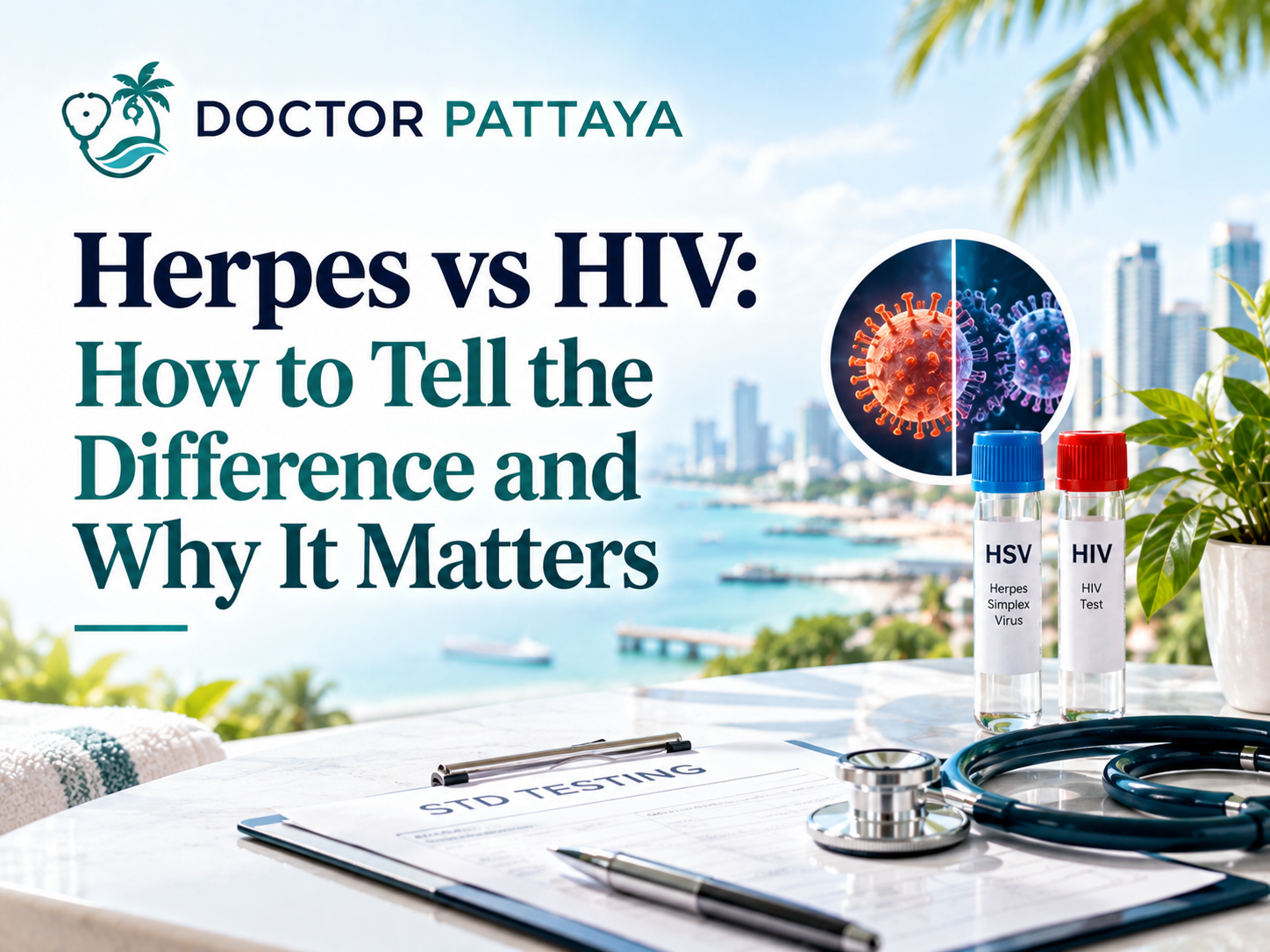
Herpes and HIV are two completely different viruses. Both can cause flu-like symptoms and genital discomfort, which is why people confuse them. Herpes causes visible blisters or sores that heal within weeks. HIV rarely causes visible lesions but can silently damage your immune system for years. Only testing confirms which one you are dealing with, and in some cases, you need to test for both at the same time.
You noticed something this morning. Maybe it is a sore that appeared after a big night out, or maybe you have spent the last week feeling feverish, achy, and completely flat. You searched your symptoms and landed somewhere between panic and confusion, because herpes and HIV share enough overlap to send anyone down a spiral. Take a breath. This is exactly the kind of thing we sort out every day at the clinic.
The two viruses are not the same. They do not behave the same way and they do not carry the same long-term risks. But they do interact, and that part matters more than most people realise. Here is what you need to know, in plain terms, so you can decide what to do next.
What Is Herpes?
Herpes simplex virus comes in two types. HSV-1 is the one most people associate with cold sores around the mouth. HSV-2 usually causes genital herpes, though either type can show up in either location. Both are extremely common worldwide.
The virus sits quietly in your nerve cells most of the time. Certain triggers, stress, illness, sunburn, or a run of bad sleep, can wake it up. When it does, you get an outbreak: blisters or ulcers that crust over and heal within two to four weeks. Between outbreaks, you can still pass the virus to someone else through skin-to-skin contact, even with no visible sores.
There is no cure. Antiviral medication like valacyclovir reduces how often outbreaks happen and lowers the chance of passing the virus to a partner. It does not remove the virus from your body.
What Is HIV and How Is It Different?
HIV targets your immune system. Specifically, it attacks the white blood cells your body uses to fight off infections. Left untreated long enough, it can weaken your immune system to the point where it can no longer protect you, a stage known as AIDS.
This is the core difference between the two viruses. Herpes causes localised outbreaks and then goes quiet. HIV is systemic, meaning it affects the whole body, and without treatment it keeps working in the background even when you feel completely fine.
With antiretroviral therapy, people living with HIV can reduce their viral load to undetectable levels. The evidence strongly supports that an undetectable viral load means the virus cannot be passed to a sexual partner. That is a significant and well-established fact.
Overlapping Symptoms and What Makes Them Easy to Confuse
Both viruses can cause what feels like a bad flu in the weeks after exposure: fever, swollen lymph nodes, fatigue, body aches. That is where the confusion starts, and it is completely understandable.
The clearest difference shows up at the skin. Herpes causes clustered blisters or ulcers that are often painful or itchy. Early HIV infection rarely causes visible blisters. You might get a diffuse, body-wide rash, but not the grouped lesions that are typical of herpes.
| Symptom | Herpes (HSV) | Acute HIV |
|---|---|---|
| Fever | Yes, during outbreak | Yes, common in early infection |
| Swollen lymph nodes | Sometimes | Yes, common |
| Fatigue | During outbreak | Prominent, often severe |
| Genital sores or blisters | Yes, clustered, painful | Rarely |
| Mouth sores | Yes, HSV-1 especially | Sometimes, less defined |
| Night sweats | Uncommon | Common in early HIV |
| Sore throat | Uncommon | Common |
| Rash | Localised near sores | Diffuse, body-wide |
| Duration of symptoms | 2 to 4 weeks per outbreak | 2 to 4 weeks, then often silent |
Timing matters too. Herpes symptoms usually appear two to twelve days after exposure. Early HIV symptoms typically appear two to four weeks after exposure. If your symptoms feel more like a whole-body flu than a localised sore, and they came on later, HIV testing deserves serious attention.
Why Having Herpes Raises Your HIV Risk
This is the part most people do not know, and it is clinically important.
Active herpes sores break down the skin barrier. That disruption creates direct entry points for HIV. The immune cells that HIV specifically targets are also drawn in large numbers to sites of herpes infection, which increases the risk further.
People with HSV-2 face a meaningfully higher risk of acquiring HIV from an exposure compared to people without herpes. That elevated risk does not disappear entirely when a sore heals. Low-level inflammation can persist and keep that window of vulnerability open.
If you have herpes and you are sexually active in Pattaya with ongoing exposure risk, regular HIV testing is part of responsible management, not optional. You can find out more about confidential HIV testing in Pattaya if you want to know what that looks like in practice, including how herpes affects your risk profile.
Testing for Herpes and HIV in Pattaya
For herpes, the most reliable test is a swab taken directly from an active sore. If you have a lesion that has not crusted over yet, that is the best moment to get it tested. A blood test can also show whether you have been previously exposed to HSV-1 or HSV-2, though antibodies can take up to twelve weeks to develop after initial infection.
For HIV, we use a fourth-generation combination test that detects both the virus itself and your body’s antibodies. This can pick up infection from around four weeks after exposure. A negative result before that window closes does not rule HIV out, and we will tell you exactly when to retest.
Both tests can be done in the same consultation. If you woke up in your hotel near Jomtien or Naklua with a new sore and are not sure what it is, you do not need to navigate a Thai hospital on your own. Doctor Pattaya offers hotel visits across Pattaya, Jomtien, and Naklua. A doctor comes to you, takes a swab, and arranges blood testing on the spot.
Treatment Options Available in Pattaya
For herpes, antiviral medication is stocked at the clinic and available the same day. Starting treatment early during an outbreak shortens the duration and reduces discomfort. Long-term expats dealing with frequent outbreaks can discuss daily suppressive therapy during a consultation.
For HIV, the most time-critical treatment is PEP, post-exposure prophylaxis. This is a short course of HIV medications taken after a potential exposure. It must be started within 72 hours. After that window closes, it is not effective. If you had a risk exposure last night and you are reading this now, that window is closing. Come in or call us and we will assess your situation and start PEP the same day if it is appropriate.
For those with ongoing exposure risk, PrEP is a daily tablet that significantly reduces the chance of acquiring HIV. We can assess whether it is right for you and prescribe it during a consultation. Long-term antiretroviral therapy for diagnosed HIV is not something that starts and ends at a tourist clinic, but we can assess, arrange testing, and connect you with the right ongoing care pathway.
What to Do Right Now If You Are Worried
If you have a visible sore, get it swabbed before it crusts over. Do not wait on this one.
If you had a potential HIV exposure in the last 72 hours, treat it as urgent. Come in or request a hotel visit. Every hour inside that window counts.
If your symptoms are more flu-like, no obvious sores but fever, fatigue, and swollen glands after a recent sexual encounter, get a combined HIV test and tell the doctor when the exposure happened. That timing shapes everything we do next.
And if you are simply not sure, that is fine. Uncertainty is the most common reason people walk through our door or message us at midnight from their hotel room. Sexual health consultations at Doctor Pattaya are fully confidential. Nobody at your hotel will know. The doctor who visits your room is there as your doctor, not a messenger.
Worried about herpes, HIV, or both after a potential exposure in Pattaya? Doctor Pattaya is open 24 hours a day, seven days a week. We offer confidential STI and HIV testing, herpes swabs and same-day treatment, PEP for urgent HIV exposure, and doctor hotel visits across Pattaya, Jomtien, and Naklua. Walk in, call us, or request a hotel visit. Results are explained in plain English and your privacy is protected throughout.
Frequently Asked Questions

Dr. Pipat Finn is the senior doctor at Doctor Pattaya Takecare Clinic, a 24/7 walk-in medical practice on South Pattaya Road, Chonburi, Thailand. They provide primary care, travel medicine, sexual health, vaccination, minor surgery, IV therapy, and emergency outpatient services for tourists, expatriates, and Pattaya residents. Languages: English and Thai. WhatsApp consultations: +66 95 073 5550. Call: +66 81 668 5557.