Clinically reviewed by Dr. Pipat Finn, M.D., Senior Doctor, Doctor Pattaya.
Last reviewed: October 2026
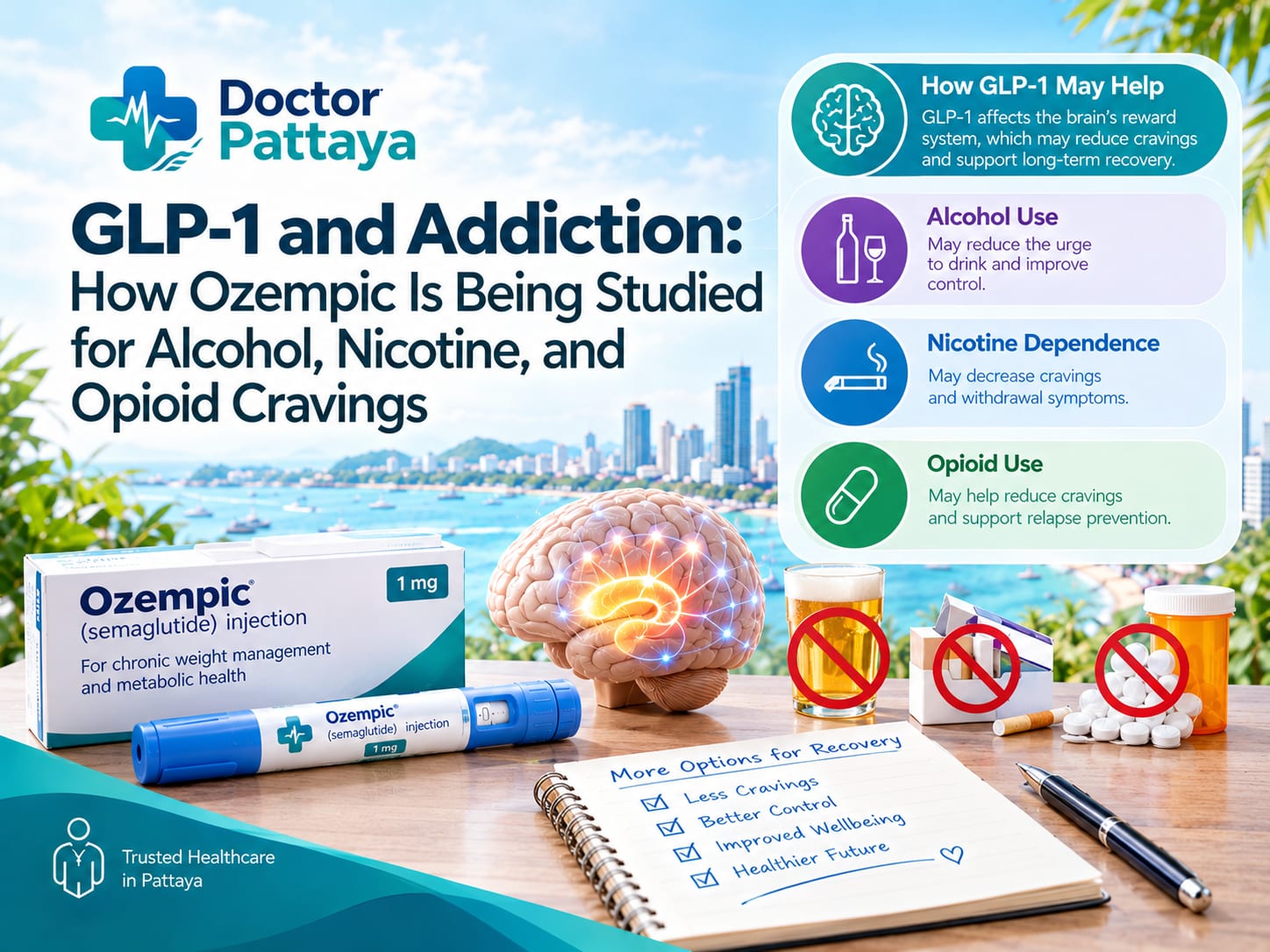
GLP-1 medications like semaglutide (Ozempic) are being studied for their effect on alcohol, nicotine, and opioid cravings. Early clinical trial results are encouraging, but these drugs are not approved for addiction treatment and are currently used off-label only. The strongest evidence so far is for alcohol use disorder. Anyone considering GLP-1 for craving reduction should speak to a doctor first to discuss suitability, alternatives, and safety.
You came to Pattaya for a holiday, or you have lived here for years, and somewhere along the way the drinking or the smoking has become harder to pull back from than you expected. Maybe you are already on semaglutide for weight management and you have noticed something: the urge to drink at dinner is quieter. You are not imagining it. Researchers noticed the same thing, and the last few years have produced a real and growing body of clinical evidence asking whether GLP-1 medications might blunt the pull of addictive substances beyond food.
This is not a story about a miracle drug. The evidence is genuinely interesting, some of it is strong, and a lot of it is still early. What follows is a clear look at what the trials actually show, what the limits are, and what this means practically if you are in Pattaya and want a real conversation with a doctor about your options.

How GLP-1 Drugs Affect the Brain’s Reward System
GLP-1 receptor agonists, drugs like semaglutide, liraglutide, and dulaglutide, were built to manage blood sugar and, later, body weight. But GLP-1 receptors exist in the brain as well as the gut. They are present in the brain’s reward circuitry, including a structure called the nucleus accumbens, which is central to how we experience craving and pleasure from substances.
The working theory is straightforward. Alcohol, nicotine, and opioids all trigger a dopamine surge that reinforces the urge to repeat the behaviour. GLP-1 receptor activity in the reward pathway appears to dampen that surge. The reward feels smaller, the craving quiets. Preclinical studies in animals showed this pattern clearly. The question was whether it translated to humans, and that is what recent trials have started to answer.
What the Clinical Trials Actually Show
Alcohol
The most important human evidence comes from a randomised controlled trial published in JAMA Psychiatry in 2024. Participants with alcohol use disorder received weekly semaglutide injections over nine weeks. Those on the active drug showed a significant reduction in alcohol consumed in a controlled lab session, in drinks per drinking day, and in weekly craving compared to the placebo group. The trial did not find a significant change in total drinking days. This was a double-blind, placebo-controlled design, which sits at a higher level of certainty than observational data.
Large observational data from the United States Veterans Affairs system also found lower rates of alcohol-related diagnoses in patients prescribed GLP-1 medications compared to those on other diabetes drugs. Observational data cannot prove causation the way a controlled trial can, but the consistency across both study types adds weight to the signal.
Nicotine
A randomised controlled trial published in eClinicalMedicine in 2023 tested dulaglutide, another GLP-1 receptor agonist, for smoking cessation. Participants on dulaglutide were not more likely to quit than those on placebo. Quit rates at the end of the twelve-week treatment period were similar in both groups. The trial did find that dulaglutide reduced post-cessation weight gain compared to placebo. Exenatide, an older GLP-1 drug, has also been studied in smokers, with some reduction in the reinforcing effect of nicotine observed. The evidence base for nicotine is smaller than for alcohol and the direction of effect on quitting is not yet clear from the completed trials.
Opioids
The opioid evidence is the weakest of the three. Most of what exists comes from animal studies and early observational human data. There are no published randomised controlled trials specifically testing GLP-1 for opioid use disorder at the time of writing. This does not mean it will not work, but the evidence is not yet strong enough to draw firm clinical conclusions.

Is GLP-1 a Replacement for Addiction Treatment, or a Tool?
GLP-1 medications are not approved by any regulator, including Thailand’s FDA, for treating alcohol use disorder, nicotine dependence, or opioid addiction. Prescribing them for these purposes is off-label, meaning a doctor can do it, but based on emerging trial data rather than an approved indication.
For alcohol use disorder, naltrexone and acamprosate remain the established first-line medications. For smoking cessation, varenicline (Champix) has the strongest evidence base. GLP-1 drugs are most useful as adjunctive therapy, meaning used alongside these treatments, or for patients already on GLP-1 for metabolic reasons who want to discuss craving reduction as an additional benefit.
Treating addiction with medication alone, regardless of what that medication is, is rarely enough. Behavioural support, honest conversations with a doctor, and addressing the patterns that drive use all matter. GLP-1 may reduce the pull of a substance, but it does not remove the reasons a person reaches for it.
Safety, Side Effects, and Who Should Not Use GLP-1 for Cravings
Nausea is the most common side effect, especially early in treatment. Vomiting, constipation, and reduced appetite are also frequent. For most patients these settle within a few weeks. Weight loss is a reliable secondary effect, which for some patients is a benefit and for others is not the goal.
Certain groups should not use GLP-1 medications. Anyone with a personal or family history of medullary thyroid carcinoma or multiple endocrine neoplasia type 2 should avoid them entirely. A history of pancreatitis is a contraindication. GLP-1s should not be used during pregnancy. People with severe gastroparesis should also avoid them.
Drug interactions are worth discussing with a doctor, particularly for anyone taking medications that also slow gastric emptying, as GLP-1s can affect how other drugs are absorbed. If you are on any ongoing treatment for a chronic condition, flag it before anything is prescribed.
What This Means for Tourists and Expats in Pattaya
Pattaya is a high-stimulation environment. Alcohol is cheap, available around the clock, and socially central in a way that makes moderation genuinely harder than it might be at home. A lot of long-term expats recognise a slow drift: one drink became two, two became a habit, and now the habit feels like it has its own momentum.
If you are already on a GLP-1 for weight management or diabetes and you have noticed your drinking or smoking has shifted, that is worth mentioning to your doctor. It may not be coincidence. If you are not on a GLP-1 and are looking at this specifically as a way to manage cravings, the conversation starts with an honest clinical assessment: what is the pattern of use, what has already been tried, and what is the safest and most evidence-based approach for you.
Reducing heavy drinking, even if not eliminating it, has real health benefits. GLP-1 therapy, where appropriate, can be part of that picture alongside other support. You can read more about the GLP-1 service at Doctor Pattaya’s GLP-1 page, including how consultations are structured and what the treatment involves.
Getting a GLP-1 Consultation in Pattaya
A consultation at Doctor Pattaya starts with a proper history: your current health, weight, any existing medications, and what you are hoping the treatment will do. If you are approaching this from a cravings angle, we will want to understand your pattern of use clearly before recommending anything. A GLP-1 prescription for craving reduction is not something to hand out without context.
If you are staying near the beach or in a hotel and prefer not to travel, we offer doctor hotel visits across Pattaya, including Jomtien and Naklua. Whether you are in a condo in Naklua or a hotel close to Jomtien Beach, the clinic is open around the clock. There is no need to time your visit around a schedule or wait until you get home to have this conversation.
Thinking about GLP-1 for alcohol or nicotine cravings? Doctor Pattaya is open 24 hours a day, seven days a week for walk-in and appointment consultations. We see tourists and long-term expats and can discuss your options clearly, including whether GLP-1 is appropriate for you and what else might help. Doctor hotel visits are available across South Pattaya, Jomtien, and Naklua. Visit doctorpattaya.com/glp-1 to learn more, or contact us to book a consultation.
Frequently Asked Questions
References
- Hendershot CS, et al. Once-Weekly Semaglutide in Adults With Alcohol Use Disorder: A Randomized Clinical Trial. JAMA Psychiatry. 2025. doi:10.1001/jamapsychiatry.2024.4789
- Lengsfeld S, et al. Effect of dulaglutide in promoting abstinence during smoking cessation: a single-centre, randomized, double-blind, placebo-controlled, parallel group trial. EClinicalMedicine. 2023;57:101865.
- Xie Y, Choi T, Al-Aly Z. Mapping the effectiveness and risks of GLP-1 receptor agonists. Nature Medicine. 2025. doi:10.1038/s41591-024-03412-w
- Au C, et al. GLP-1 receptor agonists for opioid use disorder: systematic review of preclinical and emerging clinical evidence. Pharmaceutical Technology, 2025.
The information in this article is for educational purposes only and does not constitute medical advice. It should not be used to self-diagnose or replace a consultation with a qualified physician. If you have concerns about your health, contact a licensed medical professional. For appointments at Doctor Pattaya, visit doctorpattaya.com.

Dr. Pipat Finn is the senior doctor at Doctor Pattaya Takecare Clinic, a 24/7 walk-in medical practice on South Pattaya Road, Chonburi, Thailand. They provide primary care, travel medicine, sexual health, vaccination, minor surgery, IV therapy, and emergency outpatient services for tourists, expatriates, and Pattaya residents. Languages: English and Thai. WhatsApp consultations: +66 95 073 5550. Call: +66 81 668 5557.