Clinically reviewed by Dr. Pipat Finn, M.D., Senior Doctor, Doctor Pattaya.
Last reviewed: October 2026
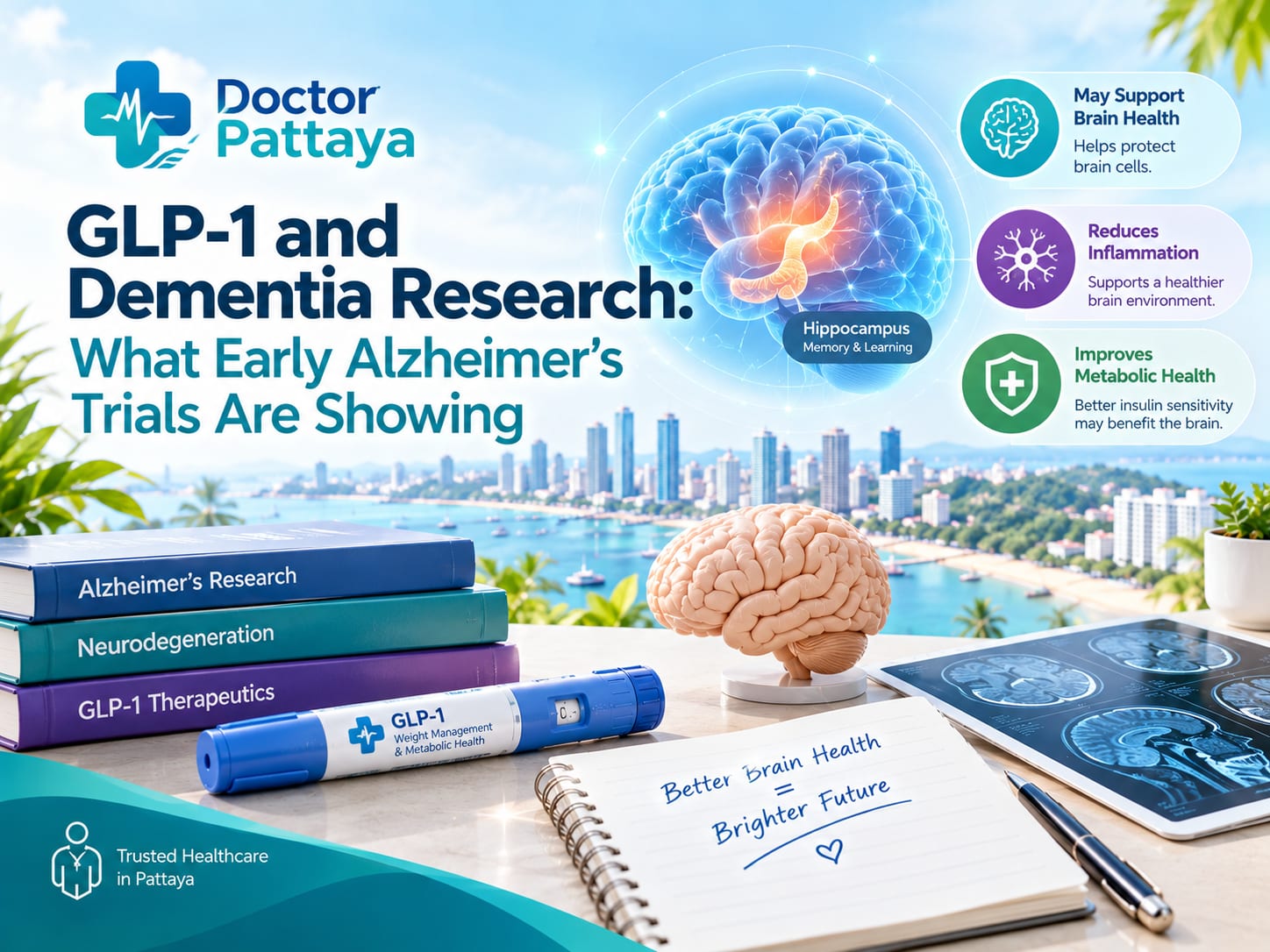
The biggest GLP-1 Alzheimer’s trial to date, the EVOKE phase 3 study, reported in December 2025 that semaglutide did not significantly slow disease progression in people with early Alzheimer’s. At the same time, real-world observational data consistently shows lower dementia rates among GLP-1 users. These two findings are not contradictory, but they point to very different things. Understanding the gap matters if you are considering GLP-1 for brain health.
You have probably seen a headline about Ozempic and Alzheimer’s. Maybe your doctor back home mentioned it, or maybe you are a long-term expat here in Pattaya, already on a GLP-1 drug for your weight or type 2 diabetes, and wondering whether it is doing something useful for your brain too. That is a completely reasonable question.
The honest answer right now is complicated. The most important trial came back negative in December 2025. The research community has since shifted its focus from "can GLP-1 treat Alzheimer’s?" to "can it prevent it, and in whom?" That is a meaningful shift. We will walk through what the trials actually found, why real-world data tells a different story, and what any of this means practically.

Why Researchers Think GLP-1 Could Help the Brain
GLP-1 receptors are found throughout the brain, not just in the gut and pancreas. When a GLP-1 drug activates those receptors, it appears to do things that could be relevant to Alzheimer’s risk.
The main theory involves brain insulin resistance. The brain depends on insulin signalling to keep neurons alive, manage energy, and allow brain cells to communicate properly. In people with obesity, type 2 diabetes, or advancing age, this signalling can break down. GLP-1 receptor agonists appear to restore part of this process in animal models, which may help protect neurons from damage.
Animal studies have also shown reductions in brain inflammation, amyloid-beta plaques (the sticky protein deposits linked to Alzheimer’s), and tau tangles (another disease marker). None of this has translated cleanly into humans yet. But it explains why researchers were optimistic enough to run large, expensive trials.
What the Clinical Trials Actually Found: Liraglutide vs Semaglutide
These two drugs have each had a major Alzheimer’s trial. Their results are different enough that they should not be lumped together.
Liraglutide was tested in the ELAD trial, a phase 2b study. Results showed a mixed picture. The primary endpoint, brain glucose metabolism measured by FDG-PET, was not met. However, secondary and exploratory measures favoured liraglutide, including a slower decline in some cognitive tests and less brain volume loss compared to placebo. Phase 2b trials are not large enough to be definitive. The investigators and outside experts called for larger phase 3 trials to test whether the secondary signals hold up.
Semaglutide is the drug most people know as Ozempic or Wegovy. The EVOKE and EVOKE+ trials were large phase 3 studies enrolling roughly 3,800 people with early Alzheimer’s. Results reported in December 2025 found no statistically significant reduction in disease progression. This is the result that carries the most weight. If you read a headline saying "GLP-1 drugs show promise for Alzheimer’s" and that story predates December 2025, it was citing earlier, smaller data that a larger trial has since not confirmed.
Doctor Pattaya’s overview of what Alzheimer’s trials show about GLP-1 covers this in more detail, including a plain-English summary of where the evidence stands now.

Real-World Evidence vs Randomised Trials: Why the Gap Exists
If EVOKE failed, why do large real-world studies keep showing that GLP-1 users have lower dementia rates? This is where patients understandably get confused.
Real-world studies are observational. They look back at patients already taking GLP-1 drugs for diabetes or obesity and compare their outcomes to patients who were not. A finding presented at the 2026 Alzheimer’s Association International Conference reported lower all-cause mortality among GLP-1-exposed patients with dementia, which generated wide coverage. These signals are genuine and worth watching.
But observational studies cannot prove causation. People prescribed GLP-1 drugs often have closer medical follow-up, more stable blood sugar, and healthier overall habits. Randomised trials are designed to strip out exactly those differences. When the largest randomised trial comes back negative, that carries more evidential weight than an observational study, even a carefully designed one. Both findings can coexist. They are just answering different questions.
Could GLP-1 Work Better as Prevention Than as Treatment?
This is the most important question to emerge after EVOKE failed, and several researchers raised it directly following the December 2025 results.
EVOKE enrolled people who already had early Alzheimer’s. At that stage, amyloid plaques have been building for years, sometimes decades. The argument is that by the time someone meets diagnostic criteria for early Alzheimer’s, the window for metabolic intervention may have already passed. GLP-1 drugs do not appear to directly clear existing plaques.
The prevention hypothesis suggests these drugs may be more useful earlier: in people with obesity, type 2 diabetes, insulin resistance, or high cardiovascular risk, before significant brain damage has accumulated. For health-conscious expats in Pattaya managing their metabolic health, this framing is the one most worth paying attention to.
The Indirect Brain-Protection Pathway
Separate from the Alzheimer’s-specific trials, GLP-1 drugs have strong evidence for benefits that reduce dementia risk through other routes.
Better blood sugar control reduces the risk of small vessel disease in the brain. Lower cardiovascular risk means fewer strokes and less white matter damage. Weight reduction lowers systemic inflammation. These are established, approved effects with solid trial evidence behind them.
This does not make GLP-1 a dementia drug. But someone taking semaglutide or liraglutide for metabolic or cardiovascular reasons may be incidentally reducing some dementia risk factors along the way. That is not the same as preventing Alzheimer’s directly, and keeping that distinction clear matters.
Getting GLP-1 in Pattaya: What Patients and Expats Should Know
GLP-1 medications, including semaglutide and liraglutide, require a prescription in Thailand. They must be issued by a licensed doctor following a clinical review. They are not available over the counter, and sourcing them informally carries real risks around product authenticity and dosing safety.
At Doctor Pattaya, a 24/7 private clinic in South Pattaya, a doctor can review your metabolic health, go through your risk factors, and prescribe GLP-1 therapy where it is clinically appropriate. GLP-1 drugs are not suitable for everyone. People with a personal or family history of medullary thyroid cancer or multiple endocrine neoplasia type 2 should not use them, and anyone who develops severe abdominal pain or vomiting while on treatment should see a doctor promptly. If you are already on GLP-1 and want to understand what the current dementia research means for your specific situation, that conversation is available here too.
Walk-in appointments are available. If you are based in Jomtien, Pratumnak, or Naklua, the clinic is accessible from all of those areas. Hotel visits are available across Pattaya if you cannot travel.
Want to understand what the current GLP-1 Alzheimer’s research means for your health? Doctor Pattaya is a 24/7 private clinic in South Pattaya. A doctor can review your metabolic health, discuss your risk profile, and prescribe GLP-1 medication where it is clinically appropriate. Walk-ins welcome. Hotel visits available across Pattaya, Jomtien, and Naklua. Contact Doctor Pattaya to book a consultation or ask a question.
FAQ
References
- Alzheimer Europe. Results of EVOKE and EVOKE+ trials show no effect of oral semaglutide on AD progression. 2025.
- NeurologyLive. GLP-1 Semaglutide Fails to Outperform Placebo in Phase 3 EVOKE Trial in AD. November 2025.
- ELAD trial results, Nature Medicine 2025, via PMC. Evaluation of liraglutide in Alzheimer’s disease — primary endpoint results.
- MIMS. GLP-1RA exposure lowers mortality in patients with dementia. AAIC 2026 data.
- World Health Organization. Dementia fact sheet. Updated March 2023.
The information in this article is for educational purposes only and does not constitute medical advice. It should not be used to self-diagnose or replace a consultation with a qualified physician. If you have concerns about your health, contact a licensed medical professional. For appointments at Doctor Pattaya, visit doctorpattaya.com.

Dr. Pipat Finn is the senior doctor at Doctor Pattaya Takecare Clinic, a 24/7 walk-in medical practice on South Pattaya Road, Chonburi, Thailand. They provide primary care, travel medicine, sexual health, vaccination, minor surgery, IV therapy, and emergency outpatient services for tourists, expatriates, and Pattaya residents. Languages: English and Thai. WhatsApp consultations: +66 95 073 5550. Call: +66 81 668 5557.