Clinically reviewed by Dr. Pipat Finn, M.D., Senior Doctor, Doctor Pattaya.
Last reviewed: October 2026
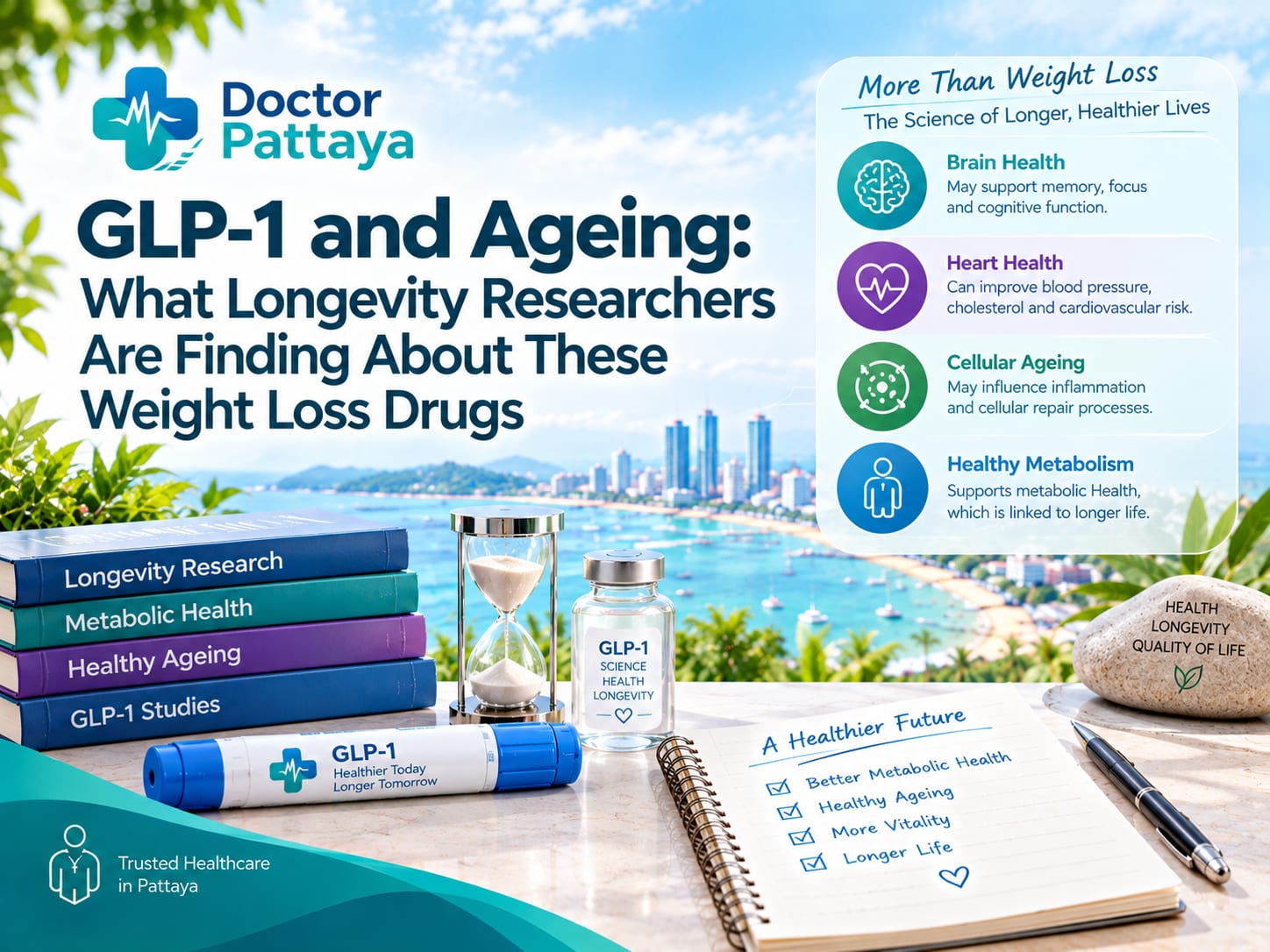
GLP-1 receptor agonists like semaglutide and tirzepatide were developed for diabetes and weight loss. A September 2026 mouse study published in Nature showed lifespan extension, and conference data from Lilly and Novo Nordisk suggest these drugs may reduce biological age by two to four years in humans. No human clinical trial has yet confirmed that GLP-1 drugs extend lifespan in healthy adults. This is a fast-moving area of research, and anyone considering GLP-1 for longevity purposes needs medical supervision, baseline blood work, and monitoring for muscle loss.
You have been living in Pattaya for a few years, you keep yourself reasonably fit, and you have been reading about GLP-1 drugs showing up in longevity research. Maybe a friend back home started semaglutide and mentioned something about anti-ageing benefits. Maybe you caught the Nature headline and thought: is this real, and can I actually access this here?
That is a sensible question. You deserve a straight answer rather than breathless hype or a flat dismissal.
The short version: the science is genuinely interesting, the human evidence is not there yet, and the muscle-loss risk for older adults is real and often glossed over. This article explains what the research actually shows, flags what is still unknown, and tells you what a supervised approach looks like if you want to explore this further. The term healthspan, meaning how many of those years you live in good health, is what researchers are really chasing. Whether GLP-1 drugs deliver on that promise is still being tested.

The September 2026 Nature Study: What the Mouse Data Actually Shows
Feng et al. at UC Berkeley published results in Nature in September 2026 showing that semaglutide extended median lifespan in mice. The treated female mice lived longer than untreated controls, and the researchers also observed improvements in physical function and reduced markers of age-related decline.
That is a meaningful finding. It also has clear limits. The study used female mice only. The untreated control group received no calorie restriction, and the GLP-1-treated mice ate less. The researchers themselves noted they could not confirm whether the lifespan extension came from direct GLP-1 pathway effects or simply from reduced calorie intake, which is itself a well-established way to extend mouse lifespan.
This does not make the study unimportant. It makes it the starting point, not the conclusion.
Epigenetic Clocks and Biological Age: What the Conference Data Suggests
Lilly presented conference data suggesting tirzepatide reduced biological age by around three to six years in one small analysis of adults over fifty. Separately, Novo Nordisk researchers reported that semaglutide reduced the heart’s biological age by two to four years compared with placebo using protein-based aging measures, which are different from epigenetic clocks. Neither dataset had been peer-reviewed and published in a journal as of this writing. An epigenetic clock measures chemical tags on your DNA that change as you age. Your biological age from this test tells you how old your cells appear, which can differ from your actual age.
These are research tools, not clinical diagnostics. A lower score does not confirm you will live longer.
The signal is interesting enough to follow. It is not strong enough to base a treatment decision on by itself.

Beyond Weight Loss: Cardiovascular and Neurological Signals
The cardiovascular data is the strongest part of the longevity argument. The SELECT trial, published in the New England Journal of Medicine in 2023, showed that semaglutide reduced major cardiovascular events in adults with overweight or obesity and established cardiovascular disease who did not have diabetes. Heart disease remains one of the leading drivers of shortened healthspan, so this finding matters.
The neurological signals are earlier and less certain. Researchers are exploring whether GLP-1 receptor activation influences chronic low-grade brain inflammation linked to Alzheimer’s and Parkinson’s disease. Animal studies have shown promising signals. Human trial results in this area were still pending as of late 2026.
For an expat in their fifties or sixties in Pratumnak or Naklua thinking about long-term health, this is the part of the research worth watching. Not ready to act on, but worth monitoring.
The Muscle-Loss Problem: A Critical Caveat for Older Adults
This is the part most articles rush past, and it is the one that matters most if you are over fifty. Multiple 2026 reviews have found that a meaningful portion of total weight lost on GLP-1 drugs may come from lean mass rather than fat, though estimates vary across studies and the clinical significance is still being assessed. Lean mass means muscle. Losing muscle as you age raises the risk of falls, weakness, and metabolic decline.
This does not mean GLP-1 drugs are wrong for older adults. It means they need to be used alongside resistance training and adequate protein intake. Current guidance supports at least two to three sessions of resistance exercise per week during GLP-1 treatment, alongside a protein intake of around 1.2 to 1.6 grams per kilogram of body weight per day, in line with European Society for Clinical Nutrition and Metabolism guidance. Monitoring lean mass during treatment is the responsible way to track this.
This is a practical conversation to have with a doctor before you start, not after you have lost several kilograms and feel weaker than expected.
What the Human Trials Still Need to Prove
The US Advanced Research Projects Agency for Health, known as ARPA-H, has allocated up to 38 million dollars toward a trial called VITAL-H, run by the Barshop Institute at UT Health San Antonio. VITAL-H is testing semaglutide alongside two other approved drugs in healthy adults aged 60 to 65, specifically to measure whether these drugs preserve healthspan in people without a primary indication for them. This will be the first rigorous test of whether GLP-1 drugs extend healthspan in people who are otherwise well.
Until those results are available, every longevity claim for GLP-1 in healthy adults is based on data from people with obesity, type 2 diabetes, or cardiovascular disease, or on animal models. The biology may transfer. It may not.
If you read the research and want to stay informed, the ARPA-H trial is the one to follow. In the meantime, the only honest answer to whether GLP-1 extends human lifespan in healthy people is: we do not yet know.
Who Should Not Take GLP-1 Drugs for Longevity Right Now
GLP-1 receptor agonists are not appropriate for everyone, regardless of what the longevity research shows. A personal or family history of medullary thyroid carcinoma or Multiple Endocrine Neoplasia syndrome type 2 are listed contraindications on all current prescribing labels. A history of pancreatitis warrants careful clinical assessment before any GLP-1 use. Severe kidney impairment requires dosing review and close monitoring.
A history of eating disorders is a clinical flag that needs discussion before starting any drug that strongly suppresses appetite. Pregnancy and breastfeeding are also contraindications.
If any of these apply to you and you are reading about GLP-1 for anti-ageing, the conversation with a doctor is not optional. It is the first step.
Getting GLP-1 Treatment Safely in Pattaya
If you have read the research and want to explore this with medical support, the practical question is how to do it properly here. The starting point is always a baseline metabolic blood panel: liver function, kidney function, fasting glucose, lipids, and a full blood count. That gives both you and the prescribing doctor a clear picture before any drug is started.
Lean-mass monitoring should be part of any ongoing plan. Regular follow-up appointments allow dose adjustments based on how you are tolerating treatment and what the blood work shows. You can find out more about what a supervised approach looks like on the GLP-1 treatment page at Doctor Pattaya.
If you are near Jomtien Beach or Pratumnak Hill, both areas are covered for clinic visits and hotel visits where needed. The goal is to engage with this research responsibly, with the monitoring in place to catch problems early and adjust the plan if something is not working. Doctor Pattaya also offers 24/7 emergency medical care if anything unexpected comes up during treatment.
Thinking about GLP-1 treatment in Pattaya and want to understand whether it is right for you? Doctor Pattaya is a 24/7 private clinic in South Pattaya offering supervised GLP-1 prescribing, baseline metabolic blood panels, and follow-up monitoring. Walk in any time or contact us to arrange a consultation. We cover Jomtien, Pratumnak, Naklua, and the wider Pattaya area including hotel visits.
Frequently Asked Questions
References
- Feng Y et al. (Danica Chen lab, UC Berkeley). Semaglutide extends lifespan and slows physiological aging in healthy mice. Nature, September 2026.
- Lincoff AM et al. Semaglutide and Cardiovascular Outcomes in Obesity without Diabetes. New England Journal of Medicine, 2023.
- UT Health San Antonio. UT San Antonio to lead $38 million national trial testing drugs to extend healthspan. News release, 2026.
- Technology Networks. Semaglutide may slow the pace of epigenetic aging. 2026.
- Jastreboff AM et al. (SURMOUNT-5). Tirzepatide versus semaglutide for obesity. New England Journal of Medicine, May 2025.
- Drug Discovery and Development. GLP-1 impact on lean mass: what the evidence shows. 2026.
The information in this article is for educational purposes only and does not constitute medical advice. It should not be used to self-diagnose or replace a consultation with a qualified physician. If you have concerns about your health, contact a licensed medical professional. For appointments at Doctor Pattaya, visit doctorpattaya.com.

Dr. Pipat Finn is the senior doctor at Doctor Pattaya Takecare Clinic, a 24/7 walk-in medical practice on South Pattaya Road, Chonburi, Thailand. They provide primary care, travel medicine, sexual health, vaccination, minor surgery, IV therapy, and emergency outpatient services for tourists, expatriates, and Pattaya residents. Languages: English and Thai. WhatsApp consultations: +66 95 073 5550. Call: +66 81 668 5557.