
Clinically reviewed by Dr. Pipat Finn, M.D., Senior Doctor, Doctor Pattaya.
Last reviewed: November 2026
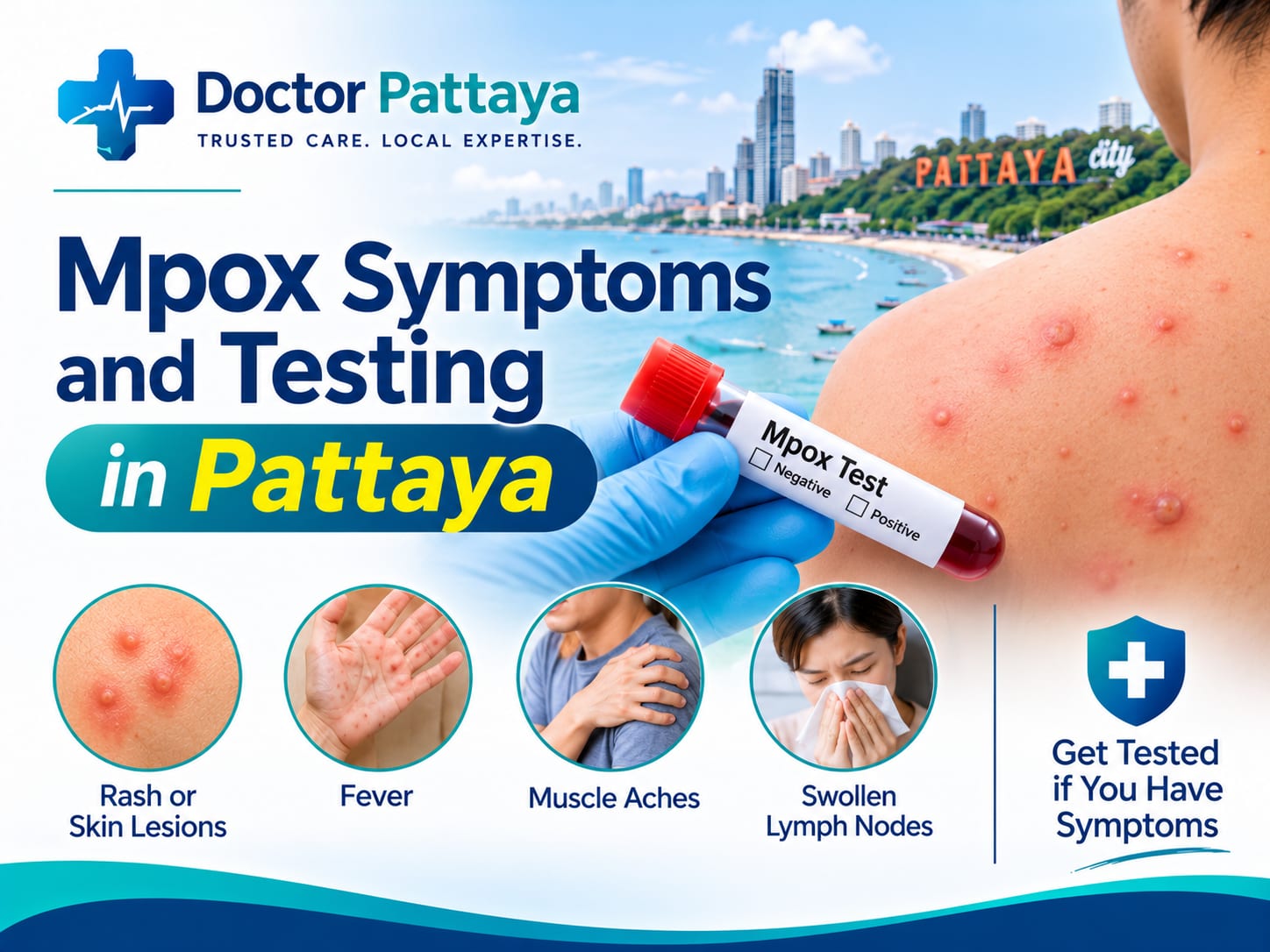
Mpox spreads through close skin-to-skin contact and causes fever, swollen lymph nodes, and a distinctive blister-like rash. Thailand has confirmed mpox cases including the country’s first known clade Ib case in 2024. If you have a new rash or unexplained blisters, get a PCR swab test. Do not wait for it to resolve on its own.
You wake up on day three of your Pattaya trip with a rash you cannot explain. A few blisters near the groin or on your face. Fever last night. Lymph nodes that feel tender and swollen. You are searching symptoms at 7am and hoping it is just heat rash or an insect bite from the beach. It might be. But if there is any chance it is mpox, you want to know now.
Mpox is present in Thailand and cases have been confirmed in Chon Buri province, which is the province Pattaya sits inside. Getting tested is straightforward and does not have to derail your trip. Here is what to look for, how to get tested, and what to do next.

How Mpox Spreads
Mpox spreads mainly through direct skin-to-skin contact with an infected person’s lesions, rash, or scabs. It also spreads through prolonged face-to-face exposure to respiratory droplets, and through contact with contaminated bedding or clothing.
Sexual contact is a common route of transmission but not the only one. Mpox is not exclusively a sexually transmitted infection. Anyone who has close physical contact with an infected person can catch it.
Thailand’s national surveillance has been active since the country confirmed its first known clade Ib case in August 2024, when a case was identified in Bangkok. Cases have been reported across Thailand, and Pattaya, as a high-traffic destination in the region, is not insulated from that risk. Clade Ib is a subvariant that prompted surveillance upgrades across Southeast Asia. Pattaya sits inside Chon Buri, so this is local, not distant news.
Early Symptoms and Rash Stages
The illness usually starts with fever, headache, muscle aches, and swollen lymph nodes, including in the groin. This phase before the rash appears lasts roughly one to five days according to WHO guidance.
The rash follows. It typically starts as flat red spots, then raises and fills with clear fluid, then turns to pustules filled with pus, before crusting over and scabbing. All lesions on the body tend to be at the same stage at the same time. That uniform progression is one of the features that distinguishes mpox from other viral rashes.
Swollen lymph nodes are a strong clue. Herpes and chickenpox rarely cause the same degree of lymph node swelling. You remain contagious until every scab has fully separated and new skin has formed underneath.
Mpox Versus Herpes or Syphilis
All three can cause sores or blisters in the genital area, and all three are worth testing for. The differences matter clinically but are not always obvious to the naked eye.
Mpox lesions tend to be deep and round, with a small central dip. They appear on the face, palms, and soles as well as the genitals. Herpes tends to cause shallow clustered blisters in one localised area. Syphilis causes a painless ulcer, usually solitary with a firm edge.
Co-infection is possible. Having mpox does not rule out herpes, syphilis, or another STI. That is why a full sexual health screen alongside mpox testing makes sense. You can book a combined panel through our sexual health services page.

PCR Testing for Mpox in Pattaya
The only way to confirm mpox is a PCR test from a lesion swab. A swab is taken directly from an active blister or pustule and sent to a certified laboratory. Blood tests alone cannot confirm mpox.
Doctor Pattaya offers walk-in mpox PCR testing around the clock. No appointment is needed. If you have an active rash, come in and we will assess it the same visit.
Results take a few days depending on lab processing. We contact you as soon as they are back. If you are staying in Jomtien or anywhere across South Pattaya, you do not need to travel far. A doctor in South Pattaya is available 24 hours, or we can arrange a hotel visit if you are too unwell to come in.
The Department of Disease Control Thailand requires confirmed cases to be reported. Our clinic handles that process on your behalf. You will not need to navigate the paperwork yourself.
Isolation and Recovery
If you test positive, you need to isolate until all your lesions have fully crusted over and the scabs have separated. That is the point at which you stop being contagious. There is no fixed number of days that applies to everyone. It depends on how your rash progresses.
Stay in your accommodation. Avoid physical contact with others, including travel companions. Use separate towels and bedding. Wash hands frequently.
Mild mpox does not require antiviral treatment in most cases. Symptom management, rest, and keeping lesions clean is the standard approach for uncomplicated illness. If you develop difficulty breathing, eye involvement, or signs of secondary skin infection, come back in or call us straight away. Those are not wait-and-see situations.
Doctor Pattaya can provide a medical certificate for travel insurance purposes and advise on fit-to-fly timing once you have cleared the infectious period.
Vaccine After Exposure to Mpox
If you have been exposed to a confirmed mpox case, there is a vaccine option. The JYNNEOS vaccine, also known as MVA-BN, is licensed for both pre-exposure vaccination in higher-risk individuals and post-exposure use.
For post-exposure use, the vaccine is most effective when given within four days of exposure. It can still be given up to 14 days after exposure and may reduce severity even if it does not prevent infection entirely. After 14 days, the evidence for post-exposure benefit is weaker. Clinicians may still consider vaccination on a case-by-case basis depending on ongoing exposure risk and immune status.
Vaccine availability in Thailand can vary. Contact Doctor Pattaya directly to check current stock before coming in. If you are in a higher-risk group, including men who have sex with men with multiple partners, pre-exposure vaccination is worth discussing at any visit. Our STI laboratory testing service can run alongside a vaccine consultation in the same appointment.
Worried about a rash, blisters, or possible mpox exposure in Pattaya? Doctor Pattaya is open 24 hours, seven days a week. Walk in any time for same-day mpox PCR testing, rash assessment, and post-exposure vaccine advice. We also offer hotel visits across Pattaya, Jomtien, and Naklua if you cannot get to the clinic. No appointment needed.
Frequently Asked Questions
References
- World Health Organization. Mpox (monkeypox): fact sheet. Updated 2024.
- Centers for Disease Control and Prevention. Clinical signs and symptoms of mpox. Reviewed 2024.
- Centers for Disease Control and Prevention. Vaccine considerations for mpox. Reviewed 2024.
- Bloomberg News. Thailand confirms Asia’s first case of new mpox virus strain. 22 August 2024.
- Association of Public Health Laboratories. Thailand reports its first clade I mpox cluster: how public health partnerships worked to identify the cases. 2025.
- European Medicines Agency. Imvanex (MVA-BN): product information. Updated 2024.
The information in this article is for educational purposes only and does not constitute medical advice. It should not be used to self-diagnose or replace a consultation with a qualified physician. If you have concerns about your health, contact a licensed medical professional. For appointments at Doctor Pattaya, visit doctorpattaya.com.

Dr. Pipat Finn is the senior doctor at Doctor Pattaya Takecare Clinic, a 24/7 walk-in medical practice on South Pattaya Road, Chonburi, Thailand. They provide primary care, travel medicine, sexual health, vaccination, minor surgery, IV therapy, and emergency outpatient services for tourists, expatriates, and Pattaya residents. Languages: English and Thai. WhatsApp consultations: +66 95 073 5550. Call: +66 81 668 5557.