
Clinically reviewed by Dr. Pipat Finn, M.D., Senior Doctor, Doctor Pattaya.
Last reviewed: November 2026
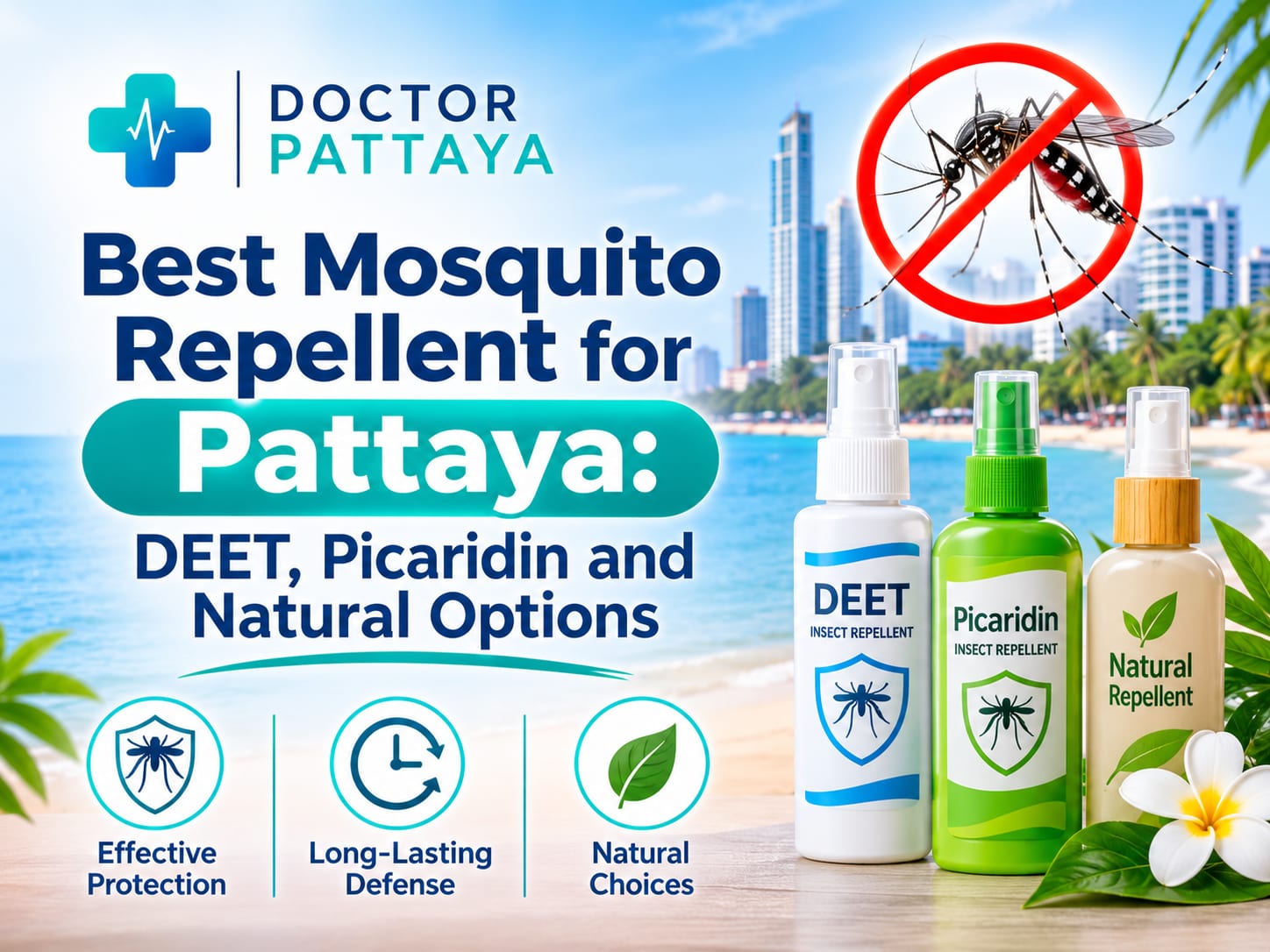
For Thailand’s tropical climate, DEET (20 to 30 percent concentration) or picaridin (20 percent) gives the most reliable protection against dengue-transmitting mosquitoes. Both are proven active ingredients. Reapply after swimming, heavy sweating, or every few hours in high humidity. Natural repellents offer limited protection and are not recommended as your sole defence in a dengue-endemic area.
You packed sunscreen. You packed after-sun. Repellent? Maybe, or maybe you figured you would grab something at a Pattaya pharmacy once you landed. That plan works, with a few things worth knowing before you walk into Boots or Watsons on Second Road.
Dengue is real in Chonburi province, and the mosquitoes that carry it bite during the day, not just at night. The right repellent, used correctly, makes a genuine difference. This guide covers what actually works, what you will find on local shelves, and when a bite needs more than antihistamine cream.

When Mosquitoes Bite Most in Pattaya
The mosquitoes you need to worry about most are Aedes aegypti and the tiger mosquito, Aedes albopictus. Both are day biters. Peak activity is in the two hours after sunrise and the two hours before sunset, though they bite throughout the day in shade, humidity, and anywhere with standing water nearby.
Pattaya’s rainy season runs roughly May to October. That is when mosquito populations peak and dengue transmission risk rises. Dengue is endemic here year-round, though, so if you are an expat or a long-stay visitor, the dry months do not mean no risk.
The coastal strip of South Pattaya, Jomtien, and Pratumnak sits at lower elevation with plenty of pooled water and vegetation after rain. If you are spending time at a beach bar, a garden restaurant, or a resort pool at dusk, you are in prime Aedes territory.
Night-biting Anopheles mosquitoes, the malaria vector, are more of a concern in rural, forested areas well outside central Pattaya. Urban Pattaya is not considered a malaria-risk zone under current Thai Ministry of Public Health guidance.
Repellent Ingredients Compared for Thailand
DEET is the most studied active ingredient available. Products at 20 to 30 percent concentration give several hours of protection in tropical conditions. Apply it to exposed skin, avoid the eye area and broken skin, and wash it off when you are indoors for the evening.
Picaridin, also labelled icaridin, works as well as DEET at equivalent concentrations and is gentler on plastics and synthetic fabrics. That matters when you are wearing a swimsuit or handling sunglasses. At 20 percent concentration, protection duration is comparable to mid-range DEET. The WHO recommends both DEET and picaridin for dengue-endemic regions.
IR3535 is a third synthetic option sold under various brand names. It is effective and well-tolerated on skin, though the evidence base is smaller than for DEET and picaridin. It offers meaningful protection but is not the first recommendation in a high-risk dengue setting.
One practical rule for the Pattaya climate: humidity and sweat reduce how long any repellent lasts on your skin. The duration on the product label assumes standard conditions. After a beach session, a 40-degree poolside afternoon, or an outdoor dinner, treat the clock as reset and reapply as soon as you are dry.
If you are using sunscreen as well, apply it first. Let it absorb for a few minutes, then apply repellent over the top. Applying in the reverse order reduces how well the sunscreen works. Avoid combination sunscreen-repellent products: they require different reapplication frequencies and the combination compromises both.
Safe Choices for Children and Pregnancy
DEET is considered safe for children over two months of age at concentrations up to 30 percent, according to current CDC guidance. Apply it for them: children should not handle the product themselves. Keep it away from their hands, as children touch their faces. Avoid applying it to cuts or irritated skin.
For children under three years, avoid oil of lemon eucalyptus (OLE) entirely. The age floor for OLE is three years. Do not confuse it with plain lemon eucalyptus essential oil, which is a different product and has no meaningful repellent evidence.
During pregnancy, picaridin is a reasonable first choice. DEET has been used in pregnancy and no harm has been shown in available studies, but the evidence base is more limited than for the general population. Natural alternatives like citronella provide insufficient protection in a dengue-endemic area and should not replace a proven repellent during pregnancy.

Brands Found in Thai Pharmacies
Boots and Watsons in central Pattaya and around Jomtien typically stock repellents, but concentrations vary. What you usually find: OFF! spray at around 15 percent DEET, Sketolene at similar concentrations, and citronella-based products marketed for children.
Products with 20 to 30 percent DEET or 20 percent picaridin are harder to source locally. If you need reliable higher-concentration repellent, bring it from home or order it before you arrive. If you are already here and need advice on what is available, the team at Doctor Pattaya can point you in the right direction during a consultation.
For gear protection, permethrin is a separate product you apply to clothing, hats, and mosquito nets, not to skin. It binds to fabric and remains effective through several washes. It is particularly useful for expats spending time outdoors around Naklua, the outer Jomtien area, or anywhere with significant vegetation. Permethrin-treated clothing adds meaningful protection on top of skin-applied repellent, though it is not widely stocked in central Pattaya pharmacies.
Applying Mosquito Repellent Correctly in Thailand’s Climate
Spray or pump products are easier to apply evenly than sticks. Cover all exposed skin: arms, legs, neck, and ears. The feet and ankles are often missed and are a common bite site, especially at outdoor restaurants and beach bars.
After swimming at Jomtien or at a resort pool, your repellent is gone. Apply it immediately after you dry off. Even water-resistant formulas do not hold through full immersion. DEET can also degrade synthetic swimwear fabric over repeated use, so picaridin is the more practical choice if you are spending most of your time in and out of water.
If you are moving between air-conditioned venues and open-air areas, the transition is where you are most exposed. The mosquitoes at a beachfront bar at dusk are real. The ones in your hotel room with the air conditioning running are not. Adjust your use accordingly.
What to Do If You Still Get Bitten in Pattaya
Most bites cause localised itching and mild swelling that settles within a day or two. Antihistamine cream or oral antihistamine helps with itch. Avoid scratching: the skin barrier breaks down quickly in tropical humidity, and an open scratch can progress to a skin infection faster here than in a cooler climate.
Watch for expanding redness, warmth, and swelling around a bite site over 24 to 48 hours. That pattern can suggest cellulitis, a bacterial skin infection that needs antibiotic treatment. Left too long, it spreads. Doctor Pattaya can assess and treat this the same day, walk-ins welcome.
The other thing to watch for is fever starting within two weeks of a bite. Dengue typically brings high fever, headache, pain behind the eyes, and muscle or joint pain. A rash can follow a few days in. If that combination shows up, do not wait to see if it passes. Come in for a dengue blood test at Doctor Pattaya’s 24/7 clinic. Early assessment matters.
If you need insect bite treatment in Pattaya, the clinic handles everything from infected bites to allergic reactions, and you can walk in without an appointment any time of day or night. For a fever after time outdoors, the fever treatment and dengue testing page has more detail on what to expect. If a bite has become inflamed and spreading, cellulitis treatment in Pattaya covers what that assessment involves.
Bitten and not sure if it is infected? Running a fever after spending time outdoors in Pattaya or Jomtien? Doctor Pattaya is open 24/7, no appointment needed. We see walk-ins for insect bite assessment, dengue testing, cellulitis treatment, and allergic reactions. Hotel visits are available across Pattaya, Jomtien, and Naklua. Come in, or call us and we will come to you.
Frequently Asked Questions
References
- World Health Organization. Dengue and severe dengue. WHO Fact Sheet, 2024.
- Centers for Disease Control and Prevention. Avoid Bug Bites. Travelers’ Health, 2024.
- Fradin MS, Day JF. Comparative efficacy of insect repellents against mosquito bites. New England Journal of Medicine. 2002;347(1):13-18.
- U.S. Environmental Protection Agency. Using Insect Repellents Safely and Effectively. EPA, 2023.
The information in this article is for educational purposes only and does not constitute medical advice. It should not be used to self-diagnose or replace a consultation with a qualified physician. If you have concerns about your health, contact a licensed medical professional. For appointments at Doctor Pattaya, visit doctorpattaya.com.

Dr. Pipat Finn is the senior doctor at Doctor Pattaya Takecare Clinic, a 24/7 walk-in medical practice on South Pattaya Road, Chonburi, Thailand. They provide primary care, travel medicine, sexual health, vaccination, minor surgery, IV therapy, and emergency outpatient services for tourists, expatriates, and Pattaya residents. Languages: English and Thai. WhatsApp consultations: +66 95 073 5550. Call: +66 81 668 5557.