Clinically reviewed by Dr. Pipat Finn, M.D., Senior Doctor, Doctor Pattaya.
Last reviewed: October 2026
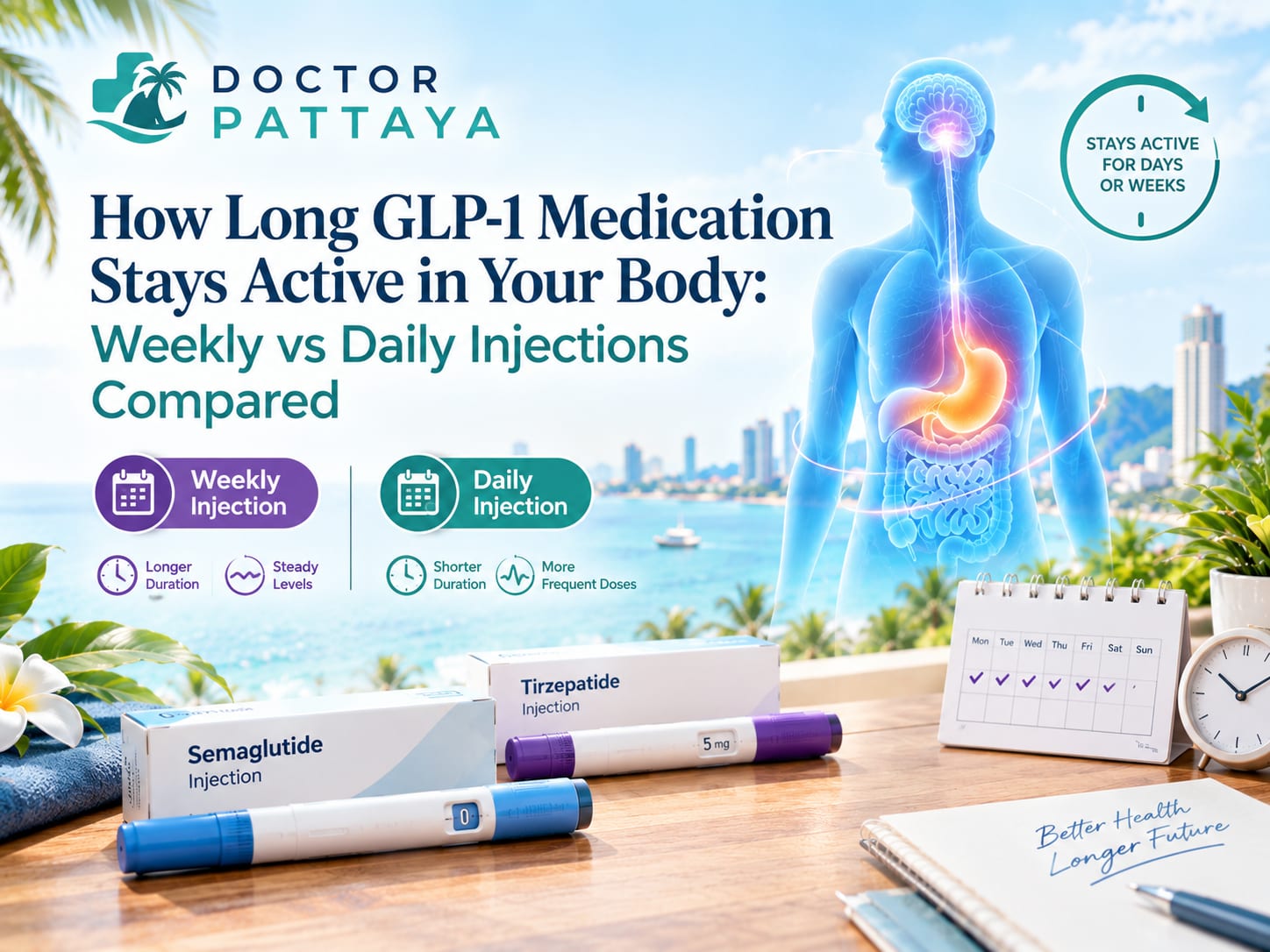
Weekly GLP-1 injections like semaglutide (Ozempic, Wegovy) have an elimination half-life of approximately seven days, meaning the drug takes around five weeks to clear your system entirely. Daily injections like liraglutide (Saxenda) have a much shorter half-life of roughly 13 hours. Tirzepatide (Mounjaro) sits between them at around five days. How long GLP-1 medication lasts in the body determines your dosing schedule, what happens if you miss a dose, and how long the drug continues working after you stop.
Your GLP-1 pen is sitting on the kitchen counter back home. You are three days into a stay near Pratumnak and just realised it. Or you are a long-term expat in Naklua whose prescription ran out last week. Either way, you want the same answer: how long does this medication actually stay in my body, and what happens now?
The answer depends entirely on which drug you are taking. A weekly injection like semaglutide behaves very differently from a daily one like liraglutide. That difference shapes your dosing window, what to do if you miss an injection, and what to expect when you stop. Here is the plain-language version.

Why Your Body’s Own GLP-1 Disappears in Minutes
Your body already makes a hormone called GLP-1. It is released from your gut after eating, signals your pancreas to release insulin, slows digestion so you feel full, and reduces appetite. The problem is that an enzyme called DPP-4 breaks it down within about two minutes.
That window is too short to do much. GLP-1 medications are engineered specifically to survive that enzyme and stay active long enough to have a real effect. Different drugs achieved this in different ways, which is why their durations vary so dramatically.
How Long Each GLP-1 Medication Stays Active in Your Body
| Medication | Brand name(s) | Dosing | Elimination half-life | Approximate time to clear system |
|---|---|---|---|---|
| Semaglutide | Ozempic, Wegovy | Once weekly | ~7 days | ~5 weeks |
| Tirzepatide | Mounjaro, Zepbound | Once weekly | ~5 days | ~4 weeks |
| Liraglutide | Saxenda, Victoza | Once daily | ~13 hours | ~3 days |
| Exenatide | Byetta | Twice daily | ~2.4 hours | ~1 day |
The half-life tells you how long it takes for the drug concentration in your blood to fall by half. After five half-lives, the drug is largely gone. Semaglutide, at seven days, takes roughly five weeks to clear. Liraglutide, at 13 hours, is out of your system in a few days.
Semaglutide stays active so long because it is chemically attached to a fatty acid that binds to albumin, a protein in your blood. That binding protects it from the DPP-4 enzyme and from clearance by your kidneys. Tirzepatide uses a similar approach and also targets a second receptor called GIP, which is why it is often called a dual agonist. Its duration profile is comparable to semaglutide.
Victoza and Saxenda are the same molecule, liraglutide, at different doses. Victoza is used for type 2 diabetes, Saxenda for weight management. Both require daily injections because the short half-life cannot sustain once-weekly dosing. Saxenda is used in Thailand, so if you are on daily liraglutide and passing through Pattaya, the logistics around a missed dose are very different from someone on a weekly pen.

What Steady State Means and Why Results Take Weeks
When you start a weekly GLP-1, each dose adds to what is still in your system from the previous week. Over four to five weeks this builds to a stable plateau called steady state, when drug levels for that dose stop climbing.
This matters because some patients judge the medication by week one or two, before it has reached that level. Appetite suppression in the first week is real but partial. By week four or five at a given dose, drug levels have levelled off. Weight loss itself builds more slowly, over months. Dose titration follows the same logic: you stay at each step for several weeks before moving up, giving your body time to stabilise and your doctor time to assess tolerance.
What Happens When You Stop Taking GLP-1 Medication
There are no withdrawal symptoms. GLP-1 medications are not physically addictive. Stopping is not usually dangerous. But if you take a GLP-1 for type 2 diabetes, your blood sugar can rise, so talk to your doctor first.
What does happen is a gradual return to your baseline as the drug clears. For semaglutide, the washout period is roughly five weeks. During that time, appetite suppression fades, gastric emptying returns to normal, and glucose regulation shifts back toward wherever your baseline was before treatment. Weight regain after stopping is common and can be significant. In one major trial, people regained about two thirds of the weight they had lost within a year of stopping. This is a conversation to have with your doctor before you stop, not after.
If you are having any surgery or procedure in Thailand, tell the surgical team and the anaesthesiologist that you are on a GLP-1 medication. These drugs slow gastric emptying, which can increase the risk of aspiration during general anaesthesia. Since 2024, guidance from several medical societies, led by the American Society of Anesthesiologists, says most people can keep taking GLP-1 medications before elective surgery. Some higher-risk patients may be asked to follow a liquid-only diet for 24 hours beforehand. Your team will decide what is right for you, so raise it at your pre-op consultation, not the morning of surgery.
What To Do If You Miss a Dose While Travelling
You are staying near Jomtien Beach, your injection day came and went, and the pen is either back home or ran out before the trip ended.
For semaglutide (Ozempic or Wegovy), the prescribing information states that if fewer than five days have passed since your scheduled injection, take the missed dose and return to your normal weekly schedule. If more than five days have passed, skip it and resume on your next scheduled day. Never take two doses at once.
For tirzepatide (Mounjaro), the window is four days. Same rule: take the missed dose if you are within four days, skip it if you are not.
A single missed dose will not undo your progress. Given the seven-day half-life of semaglutide, some therapeutic activity is still present well past your injection day. What you may notice is appetite beginning to return gradually as drug levels fall.
If you have missed two or more consecutive doses, or if there has been a gap of two weeks or more in treatment, you may need to re-titrate. That means restarting at a lower dose rather than picking up where you left off. Re-titration reduces the risk of nausea and other side effects when restarting after a gap. A brief clinical review before restarting is the right approach, and Doctor Pattaya can help with that whether you are staying in South Pattaya, near Jomtien, or anywhere in between.
Getting GLP-1 Medication in Pattaya
GLP-1 injections are prescription medicines. It is safest to have a doctor here review your treatment before you continue. That applies to tourists, long-term expats, and residents equally.
The doctor reviews your history, current medication, any recent blood results if you have them, and assesses whether continuing or starting treatment is appropriate. If it is, the doctor will talk you through your options. GLP-1 medicines are not for everyone. Do not use them if you or a close family member has had medullary thyroid cancer or MEN 2, if you are pregnant, or if you have had a serious allergic reaction to the drug. See a doctor urgently for severe stomach pain that will not go away, with or without vomiting, signs of an allergic reaction, or signs of dehydration such as passing very little urine.
If you are already on a GLP-1 program and simply need to continue while you are here, bring your packaging or documentation showing your current dose. That makes the consultation faster and ensures you get the right dose, not a starter dose when you have been titrating for months.
Walk-ins are welcome. If you are staying somewhere between Naklua and Jomtien and cannot easily get to the clinic, a doctor hotel visit is also available. For a full overview of what the program involves, the GLP-1 service page covers the process for patients who are new to treatment in Thailand.
On a GLP-1 program and travelling through Pattaya? Or thinking about starting? Doctor Pattaya is open 24/7, and walk-ins are welcome. If you have missed a dose, are unsure whether you need to re-titrate, or want to get started safely, come in or book a hotel visit. Hotel visits are available across Pattaya, Jomtien, and Naklua.
FAQ
References
- US National Library of Medicine, DailyMed. Ozempic (semaglutide) injection prescribing information. Novo Nordisk.
- European Medicines Agency. Mounjaro (tirzepatide) EPAR product information. EMA.
- US Food and Drug Administration. Saxenda (liraglutide) injection prescribing information. Novo Nordisk, 2023.
- American Society of Anesthesiologists. Most patients can continue diabetes, weight loss GLP-1 drugs before surgery: new multi-society clinical practice guidance released. ASA, 2024.
- Kindel TL, et al. Multisociety clinical practice guidance for the safe use of glucagon-like peptide-1 receptor agonists in the perioperative period. Surgery for Obesity and Related Diseases, 2024.00794-9/fulltext)
- Wilding JPH, et al. Weight regain and cardiometabolic effects after withdrawal of semaglutide: The STEP 1 trial extension. Diabetes, Obesity and Metabolism, 2022.
The information in this article is for educational purposes only and does not constitute medical advice. It should not be used to self-diagnose or replace a consultation with a qualified physician. If you have concerns about your health, contact a licensed medical professional. For appointments at Doctor Pattaya, visit doctorpattaya.com.

Dr. Pipat Finn is the senior doctor at Doctor Pattaya Takecare Clinic, a 24/7 walk-in medical practice on South Pattaya Road, Chonburi, Thailand. They provide primary care, travel medicine, sexual health, vaccination, minor surgery, IV therapy, and emergency outpatient services for tourists, expatriates, and Pattaya residents. Languages: English and Thai. WhatsApp consultations: +66 95 073 5550. Call: +66 81 668 5557.