
Clinically reviewed by Dr. Pipat Finn, M.D., Senior Doctor, Doctor Pattaya.
Last reviewed: November 2026
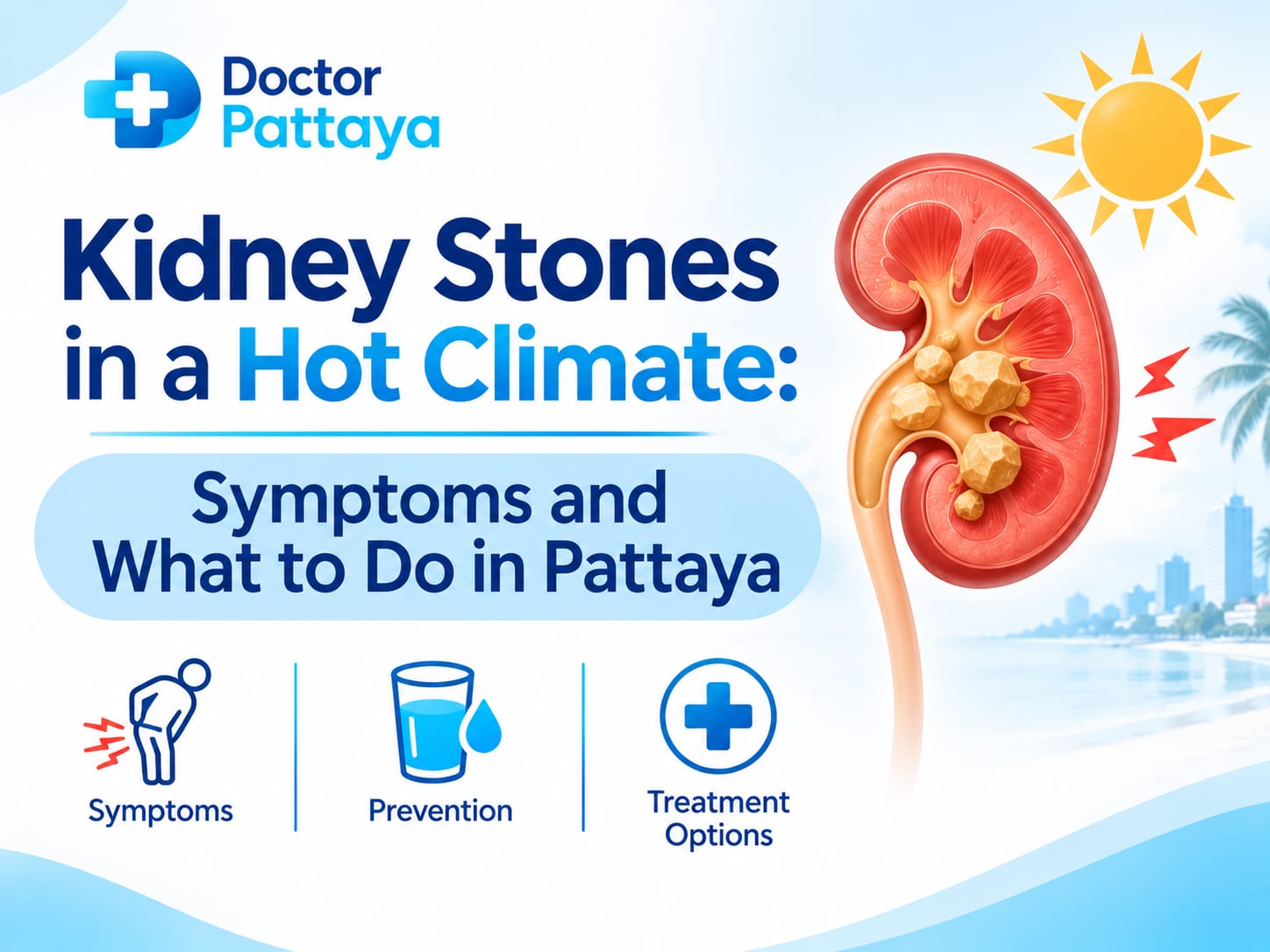
Hot weather makes kidney stones more likely by concentrating your urine. The main symptom is a severe, wave-like pain below your ribs on one side, often moving toward your groin, sometimes with blood in your urine or vomiting. Most small stones pass on their own with good hydration and pain relief. If you have fever on top of the pain, that changes things: get seen the same day.
You woke up at 3 a.m. with a pain you have never felt before. It is coming in waves, sitting just below your right ribs, and nothing you do makes it better. You have been out in the heat all day, maybe had a few drinks, and you are wondering if something is seriously wrong. That pain could well be a kidney stone, and in Pattaya’s heat, they are not uncommon.
The good news is that most kidney stones do not need surgery. What they do need is a quick diagnosis to rule out anything serious, some proper pain relief, and a clear plan for the next few days. Here is what you need to know.

Why Kidney Stone Symptoms Get Worse in Hot Weather
When you sweat heavily on a full day at Jomtien or Pratumnak Hill, your body pulls water from wherever it can, including your kidneys. Your urine becomes more concentrated. When it gets concentrated enough, minerals like calcium and oxalate stop dissolving properly and start forming crystals. Those crystals can build into a stone over days or weeks.
Pattaya’s heat index regularly sits above 35 degrees Celsius, and it climbs further on a beach day with sun reflecting off the water. Dark yellow urine is the first warning sign. If you are barely urinating at all, your body is already at a level that encourages stone formation.
The tricky part is that stones often form before you feel anything. You can be dehydrated for days, then one morning a small crystal shifts into the tube connecting your kidney to your bladder, and the pain starts immediately.
What a Stone Attack Usually Feels Like
The pain of a kidney stone, known as renal colic, is distinct. It comes in waves. It sits in your flank, the area between your ribs and your hip, and it often moves toward your groin or genitals as the stone travels downward. That wave-like pattern is one of the clearest signs you are dealing with a stone rather than something else.
Most people also feel nauseated. Some vomit. You may notice blood in your urine, which can look pink, red, or dark brown. Blood in the urine from a stone looks alarming, but it does not on its own mean the situation is dangerous. What matters more is whether you also have a fever.
You might feel the urge to urinate frequently, even if very little comes out. This tends to happen when the stone sits low in the tube running from kidney to bladder.
How This Differs From a UTI or Ordinary Back Pain
Muscle strain from a long flight or a beach session usually worsens with specific movements. You can often find a sore spot by pressing along your spine. It does not cause blood in your urine and it does not come in waves.
A urinary tract infection causes burning or stinging when you urinate, with frequent urgency. The flank pain from a UTI is usually a dull ache rather than severe cramping. That said, infections and stones can occur together, which is exactly why a urine test matters rather than guessing from symptoms alone. If a UTI seems more likely, our page on urinary tract infection treatment in Pattaya has more detail.
Stone pain does not change much with posture. You cannot lie still and get comfortable. That restlessness is a classic feature that separates renal colic from most other causes of back and flank pain.

What You Can Do While You Arrange to Be Seen
Drink water steadily, not all at once. Flooding your system in one go does not help more than consistent intake. Aim for pale yellow urine as your guide. If you are struggling to keep fluids down because of nausea, that is a reason to come in sooner rather than later, since IV fluids can help.
Over-the-counter anti-inflammatory pain relief can take the edge off renal colic and is usually the first thing we reach for in clinic as well. If you have a history of stomach problems, kidney disease, or you are taking blood thinners, check before using them. Do not take more than the label recommends.
There is a class of prescription medication called alpha blockers that can help relax the ureter and make it easier for a stone to pass. Current guidelines support their use mainly for larger stones lodged in the lower part of the ureter, so a doctor will advise whether they are likely to help in your case. These are something a doctor would prescribe at your first visit. This is not a home remedy, but it is worth knowing that there are options beyond just waiting and drinking water.
When You Need Urgent Imaging or a Hospital
Fever combined with flank pain is the combination that changes the picture entirely. It suggests the stone may be blocking a kidney that is now infected. This needs IV antibiotics and urgent urological review, not a wait-and-see approach. If you have fever and flank pain together, come straight in or go directly to a hospital emergency department.
Doctor Pattaya can carry out a bedside ultrasound to look for swelling inside the kidney when urine cannot drain properly. We can also run a urine dipstick test immediately to check for blood, infection markers, and crystals. These two tests together give us a clear enough picture to decide your next step, whether that is managing things at the clinic or referring you for a CT scan at a hospital.
A CT scan of the urinary tract is the most accurate way to confirm a stone, see exactly where it is, and measure its size. We use that to decide whether a stone is likely to pass on its own or whether a urologist needs to get involved. For straightforward cases, bedside ultrasound and a urine test is often all we need to get you on the right track.
If you have only one functioning kidney and you have flank pain with reduced urine output, that warrants urgent imaging the same day. Do not wait on this.
Preventing Your Next Stone in a Tropical Climate
If you have already had one stone, your risk of getting another is real. The most effective thing you can do in Pattaya’s heat is keep your urine consistently pale yellow throughout the day. That means drinking more than you think you need, especially on beach days, and especially if you are drinking alcohol.
Alcohol is a diuretic, meaning it increases urine output and fluid loss at the same time as sweating is already draining your reserves. It may also raise uric acid levels, a proposed risk factor for uric acid stones, though the clinical evidence linking alcohol directly to stone formation is not yet conclusive. Combined with 35-degree heat, a day that starts at the pool and ends near Walking Street can leave you significantly dehydrated by midnight. Alternating alcoholic drinks with water is genuine stone prevention in this climate, not just general wellness advice.
Thai food can be high in sodium and in oxalate-rich ingredients like spinach, nuts, and certain sauces. Oxalate is one of the main building blocks of the most common type of kidney stone. You do not need to avoid Thai food, but if you have a stone history, it is worth watching portion sizes of high-oxalate foods and keeping salt intake in check.
If you are staying in Pattaya long-term, a check-up with baseline blood and urine results makes recurrence prevention much easier. Expats near Naklua or along the Jomtien strip can walk in anytime without an appointment. Our team at Doctor Pattaya in Jomtien and Doctor Pattaya in North Pattaya are both set up for exactly this kind of follow-up.
If you are dealing with flank pain, blood in your urine, or you are not sure whether what you are feeling is a stone, a UTI, or something else, Doctor Pattaya is open 24 hours a day. We can run a urine test and bedside ultrasound during your visit and give you a clear answer the same day. Walk in anytime, or book a hotel visit if you need us to come to you across Pattaya, Jomtien, or Naklua. No appointment needed.
Frequently Asked Questions
References
- Scales CD Jr, Smith AC, Hanley JM, Saigal CS; Urologic Diseases in America Project. Prevalence of kidney stones in the United States. European Urology. 2012;62(1):160-165.
- Türk C, Neisius A, Petrik A, et al. (Skolarikos A et al. 2025 update). EAU Guidelines on Urolithiasis 2026. European Association of Urology, 2026.
- Peng Y, et al. Association between alcohol consumption and kidney stone disease: a review. PMC, 2024.
The information in this article is for educational purposes only and does not constitute medical advice. It should not be used to self-diagnose or replace a consultation with a qualified physician. If you have concerns about your health, contact a licensed medical professional. For appointments at Doctor Pattaya, visit doctorpattaya.com.

Dr. Pipat Finn is the senior doctor at Doctor Pattaya Takecare Clinic, a 24/7 walk-in medical practice on South Pattaya Road, Chonburi, Thailand. They provide primary care, travel medicine, sexual health, vaccination, minor surgery, IV therapy, and emergency outpatient services for tourists, expatriates, and Pattaya residents. Languages: English and Thai. WhatsApp consultations: +66 95 073 5550. Call: +66 81 668 5557.