
Clinically reviewed by Dr. Pipat Finn, M.D., Senior Doctor, Doctor Pattaya.
Last reviewed: November 2026
A mole should be checked if it has changed in size, shape, or colour, bleeds without injury, itches persistently, or looks clearly different from your other moles. Any one of these signs warrants a clinical assessment, not a wait-and-see approach. At Doctor Pattaya, we can assess a suspicious mole the same day, with dermoscopy and minor surgery available on-site.
You notice something on your arm at breakfast. It was not there last month, or maybe it was and now it looks different. You are three days into a Pattaya holiday, the sun has been relentless, and the last thing you wanted was a reason to Google symptoms at 7 a.m. Take a breath. Most lumps, bumps, and skin marks are completely harmless, and the ones that need attention are very treatable when caught early.
The tricky part is knowing which category yours falls into. Skin tags, ordinary warts, age spots, and moles can all look similar at a glance, especially after weeks of intense sun on the beach in Jomtien or Pratumnak. This guide helps you tell them apart, explains which changes need a doctor today rather than next month, and walks you through what to expect if you come in. UV damage moves faster in a tropical climate than most people expect, and that matters for how quickly you act.

How Skin Tags, Ordinary Warts and Moles Usually Differ
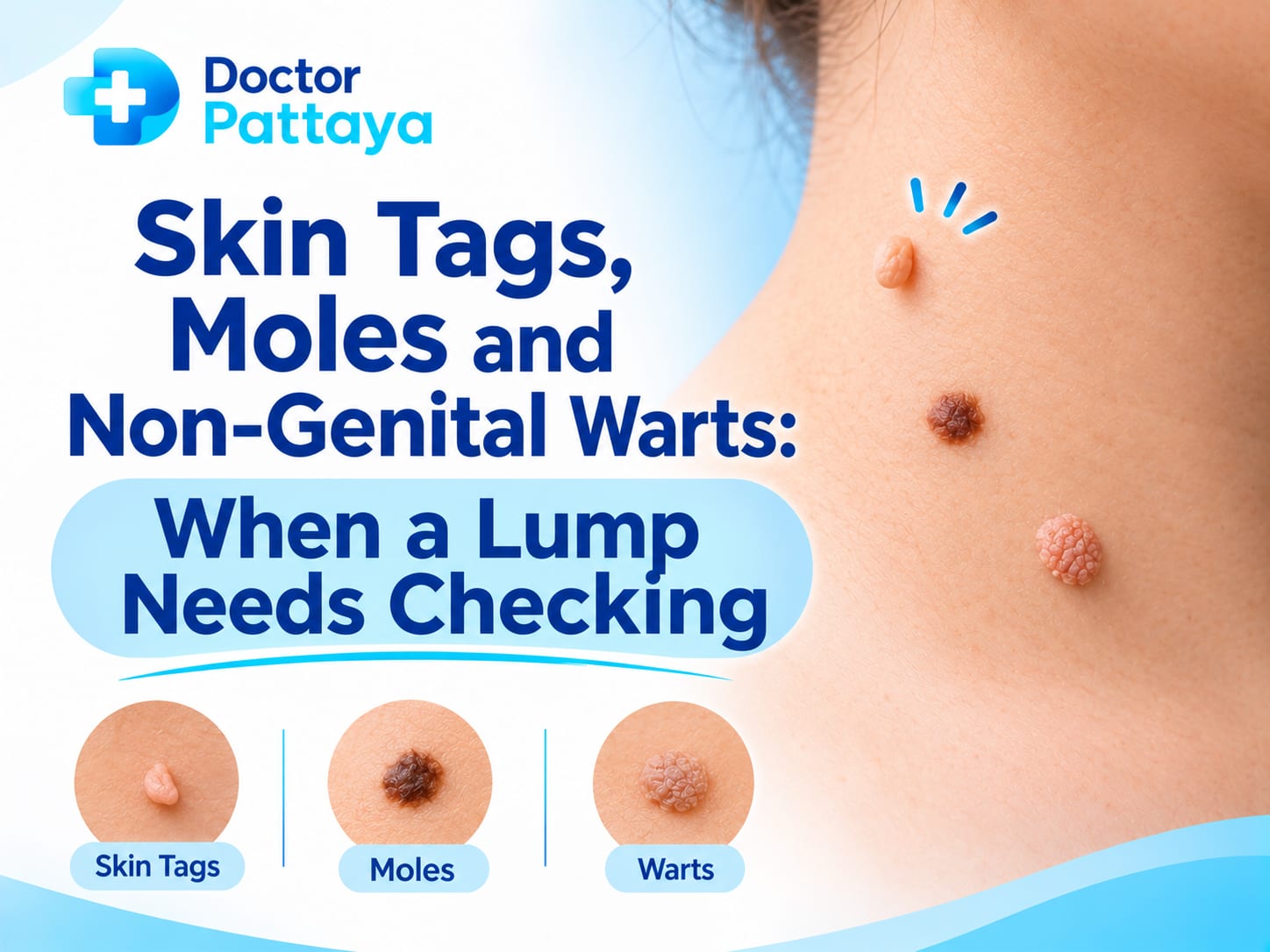
Skin tags are soft, skin-coloured, and hang off the skin on a thin stalk. They do not change, they cause no harm, and they are entirely benign. Common spots include the neck, underarms, and eyelids.
Warts on the body are caused by HPV (human papillomavirus). They tend to feel rough or bumpy and often appear on the hands, fingers, or the soles of feet. Cryotherapy, which means freezing the wart with liquid nitrogen, is one standard treatment. Salicylic acid is another. Neither works overnight.
Moles are clusters of pigmented cells. Most adults have several dozen, and the vast majority are harmless. They are, however, the lesion type most likely to develop into something that needs medical attention. Flat brown spots that appear after years in the sun, called solar lentigines, are sometimes confused with moles but are generally benign. A doctor can tell them apart quickly.
Changes in a Mole That Should Be Checked Sooner, Not Later
The UV index on the coast here regularly sits above 10, which is classified as extreme. That is higher than most of Europe or North America on a typical summer day. Skin that has taken years of this, as it does for long-term expats in Pattaya, carries a meaningfully higher risk of mole change. Tourists are not off the hook either: two weeks of intense beach exposure can cause sun damage that shows up months later.
If a mole is changing, that is the signal that matters most. Dermoscopy uses a magnified light source to examine details of a mole that are invisible to the naked eye. It is part of a standard mole assessment at Doctor Pattaya and takes only a few minutes.
One useful check is the ugly duckling sign. If one mole simply looks different from all your others, that alone is a reason to have it assessed. Some serious moles satisfy none of the standard criteria below but stand out as the odd one out in a cluster of otherwise similar marks.
Colour, Border, Size and Bleeding
The ABCDE rule is the standard clinical framework for mole assessment. Asymmetry means one half does not match the other. Border means the edge is ragged, notched, or blurred. Colour means more than one shade of brown, black, red, or white within the same mole. Diameter over 6 mm is a rough threshold, though smaller moles can still need attention. Evolving means anything that is changing: shape, size, colour, texture, or new symptoms like itching or bleeding.
Meeting even one of these criteria is enough reason to come in. Meeting two or more is a reason to come in today.
One thing worth flagging separately: a type of melanoma called acral lentiginous melanoma develops on the palms, soles of feet, or under the nails. It is the most common melanoma subtype in East Asian populations such as those in Japan, Korea, and China, and is frequently missed because patients do not think to check those areas. A new dark streak under a nail, or a pigmented patch on your palm or sole, needs a clinical eye.

When Removal Is Cosmetic and When It Is Medical
Cosmetic removal means the lesion is benign and you simply want it gone. Medical removal means the lesion has features that need investigation. The process differs.
For a clearly benign skin tag or stable mole, a simple procedure under local anaesthetic is usually all that is needed. A shave excision shaves the lesion flat rather than cutting it out entirely. It is quick, done in-clinic, and leaves a small mark that usually fades over time.
When a mole has suspicious features, it is removed with a margin of normal skin and sent for histopathology, which is laboratory examination of the tissue under a microscope. This confirms whether the cells are normal, pre-cancerous, or malignant. Minor surgery and wound care are available on-site at Doctor Pattaya, and suspicious samples go to a certified pathology lab. If you are a tourist with limited time in Pattaya, assessment and removal can often happen in the same appointment.
Do not use over-the-counter wart freeze sprays or salicylic acid on a mole. If the lesion turns out to be a melanoma, those treatments cause tissue damage and can delay an accurate diagnosis by weeks. If you are unsure what you are looking at, come in before you try anything yourself. For any other skin concerns alongside your visit, wound dressing and wound care in Pattaya is also available on-site.
Why Genital Lumps Are a Different Problem
A lump in the genital area is not a skin tag situation. It is a different clinical question and needs to be treated that way.
Genital warts are caused by specific strains of HPV. They are soft, flesh-coloured growths that can appear singly or in clusters. They look similar to other genital lesions, including molluscum contagiosum, Fordyce spots, and in rare cases early lesions from other infections. You cannot reliably tell them apart by looking.
Any genital growth should have STI screening done before any removal is attempted. This is standard clinical practice, not an overcautious one. Removing a wart without knowing your full STI status means you may be treating one problem while missing others. At Doctor Pattaya, STI laboratory testing in Pattaya is available alongside assessment, so both happen in the same visit.
Do not use over-the-counter cryotherapy on any genital growth. Tissue in that area is sensitive, the diagnosis needs confirmation first, and causing a chemical burn to an undiagnosed lesion helps nobody.
Knowing When to Check a Mole vs. When to Simply Monitor It
Not every mole needs same-day attention, but some do. Here is a practical split.
Come in today if the mole has bled without injury, has changed noticeably in a short time, is tender or itching persistently, meets two or more ABCDE criteria, or simply looks wrong compared to your other moles. These are not reasons to wait until you are back home.
A clinical check within a few days is sensible if a new mole has appeared recently, if you have not had a skin check in over a year and have spent significant time in the Pattaya sun, or if you have a spot under a nail or on your sole that you have not had looked at. For anyone spending extended time in Jomtien, Naklua, or the Pratumnak area, the minor surgery services in Pattaya page has more detail on what a mole check and same-day removal involves. Expats who have been here for years and have not had a skin check are overdue. If you are staying at a hotel and cannot easily get to the clinic, the doctor hotel visit service can come to you.
If you have a mole, skin tag, wart, or any skin growth you are unsure about, Doctor Pattaya offers same-day walk-in assessments, dermoscopic mole checks, and minor surgery at our South Pattaya clinic. We are open 24/7. No referral needed. If you are staying in Jomtien, Naklua, or Pratumnak, our doctor hotel visit service can also come to you. For genital lumps, STI screening is available in the same appointment. Walk in, or call ahead.
FAQ
References
- World Health Organization. Ultraviolet radiation and health. WHO, 2023.-radiation-and-skin-cancer)
- American Academy of Dermatology. Melanoma: signs and symptoms. AAD, 2024.
- Phan A, Touzet S, Dalle S, Ronger-Savlé S, Balme B, Thomas L. Acral lentiginous melanoma: a clinicoprognostic study of 126 cases. Br J Dermatol. 2006;155(3):561-569.
- Grob JJ, Bonerandi JJ. The ‘ugly duckling’ sign: identification of the common characteristics of nevi in an individual as a basis for melanoma screening. Arch Dermatol. 1998;134(1):103-104.
- Swetter SM, Tsao H, Bichakjian CK, et al. Guidelines of care for the management of primary cutaneous melanoma. J Am Acad Dermatol. 2019;80(1):208-250.
The information in this article is for educational purposes only and does not constitute medical advice. It should not be used to self-diagnose or replace a consultation with a qualified physician. If you have concerns about your health, contact a licensed medical professional. For appointments at Doctor Pattaya, visit doctorpattaya.com.

Dr. Pipat Finn is the senior doctor at Doctor Pattaya Takecare Clinic, a 24/7 walk-in medical practice on South Pattaya Road, Chonburi, Thailand. They provide primary care, travel medicine, sexual health, vaccination, minor surgery, IV therapy, and emergency outpatient services for tourists, expatriates, and Pattaya residents. Languages: English and Thai. WhatsApp consultations: +66 95 073 5550. Call: +66 81 668 5557.