Clinically reviewed by Dr. Pipat Finn, M.D., Senior Doctor, Doctor Pattaya.
Last reviewed: August 2026
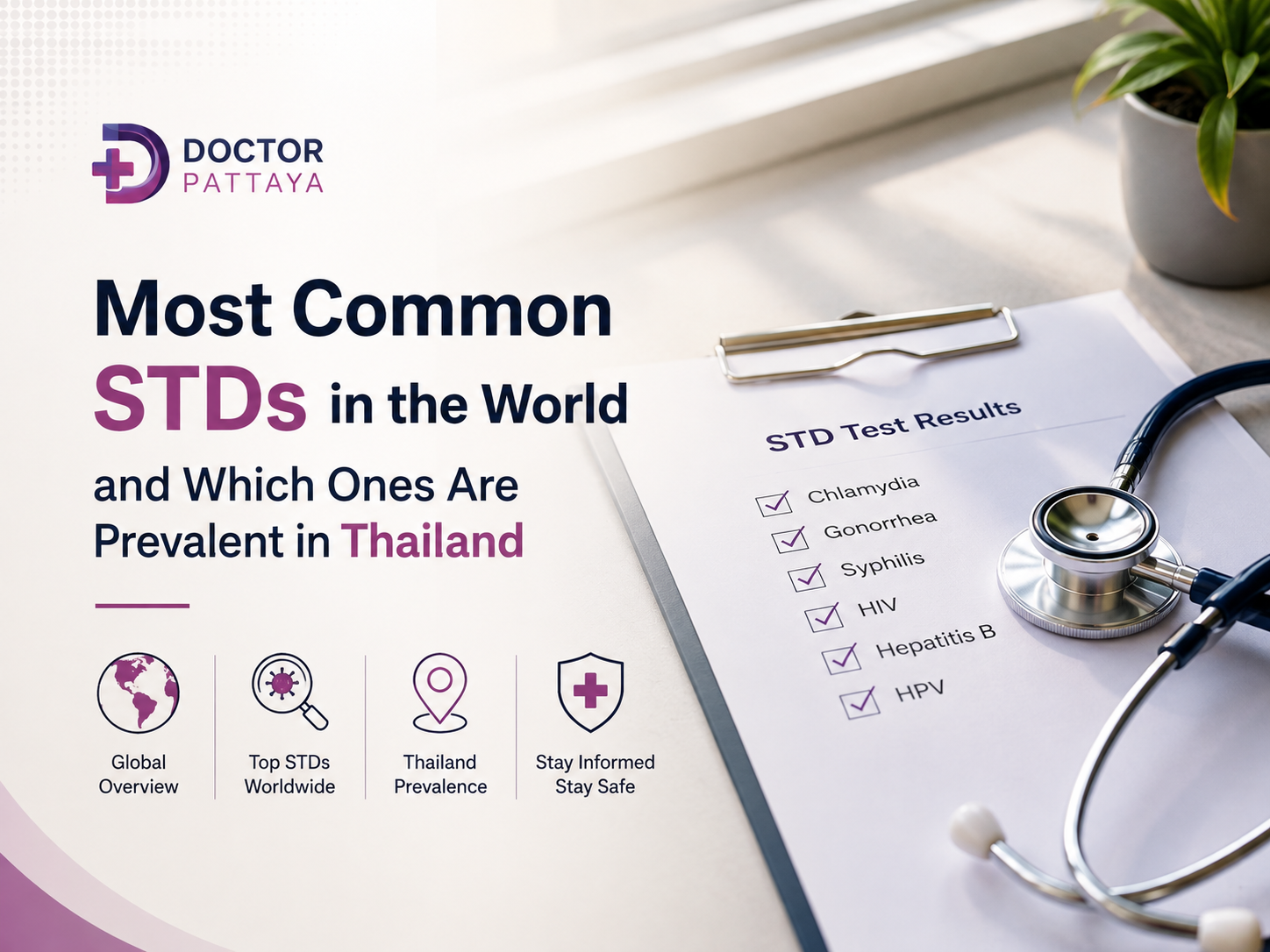
The most common STD in the world depends on how you count. Trichomoniasis has the highest number of new cases each year globally. HPV is the most widespread overall. Chlamydia is the most commonly reported bacterial infection. In Thailand, chlamydia, gonorrhea, and syphilis are all rising, and Pattaya’s nightlife environment puts some visitors at higher risk than they realise.
If you have had unprotected sex and you are now Googling symptoms from a hotel room, you are not the first person to sit in that spot. I see patients like this every week. Some come in the morning after. Some wait two weeks and hope it goes away. The ones who come in early almost always do better.
The honest answer to "what are the most common STDs" is more nuanced than most health websites make it sound. The list looks different depending on whether you are asking about global new cases, total people living with an infection, or what is actually showing up in Thai clinics right now. This article covers all of it, and tells you what to do if you are concerned.

Trichomoniasis: The Most Common Curable STD in the World
Most people have never heard of trichomoniasis. That is exactly the problem.
By new case volume, trichomoniasis is the most common curable sexually transmitted infection on the planet. The WHO estimates around 156 million new cases every year. Most people who have it feel nothing at all.
When symptoms do appear, they usually involve discharge, itching, or discomfort during sex. It is easily treated with a short course of antibiotics. Both partners need to be treated at the same time, or reinfection happens almost immediately.
HPV, Chlamydia, and the Full Global Picture
HPV, the human papillomavirus, is the most prevalent STI overall when you count everyone currently carrying the virus. Most HPV infections clear on their own. Some strains cause genital warts. Others, left undetected for years, raise the risk of certain cancers. There is no cure for HPV, but there is a vaccine, and it works well.
Chlamydia is the most commonly reported bacterial STD globally. It often causes no symptoms at all, especially in women. It can quietly damage the reproductive system over months or years if it goes untreated. A simple swab or urine test picks it up, and a course of antibiotics clears it.
Gonorrhea, syphilis, herpes, HIV, and hepatitis B round out the major infections. Each one spreads differently and needs a different response from you.

Curable vs Incurable: Why This Matters for Your Treatment
This is the framework I use with every patient who comes in after a potential exposure.
Four STDs are fully curable with the right treatment: chlamydia, gonorrhea, syphilis, and trichomoniasis. Catch them early, take the right medication, and they are gone.
Four major STDs cannot be cured but can be managed effectively: HPV, herpes, HIV, and hepatitis B. Treatment controls them, reduces symptoms, and in the case of HIV, can bring the viral load so low that transmission becomes negligible. That is not the same as harmless if ignored.
STD Symptoms You Should Not Ignore, and Some You Will Never See
The most dangerous thing about STDs is not the ones with obvious symptoms. It is the ones with none.
Chlamydia is asymptomatic in the majority of women and in a large proportion of men. Early syphilis can look like a minor skin irritation you write off as a razor nick or an insect bite. HPV may never show a single visible sign.
When symptoms do appear, watch for unusual discharge, sores or ulcers on the genitals or mouth, burning when you urinate, rashes on the palms or soles of the feet, or swollen lymph nodes in the groin. Any of these after a new or unprotected sexual encounter warrants testing. Do not wait for it to get worse.
The STD Situation in Thailand: What the Data Actually Shows
Thailand has made real progress on HIV over the past two decades. The broader STI picture is more complicated.
Syphilis has been surging, particularly among people aged 15 to 24. Gonorrhea rates have climbed steadily since 2017. Chlamydia remains the most commonly diagnosed bacterial STI at Thai clinics. HIV continues to affect a significant number of people, with new infections concentrated in certain higher-risk groups.
Pattaya is a specific environment. The combination of nightlife, high tourist turnover, and a large sex industry creates exposure risks that are genuinely higher than the national average. That is not a moral judgment. It is just the clinical reality I deal with every day. Our STD testing and treatment page has more detail on what we screen for and how.
Antibiotic-Resistant Gonorrhea in Thailand: A Growing Concern
This is something I want every patient who has had a potential gonorrhea exposure in Thailand to understand.
Gonorrhea strains in Southeast Asia have developed resistance to multiple antibiotic classes. This means the treatment that worked five years ago may not work as well today. Standard first-line antibiotics have become less reliable in this region.
If you are experiencing discharge or burning after a potential exposure, do not assume a generic antibiotic from a pharmacy will sort it out. Come in, get a proper swab, and let the clinic choose the right treatment based on current resistance patterns. Getting this wrong the first time makes it harder to treat the second time.
How Long After Exposure Should You Get Tested?
I get asked this constantly, especially by tourists who want results before they fly home.
Chlamydia and gonorrhea can be detected within one to two weeks of exposure. Syphilis usually takes three to six weeks to show up reliably on a blood test. HIV is detectable within two to four weeks using a fourth-generation test, which is what we use at Doctor Pattaya.
If you had a high-risk exposure within the last 72 hours and you are worried about HIV, that is a different conversation entirely. PEP, post-exposure prophylaxis, is a course of medication that significantly reduces the risk of HIV infection if started quickly. Come in now if that applies to you. Do not wait until morning. For ongoing protection, PrEP, taken daily before potential exposure, is also available and worth asking about if you are sexually active in Pattaya with multiple partners.
Getting Tested for the Most Common STDs in Pattaya: What to Expect
Walk-in, no appointment, no referral needed. That is how we work, and it matters when you are on holiday and time is short.
A standard STI screen covers the infections most likely to be relevant to your situation. Blood tests cover syphilis, HIV, and hepatitis B. Most results come back within one to three days. Treatment can start the same day if needed.
Everything is confidential. Nothing goes to your hotel, your travel insurer, or anyone else. Hotel visits are available across Pattaya, Jomtien, Naklua, and Pratumnak if getting to the clinic is a problem.
Co-Infections: Why Finding One STD Sometimes Means Finding Another
This is something most people do not expect when they come in.
It is not uncommon to test positive for more than one STI at the same time. Having one infection can make it easier to acquire another. Gonorrhea and chlamydia frequently appear together. Syphilis and HIV co-infection is well documented.
This is why a full panel screen is worth doing rather than testing for just the one thing you are worried about. If you come in for a gonorrhea swab and it comes back positive, I want to check everything else too. You can find out what a full screen includes on our sexual health testing page.
Concerned after a potential exposure in Pattaya? Doctor Pattaya is open 24 hours a day, 7 days a week. Walk in without an appointment for confidential STD testing, same-day treatment, and PEP if you need it within 72 hours. Doctor hotel visits are available across Pattaya, Jomtien, Naklua, and Pratumnak. Visit our STD testing and treatment page or come straight to the clinic in South Pattaya.
What is the most common STD in the world?
It depends on how you measure it. Trichomoniasis has the most new cases per year, making it the most common curable STI globally. HPV is the most prevalent overall when you include everyone currently carrying the virus. Chlamydia is the most frequently reported bacterial STD. All three are worth knowing about.
Which STDs are most common in Thailand?
Chlamydia is the most commonly diagnosed bacterial STI at Thai clinics. Syphilis is rising sharply, especially in younger adults, and gonorrhea rates have been climbing since 2017. HIV remains a significant concern in certain higher-risk groups. In Pattaya, nightlife and tourism exposure raises the risk for all of these.
Can you have an STD with no symptoms at all?
Yes, and this is one of the most important things to understand. Chlamydia is asymptomatic in the majority of cases, and trichomoniasis and HPV often cause no noticeable signs either. Testing after any new or unprotected sexual exposure matters, not just when something feels wrong.
Is gonorrhea harder to treat in Thailand than in other countries?
It can be. Gonorrhea strains in Southeast Asia have shown increasing resistance to several antibiotic classes, so a treatment that works well in Europe or the US may be less effective here. If you have had a potential exposure in Thailand, come in for a proper swab so the right antibiotic can be chosen rather than guessing.
How soon after unprotected sex should I get tested in Pattaya?
Chlamydia and gonorrhea can show up on a test within one to two weeks. Syphilis usually takes three to six weeks. HIV can be detected within two to four weeks with a fourth-generation blood test. If you are within 72 hours of a high-risk HIV exposure, come in now to discuss PEP before the window closes.
Is STD testing confidential at Doctor Pattaya?
Completely. Nothing is shared with your hotel, insurer, or anyone else without your consent. You can walk in without an appointment, get tested, and receive results and treatment privately. If you cannot get to the clinic, a doctor can come to your hotel across Pattaya, Jomtien, and Naklua.
What is the difference between PrEP and PEP for HIV?
PrEP is taken daily before potential exposure to prevent HIV infection. PEP is taken after a potential exposure and must be started within 72 hours to be effective. Both are available at Doctor Pattaya. If you think you needed PEP yesterday, come in today.

Dr. Pipat Finn is the senior doctor at Doctor Pattaya Takecare Clinic, a 24/7 walk-in medical practice on South Pattaya Road, Chonburi, Thailand. They provide primary care, travel medicine, sexual health, vaccination, minor surgery, IV therapy, and emergency outpatient services for tourists, expatriates, and Pattaya residents. Languages: English and Thai. WhatsApp consultations: +66 95 073 5550. Call: +66 81 668 5557.