Clinically reviewed by Dr. Pipat Finn, M.D., Senior Doctor, Doctor Pattaya.
Last reviewed: November 2026
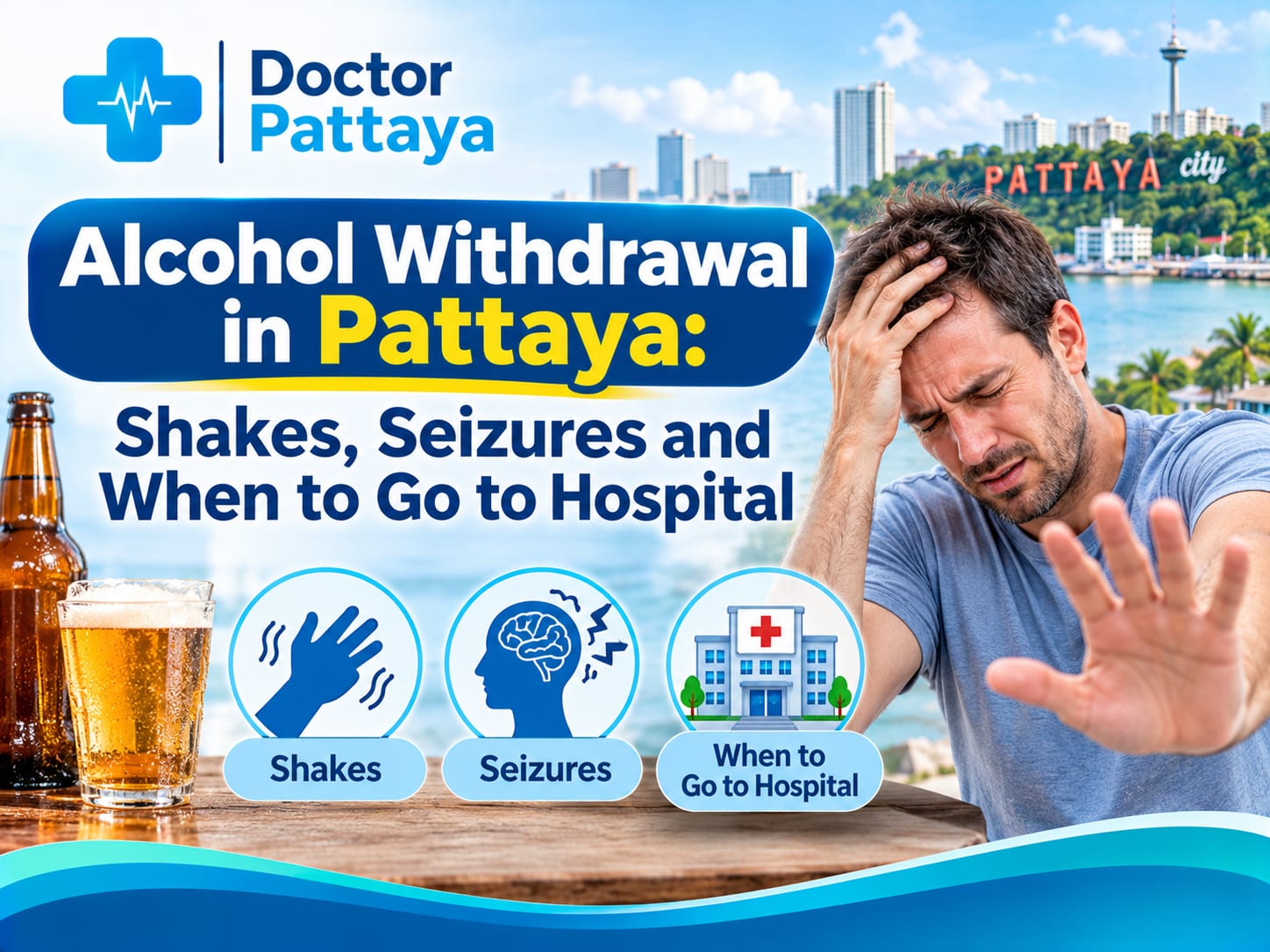
Alcohol withdrawal is not the same as a hangover. In someone who drinks heavily every day, stopping or cutting back sharply can trigger shaking, sweating, racing heart, seizures, and life-threatening confusion within hours. Symptoms typically begin within six hours of the last drink and can peak between 24 and 72 hours later. If you or someone near you is shaking hard, acting confused, or has had a seizure after stopping drinking, get medical help now.
Say you have been in Pattaya for ten days. The nights blurred together, the drinking was heavier than usual, and now you have stopped. Maybe you are flying home in two days. Maybe your body just said enough. Either way, you are lying in a hotel room in Pratumnak or along Jomtien Beach, and something feels wrong. The shaking is not going away. You are drenched in sweat. Your heart is hammering. This is not how a hangover feels.
That is the moment to take this seriously. Alcohol withdrawal can move from uncomfortable to dangerous in a matter of hours. In a hot, tropical city where dehydration already works against you, it moves faster. This guide tells you what to watch for, when to call a doctor, and what care actually looks like here in Pattaya.

How Withdrawal Is Different From a Bad Hangover
A hangover comes from one heavy night. It peaks while your blood alcohol is still dropping and fades once your body clears the alcohol, usually within 24 hours. Eating, hydrating, and resting fix it.
Withdrawal is different. It happens when someone who drinks heavily every day stops or cuts back sharply. The body has adapted to alcohol being present. When it is suddenly gone, the nervous system swings into overdrive, and that is what causes the shaking, the racing heart, and in serious cases, the seizures.
The key question is not how much you drank last night. It is how long you have been drinking heavily without a break. A tourist who had one rough night is almost certainly hungover. Someone who has been drinking all day every day for weeks or longer is at real risk of withdrawal.
Who Is Most at Risk of Severe Withdrawal
Not everyone who stops drinking will go through serious withdrawal. The risk is higher if you have been drinking heavily for a long time, if you have gone through withdrawal before, or if you have had a seizure during a previous detox. A prior episode of delirium tremens, the most severe form of withdrawal, is the strongest single predictor that it will happen again.
Other factors raise the risk: older age, liver disease, poor nutrition, and concurrent illness. Dehydration, which is easy to accumulate in Pattaya’s heat, compounds all of these. If any of these apply to you, do not try to manage this alone.

Early Alcohol Withdrawal Symptoms in the First Hours
Within six hours of the last drink, the first symptoms usually appear. Your hands shake. You sweat more than the heat explains. Your heart beats faster than normal. You feel anxious, restless, and unable to sleep even when exhausted.
These early signs reflect the nervous system running too hot. Nausea and mild headache are common too. On their own, these symptoms are uncomfortable but manageable with medical support.
The critical point is what happens next. For most people, mild symptoms peak around 24 hours and ease off. For others, they escalate.
The Withdrawal Timeline: What to Expect and When
The first six to 24 hours carry the early symptoms above. From 24 to 48 hours, seizure risk is at its highest. This is when full-body convulsions are most likely to occur, and they can cause injury or block the airway. After 48 to 72 hours, in a minority of heavy, long-term drinkers, delirium tremens can develop.
This timeline matters because people often feel they are turning a corner after the first night, then deteriorate sharply. Do not assume you are past the danger point before 72 hours have passed.
Dangerous Signs: Seizures, Confusion and Hallucinations
If you see any of the following, this is an emergency. Call for help immediately.
Seizures during withdrawal usually happen without warning. Afterward, the person may be confused, exhausted, and unable to remember what happened. Do not leave them alone.
Hallucinations can begin as early as 12 to 24 hours after the last drink. They are usually visual, things appearing to move on walls or ceilings, but can also be auditory or tactile. These are different from delirium tremens, which typically arrives later and involves full disorientation, agitation, fever, and dangerously elevated blood pressure.
One thing that is often missed: confusion during withdrawal can also point to Wernicke’s encephalopathy, a serious brain condition caused by low Vitamin B1 (thiamine). Heavy drinkers are frequently deficient in thiamine. If someone going through withdrawal becomes suddenly confused, loses coordination, or has abnormal eye movements, that combination needs urgent hospital assessment.
Low sodium, low magnesium, and low potassium are another hidden danger. These imbalances lower the seizure threshold and stress the heart. Sweating heavily in Pattaya’s heat makes all of this worse.
When to Go to Hospital for Alcohol Withdrawal
Go to the emergency room if there has been a seizure. Go if the person is confused, cannot say where they are, or is agitated and incoherent. Go if there is a high fever combined with rapid heart rate and sweating. Go if symptoms are getting worse rather than better after the first 24 hours.
For mild to moderate symptoms where the person is alert, coherent, and not deteriorating, a hotel visit from a doctor is a reasonable first step. A physician can assess severity using a clinical scoring tool called the CIWA-Ar scale, which grades withdrawal from mild to severe and guides whether home management is safe or whether hospital escalation is needed. If you are in a hotel in Jomtien, Naklua, or anywhere across Pattaya, a doctor can come to you.
The hardest call is the one you delay. Severe withdrawal carries a real mortality risk when untreated. Calling a doctor early is never the wrong decision.
What Medical Care for Alcohol Withdrawal Involves
The first-line treatment for withdrawal is benzodiazepines, a class of medication that calms the overactive nervous system, reduces seizure risk, and eases the physical symptoms. Diazepam is widely used in Thailand. The dose and route depend on severity.
Thiamine (Vitamin B1) is given routinely because thiamine deficiency is common in heavy drinkers and can cause Wernicke’s encephalopathy if not corrected. IV thiamine is preferred when someone presents in withdrawal. This is not optional: it is a standard part of safe withdrawal management.
IV fluids correct dehydration and replace lost electrolytes. For moderate to severe cases, hospital admission allows continuous monitoring, intravenous medication, and rapid response if a seizure occurs.
For mild presentations where the person is clinically stable, Doctor Pattaya can administer an initial assessment, IV fluids, and thiamine during a hotel visit, and advise on close monitoring with clear escalation triggers. This is not a substitute for hospital care in severe cases. It is a bridge that keeps someone safe while the clinical picture becomes clearer.
Alcohol and the Pattaya Context: Why Withdrawal Can Hit Hard Here
Pattaya’s holiday pattern is distinct. Some visitors drink at a level they would never sustain at home, every day for one to three weeks, in heat that accelerates dehydration, often skipping meals, sometimes mixing alcohol with other substances. That combination compresses the timeline for physical dependence.
A person who would not normally qualify as alcohol-dependent can develop significant physical reliance during a heavy holiday. If that person then stops abruptly, the same withdrawal risk applies. The tropical heat means sweating is heavier, fluids and electrolytes are lost faster, and the cardiovascular stress of withdrawal is amplified.
If you are an expat in Pattaya who drinks daily and you are thinking about stopping, do not do it cold turkey without speaking to a doctor first. A supervised, gradual reduction plan is far safer than an abrupt stop. For anything acute, 24/7 emergency care in Pattaya is available around the clock.
Need help now? If you or someone with you is shaking, sweating heavily, confused, or has had a seizure after stopping drinking, do not wait. Doctor Pattaya is open 24/7 and a doctor can visit your hotel anywhere in Pattaya, Jomtien, Naklua, or Pratumnak. We can assess withdrawal severity, give IV fluids and thiamine, prescribe medication for symptom control, and tell you clearly whether hospital care is needed. Walk in or call ahead, any hour.
Frequently Asked Questions
References
- Bayard M, McIntyre J, Hill KR, Woodside J. Alcohol withdrawal syndrome. American Family Physician. 2004;69(6):1443-1450.
- Schuckit MA. Recognition and management of withdrawal delirium (delirium tremens). New England Journal of Medicine. 2014;371(22):2109-2113.
- Latt N, Dore G. Thiamine in the treatment of Wernicke encephalopathy in patients with alcohol use disorder. Internal Medicine Journal. 2014;44(9):911-915. Australian alcohol treatment guidelines on seizures and thiamine
- National Health Service (NHS). Alcohol misuse: treatment. NHS, 2023.
- Mirijello A, D’Angelo C, Ferrulli A, et al. Identification and management of alcohol withdrawal syndrome. Drugs. 2015;75(4):353-365. Seizures in alcohol-dependent patients: epidemiology, pathophysiology and management, PubMed
The information in this article is for educational purposes only and does not constitute medical advice. It should not be used to self-diagnose or replace a consultation with a qualified physician. If you have concerns about your health, contact a licensed medical professional. For appointments at Doctor Pattaya, visit doctorpattaya.com.

Dr. Pipat Finn is the senior doctor at Doctor Pattaya Takecare Clinic, a 24/7 walk-in medical practice on South Pattaya Road, Chonburi, Thailand. They provide primary care, travel medicine, sexual health, vaccination, minor surgery, IV therapy, and emergency outpatient services for tourists, expatriates, and Pattaya residents. Languages: English and Thai. WhatsApp consultations: +66 95 073 5550. Call: +66 81 668 5557.