
Clinically reviewed by Dr. Pipat Finn, M.D., Senior Doctor, Doctor Pattaya.
Last reviewed: November 2026
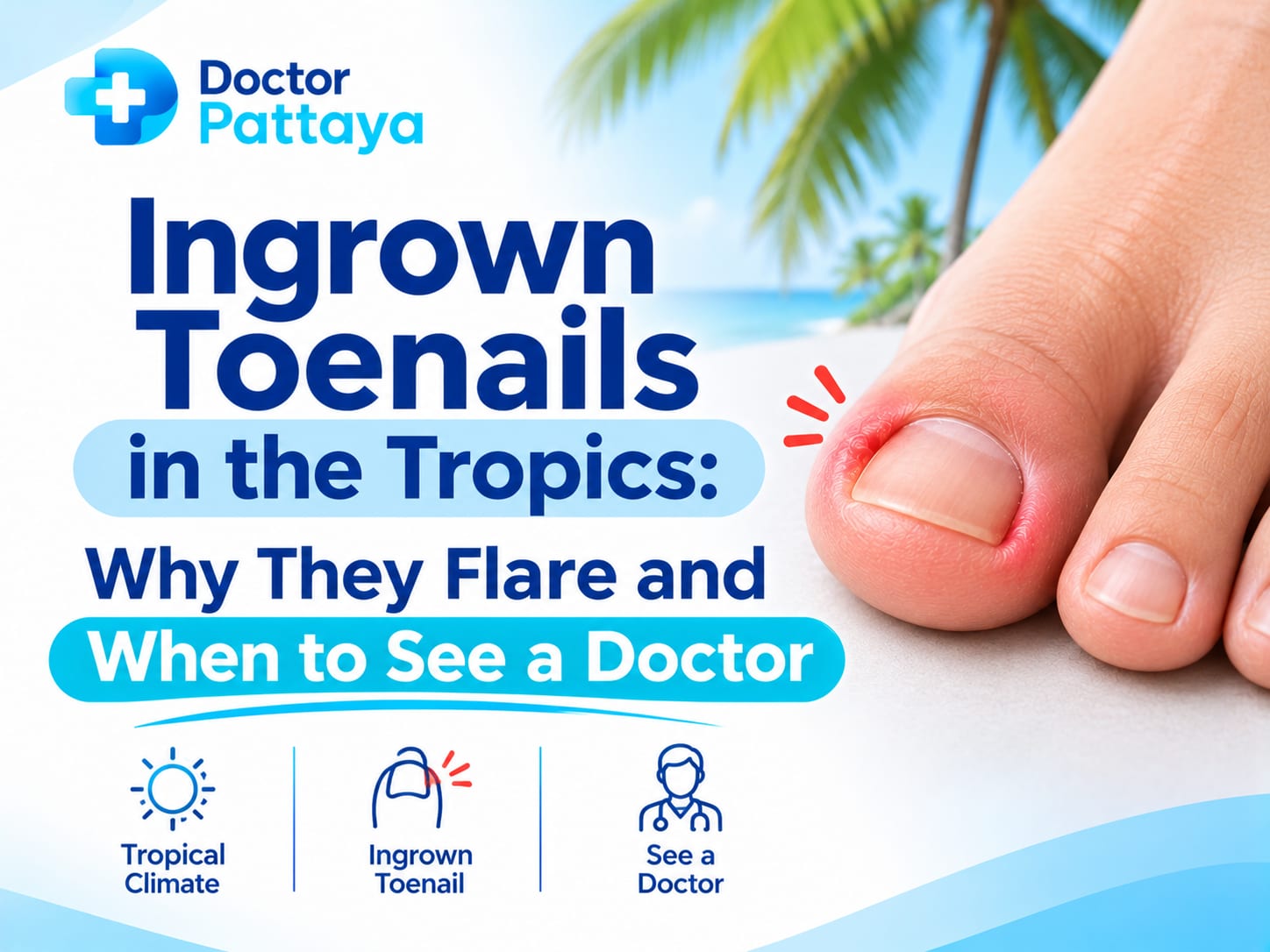
Heat, humidity, and damp footwear make ingrown toenails worse faster than in a cool climate. A mild nail fold irritation can become a painful infection within days here. If you have redness spreading past the nail, pus, or a fever, see a doctor the same day. If your toe is sore but not yet infected, there are safe steps to try at home first.
You are three days into your Pattaya trip and your big toe is throbbing. It was a little tender before you flew out. Now, after a full day in flip-flops on the beach at Jomtien and an evening walking the promenade, it is red, swollen, and angry. It did not feel this urgent at home.
That is exactly the point. An ingrown toenail in the heat behaves differently from one in a cooler, drier place. The warmth, the constant moisture from sweat and seawater, and the pressure from sandals all work together to push a mild problem toward a real infection quickly. This guide walks you through what is happening, what you can safely do yourself, and when to come in so you can get back to enjoying your holiday.

Why Ingrown Toenails Get Worse Faster in a Tropical Climate
In a tropical climate like Pattaya’s, the skin around your nails stays soft and moist almost all day. That softened skin makes it much easier for the nail edge to press in and break the surface. At home, your skin is drier and offers more resistance. Here, it offers almost none.
Flip-flops and open-toed sandals might feel like the right choice in 35-degree heat, but they create their own problem. The strap across the top of the foot pushes the big toe inward with each step. Pool shoes and tight sneakers do the same thing for a different reason: they trap moisture and heat around the nail for hours at a time.
Fungal nail infections are more common in tropical climates. A fungal nail thickens and distorts over time, and a thickened nail is more likely to press into the surrounding fold. If your nail already looked a little thick or discoloured before you arrived, that may be part of why it has flared now.
Pedicures are popular in Pattaya and around Thepprasit Road, and they are often very good value. The risk is in how the nail is cut. Cutting deep into the nail corners leaves a small nail fragment that works its way into the skin as the nail grows. That tiny sliver is the start of most ingrown nail problems.
Home Care That Is Safe to Try First
If the toe is sore but not yet swollen, pus-free, and the redness stays right at the nail edge, you have a short window for home management.
Soak the foot in warm water for ten to fifteen minutes, two to three times a day. This softens the nail groove and reduces pressure. After soaking, gently lift the nail edge away from the skin using a small piece of clean cotton wool or dental floss placed under the corner of the nail. This redirects the nail as it grows and can relieve pressure quickly.
Keep the area clean and dry between soaks. Apply an over-the-counter antiseptic cream to the nail fold. Wear open shoes or go barefoot when you can. If you are spending the day around Pratumnak Hill or walking down to Bali Hai Pier, loose, wide sandals are better than flip-flop straps across the nail.
Do not try to cut the corner of the nail out yourself. This rarely solves the problem. Without sterile instruments, it introduces bacteria into already-irritated tissue. In this humidity, that shortcut can turn a mild nail problem into a skin infection within twenty-four hours.
Signs the Nail Is Infected and Needs a Clinic
There is a point where home care stops being enough. The sooner you recognise it, the simpler the treatment.
Watch for redness spreading past the nail fold. That means the infection is moving into the surrounding skin. Pus at the nail edge, increasing warmth in the toe, or a nail fragment visibly embedded in the skin are all signs that the nail needs professional attention. A fever, however mild, tells you the infection may be spreading further, and that needs same-day care.
Cellulitis is a bacterial skin infection that spreads quickly through the lower leg. It can start from something as small as a neglected ingrown toenail. The signs are a spreading area of redness and warmth moving up the foot or ankle and a toe that is significantly warmer than the rest of the foot. If you see this, do not wait until tomorrow.
If you have diabetes, poor circulation, or any condition affecting feeling in your feet, skip the home-care window entirely. See a doctor the same day your toe becomes uncomfortable. Infections in a diabetic foot progress faster and go deeper, and what looks minor on the surface can already be more serious beneath it.
Doctor Pattaya’s clinic in South Pattaya is open around the clock. If you are unsure whether your toe has crossed the line from mild to infected, come in for an assessment. That takes a few minutes and saves a lot of guessing.
What an Ingrown Toenail Procedure Involves
If the nail needs treatment beyond home care, the standard approach is a partial nail avulsion: removing the small section of nail that is causing the problem. This is done under local anaesthesia, a small injection to numb the toe, so the procedure itself is painless. You will feel pressure but not sharp pain.
In cases where the nail has ingrown repeatedly, the doctor may also apply a chemical to the base of the nail to prevent that strip from growing back. This significantly reduces the chance of recurrence. The whole process is an outpatient minor surgery procedure, and most patients walk out the same day.
After a nail procedure in Pattaya’s climate, your wound dressing needs more attention than it would at home. Heat and humidity mean the dressing can become waterlogged and warm underneath, which creates exactly the conditions bacteria thrive in. Change your dressing more frequently, keep the foot elevated when resting, and avoid soaking the foot in the sea or pool until the wound has closed. For wound dressing changes you are not confident doing yourself, it is worth coming back for a professional redressing rather than struggling with it in a hotel bathroom.
Keep the wound dry for at least the first few days. After that, re-entry to the sea or pool depends on how the wound is healing. When you come in for your follow-up, we can tell you clearly where you stand. Do not make the call yourself based on how it looks from the outside, because surface healing and deeper tissue healing do not always match.
A few aftercare notes that apply directly to Pattaya life: wear open shoes that do not press on the nail for at least two weeks. Cut nails straight across, never curved, and never below the tip of the toe. If you are heading to a pedicure salon, tell the technician what you have had done and ask them to cut straight across only.
Need a same-day nail procedure or wound dressing in Pattaya? Doctor Pattaya’s minor surgery service is available around the clock for walk-in and same-day care. We handle partial nail procedures and wound dressing in a fully equipped clinic in South Pattaya. No appointment needed. If you are staying in Jomtien, Pratumnak, or further along the coast, we can also arrange a hotel visit. Come in, let us take a look, and we will have you back on your feet the same day.
Frequently Asked Questions
References
- Khunger N, Kandhari R. Ingrown toenails. Indian J Dermatol Venereol Leprol. 2012;78(3):279-289.
- Heidelbaugh JJ, Lee H. Management of the ingrown toenail. Am Fam Physician. 2009;79(4):303-308.
- Mayfield JA et al. Preventive foot care in people with diabetes. Diabetes Care. 2003. (via WHO Global Report on Diabetes, WHO 2016).
- NHS. Ingrown toenail. National Health Service, UK. Updated 2023.
The information in this article is for educational purposes only and does not constitute medical advice. It should not be used to self-diagnose or replace a consultation with a qualified physician. If you have concerns about your health, contact a licensed medical professional. For appointments at Doctor Pattaya, visit doctorpattaya.com.

Dr. Pipat Finn is the senior doctor at Doctor Pattaya Takecare Clinic, a 24/7 walk-in medical practice on South Pattaya Road, Chonburi, Thailand. They provide primary care, travel medicine, sexual health, vaccination, minor surgery, IV therapy, and emergency outpatient services for tourists, expatriates, and Pattaya residents. Languages: English and Thai. WhatsApp consultations: +66 95 073 5550. Call: +66 81 668 5557.