Clinically reviewed by Dr. Pipat Finn, M.D., Senior Doctor, Doctor Pattaya.
Last reviewed: October 2026
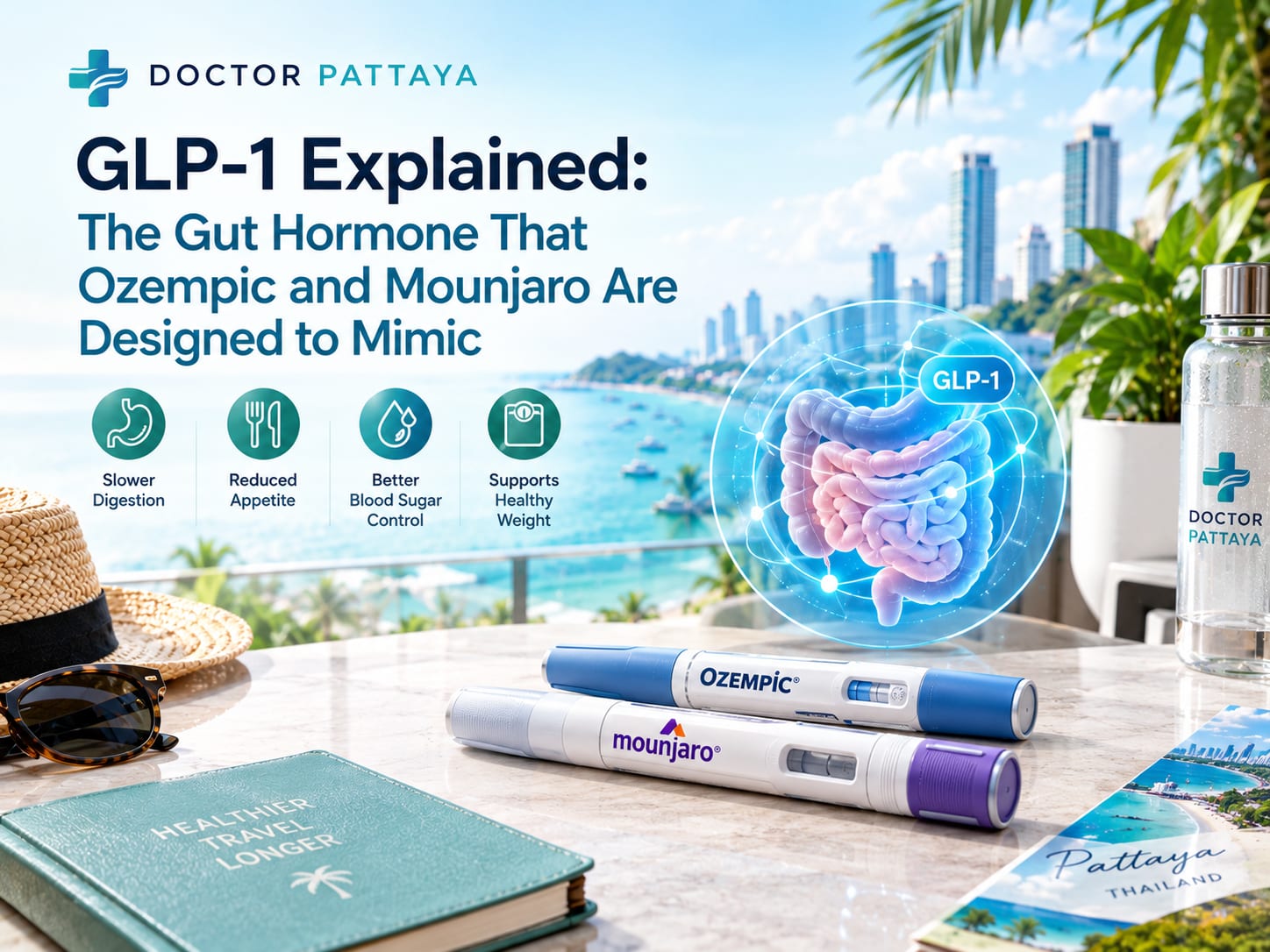
GLP-1 is a hormone your gut releases after you eat. It tells your pancreas to release insulin, slows digestion, and signals your brain that you are full. Drugs like Ozempic and Mounjaro mimic this hormone but last far longer than the natural version, which your body breaks down in about two minutes. That extended action is what makes them effective for blood sugar control and weight loss.
You have been hearing about Ozempic for months. Maybe a friend back home lost weight on it, or a doctor suggested it before your move to Thailand. Now you are sitting across from me in Pattaya, asking the question that actually matters: what is this hormone, and why does mimicking it change anything?
GLP-1 stands for glucagon-like peptide-1. Your gut makes it every time you eat. It helps control blood sugar, slows how fast your stomach empties, and tells your brain you have had enough. The problem is that your body destroys it within about two minutes of releasing it. That short window is exactly why scientists spent decades engineering drugs that do the same job but last a full week. Understanding that gap, between what your body does naturally and what these medications do, is the key to understanding why Ozempic, Mounjaro, and similar treatments work the way they do.

What Is GLP-1 and Where Does It Come From?
GLP-1 is produced by cells that line the wall of your small intestine and colon. When food passes through your gut, especially protein, dietary fibre, and healthy fats, these cells release GLP-1 into your bloodstream within minutes.
GLP-1 belongs to a group called incretin hormones. Eating triggers far more insulin release than an equivalent amount of glucose given directly into the blood, and GLP-1 is one of the main drivers of that effect. It tells your pancreas to release insulin only when blood sugar is already rising, which is a smart and safe mechanism. Your body produces the hormone naturally every day, but its lifespan in the blood is measured in minutes rather than hours.
How GLP-1 Works in the Body
Once GLP-1 hits your bloodstream, it does four things. It triggers insulin release from the pancreas. It suppresses glucagon, the hormone that raises blood sugar. It slows how fast food leaves your stomach. And it signals your brain to reduce appetite.
The insulin effect is glucose-dependent. GLP-1 only triggers insulin release when blood sugar is high enough to need it. When your levels are normal or low, the signal switches off. This is why GLP-1 medications used on their own carry a low risk of causing dangerously low blood sugar, which is a real concern with some older diabetes drugs. The risk goes up if you also take insulin or a sulfonylurea.

Why Natural GLP-1 Lasts Only Minutes
Your body produces an enzyme called DPP-4, and DPP-4 breaks down GLP-1 almost immediately after it is released. The hormone’s half-life in the bloodstream is roughly two minutes. It is gone before it can do much beyond a brief post-meal signal.
A hormone that disappears in two minutes cannot meaningfully control appetite over hours, let alone days. So researchers engineered molecules that mimic GLP-1 but resist DPP-4 breakdown. Semaglutide, the active ingredient in Ozempic and Wegovy, has a half-life of about a week, so one injection a week is enough. That weekly duration is not a commercial convenience. It is the scientific solution to a two-minute biological limitation.
The Gut-Brain Connection: How GLP-1 Affects Hunger and Cravings
GLP-1 does not just slow your digestion. It speaks directly to your brain. The vagus nerve, which runs from your brainstem to your abdomen, carries GLP-1 signals up to the part of the brain that governs hunger and fullness.
What makes this relevant beyond basic appetite is the reward pathway. GLP-1 receptor activation in the brain appears to reduce cravings for ultra-processed and high-calorie foods. Patients on GLP-1 medications often describe not just eating less but simply not wanting the foods they used to reach for. That is brain signalling at work, not willpower. It also explains why these drugs are being studied for conditions well beyond obesity and diabetes.
Ozempic vs Mounjaro: What the Hormone Science Actually Tells You
Ozempic contains semaglutide, which activates GLP-1 receptors only. Mounjaro contains tirzepatide, which activates both GLP-1 receptors and GIP receptors. GIP is another incretin hormone that also stimulates insulin release and plays a role in fat metabolism.
In head-to-head trials, people on tirzepatide lost more weight on average than people on semaglutide. Its action on two receptors may be part of the reason, but this is not fully proven. This does not automatically make Mounjaro the right choice for everyone. Individual response varies, side effect profiles differ, and your full health picture matters. The hormone science tells you why these drugs are not interchangeable. The right one depends on your goals, your medical history, and a proper clinical assessment, not on what worked for someone else.
Beyond Blood Sugar: GLP-1’s Broader Effects on Health
This is where the science has moved quickly over the past few years. GLP-1 receptor agonists are now showing benefits well outside blood sugar and weight.
Cardiovascular trials have shown meaningful reductions in major cardiac events among high-risk patients on semaglutide, and this is now a recognised clinical indication. There is also strong evidence of benefit in fatty liver disease. In August 2025 the US FDA gave accelerated approval to semaglutide (Wegovy) for adults with an inflamed, scarred fatty liver (MASH) who do not have cirrhosis. Brain health results have been disappointing. Two large trials of oral semaglutide in early Alzheimer’s disease, called EVOKE and EVOKE+, found it did not slow the disease compared with placebo.
Some of these uses are approved only for specific groups of patients. But they are part of why clinicians are paying close attention to this drug class. If you have other health conditions alongside weight or blood sugar concerns, it is worth a full conversation with a doctor rather than treating GLP-1 as a single-purpose tool.
Getting Started with GLP-1 Treatment in Pattaya
Some people start with medication ordered online or brought from home. Starting without proper screening carries real risk. Before starting a GLP-1 medication, a doctor should review your medical history and usually check baseline blood tests such as blood sugar, kidney function, and liver function. This helps spot reasons not to use the drug and gives a baseline to track results against. These drugs are not for people who have had, or have a close family member who has had, medullary thyroid cancer or MEN 2, or who have had a serious allergic reaction to the drug. They are also not recommended during pregnancy.
The first dose is always low. Dose titration, starting small and increasing gradually over weeks, helps keep side effects manageable. Nausea is the most common early side effect, and it is often linked to starting or raising the dose. Get medical help quickly if you have severe stomach pain that does not go away, with or without vomiting, as this can be a sign of pancreatitis or gallbladder problems. Also seek care if you cannot keep fluids down or have signs of a serious allergic reaction.
If you are an expat managing this long-term, regular follow-up visits matter. If you are visiting Pattaya and already on a GLP-1 programme, a doctor can give you advice and help you plan continuity before you fly home. You can find out more about what the assessment involves at the Doctor Pattaya GLP-1 service page.
One practical note for anyone in Thailand: unused GLP-1 pens should be kept in the fridge at 2°C to 8°C and never frozen. Once out of the fridge, they must stay below 30°C and only for a limited time, such as 21 days for Mounjaro or 56 days for an Ozempic pen in use. Pattaya’s heat means consistent cold storage matters, from pharmacy to home to travel bag. If your medication has been left in a hot car or a warm hotel room for hours, it may be compromised. Ask us before using it. If you would rather be seen at your hotel, doctor hotel visits are available across the city.
Can You Boost GLP-1 Naturally?
Yes, in a modest way. Eating more dietary fibre, protein, and healthy fats stimulates natural GLP-1 release. Regular exercise and good sleep may also help, though the evidence is limited. Limiting ultra-processed foods appears to help as well.
The honest answer is that lifestyle changes alone cannot replicate what a GLP-1 medication does. Your natural GLP-1 is gone in about two minutes regardless of how clean your diet is. These strategies support overall metabolic health. They are not a substitute for clinical treatment in patients with significant weight or blood sugar issues.
If you want to understand whether GLP-1 treatment is right for you, or if you are already on Ozempic or Mounjaro and need advice while you are in Pattaya, Doctor Pattaya is open 24 hours a day, seven days a week. We see tourists, expats, and long-term residents at our clinic in South Pattaya. Doctor hotel visits are also available if you prefer to be seen where you are staying. Reach out through the contact options below to speak with one of our doctors today.
Frequently Asked Questions
References
- Drucker DJ. The biology of incretin hormones. Cell Metabolism, 2006.
- Lincoff AM, et al; SELECT Trial Investigators. Semaglutide and Cardiovascular Outcomes in Obesity without Diabetes. New England Journal of Medicine, 2023.
- American College of Cardiology. SURMOUNT-5: Greater Loss of Weight, Waist Circumference With Tirzepatide Than Semaglutide (journal scan of Aronne LJ et al, NEJM 2025). ACC, 2025.
- US Food and Drug Administration. MOUNJARO (tirzepatide) injection prescribing information. FDA, 2022.
- Medscape. Wegovy Approved for MASH With Fibrosis, No Cirrhosis. Medscape, 2025.
- NeurologyLive. GLP-1 Semaglutide Fails to Outperform Placebo in Phase 3 EVOKE Trial of Alzheimer Disease. NeurologyLive, 2025.
The information in this article is for educational purposes only and does not constitute medical advice. It should not be used to self-diagnose or replace a consultation with a qualified physician. If you have concerns about your health, contact a licensed medical professional. For appointments at Doctor Pattaya, visit doctorpattaya.com.

Dr. Pipat Finn is the senior doctor at Doctor Pattaya Takecare Clinic, a 24/7 walk-in medical practice on South Pattaya Road, Chonburi, Thailand. They provide primary care, travel medicine, sexual health, vaccination, minor surgery, IV therapy, and emergency outpatient services for tourists, expatriates, and Pattaya residents. Languages: English and Thai. WhatsApp consultations: +66 95 073 5550. Call: +66 81 668 5557.