Clinically reviewed by Dr. Pipat Finn, M.D., Senior Doctor, Doctor Pattaya.
Last reviewed: October 2026
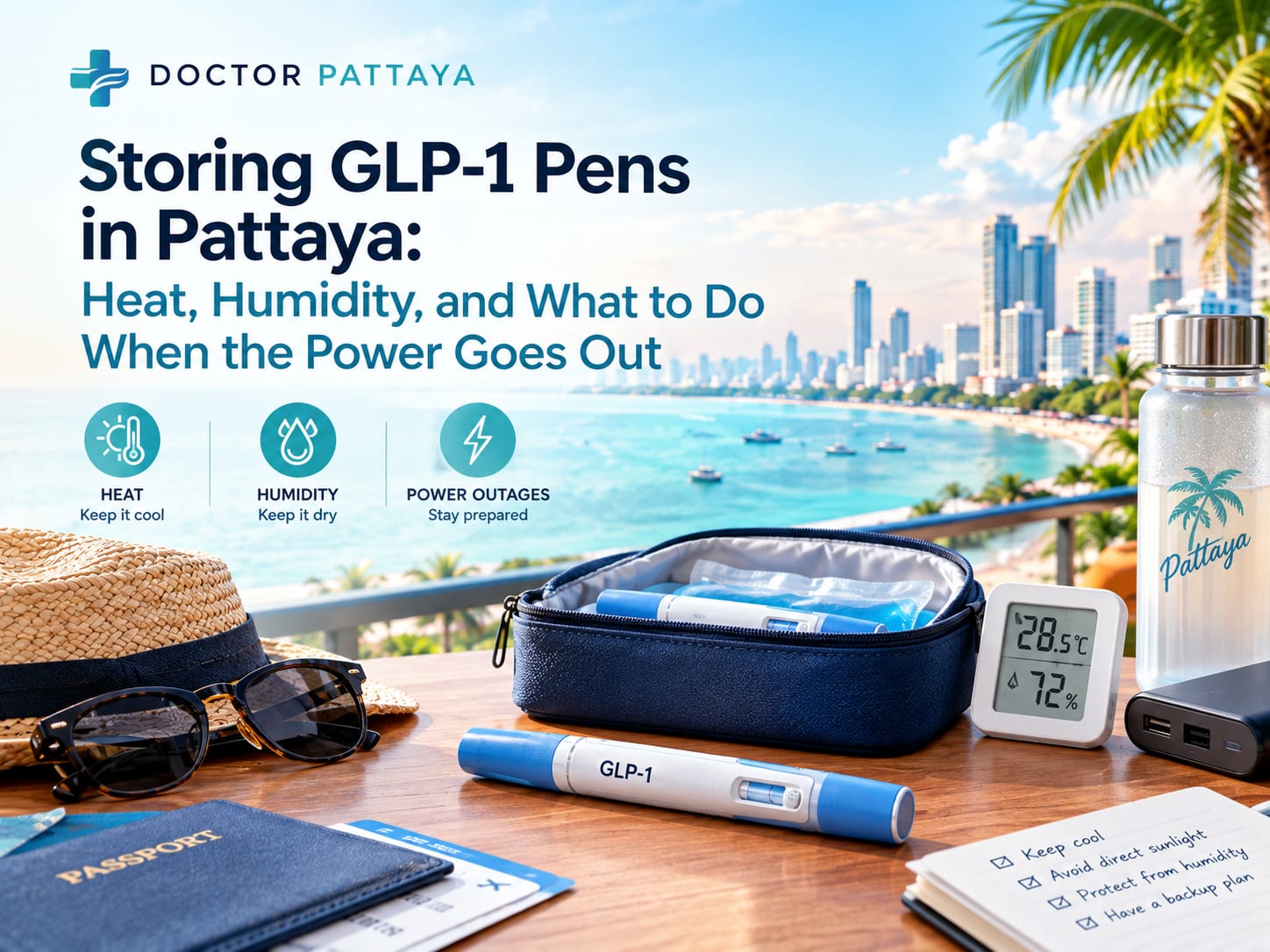
GLP-1 pens like Ozempic, Wegovy, Mounjaro, and Zepbound must stay below 30°C once in use. Pattaya’s daytime temperature sits at 30 to 33°C year-round, meaning a room without air conditioning already pushes your pen past its safe limit. Always refrigerate unopened pens. Keep in-use pens in a cool, air-conditioned space or an insulated cooler bag. If your pen has been left in a hot car, on a beach, or through a power cut, do not use it without a visual check and, when in doubt, a clinical assessment.
You flew in last week, brought your Mounjaro or Ozempic with you, and now you are three days into your Pattaya holiday wondering whether the pen sitting on your hotel dresser is still any good. Or maybe you are a long-term expat in a Jomtien condo who lost power for six hours last Tuesday and your fridge has been off the whole time. Either way, you are asking the right question.
Pattaya is not a forgiving environment for temperature-sensitive medication. The storage advice on the box was written for a climate nothing like this one. This guide covers what happens to your GLP-1 pen in Pattaya’s heat and humidity, what warning signs to look for, and what to do when things go wrong.

Why Storing GLP-1 Pens in Pattaya Heat Is Riskier Than the Label Suggests
The label says keep in-use medication below 30°C. Pattaya’s ambient daytime temperature runs between 30 and 33°C for most of the year. That means a room without air conditioning is already at or above the maximum safe temperature, before you add direct sunlight, a closed car, or a beach bag.
A parked car in Pattaya can hit 60°C inside within minutes. A beach bag left in direct sun at Jomtien gets there even faster. These are not edge cases here. They are Tuesday.
The Humidity Factor
Heat gets all the attention, but Pattaya’s humidity is a separate problem. Relative humidity here sits between 70 and 83 percent year-round. When you move a cold pen from an air-conditioned room into outdoor air, condensation forms on and around the cap seal almost immediately.
Repeated temperature cycling, from your cold condo to the hot street and back, stresses the pen’s cap and packaging seals. Keep your pen in its original carton. That is your best barrier against humidity-driven moisture getting in between injections. Avoid storing pens in your bathroom too. Bathrooms in Pattaya run hot and humid even with AC on in the rest of the unit.

Hotel Rooms, Serviced Apartments, and the Storage Realities Nobody Talks About
This is the situation most people reading this are actually in.
Budget guesthouses and short-stay rentals near Walking Street or Pratumnak do not always have a proper fridge in the room. Mini-bar fridges, when they exist, can be inconsistent. Some barely reach the right temperature, and others freeze items near the cooling element. Before you put your pen inside, check the unit has been running and test the shelf temperature with your hand. Never place the pen against the back wall where it can freeze.
If your room has no fridge, an insulated cooler bag with an ice pack is your only option. A FRIO-style evaporative cooling wallet is worth considering for longer stays or day trips. These are water-activated, need no ice or power, and hold a safe temperature for many hours. They work well for a day out in Naklua, a boat trip to Koh Larn, or anywhere you will be away from a fridge for several hours.
The Room-Temperature Window Is Shorter Than You Think Here
Semaglutide pens allow up to 56 days at room temperature. Tirzepatide pens allow 21 days. Both assume the room stays consistently at or below 30°C.
In Pattaya, that assumption collapses the moment the air conditioning goes off. If you are out for the day and the AC turns off automatically, or a power cut hits, your room temperature climbs fast. Treat the room-temperature window as a ceiling, not a target. Refrigerate when you can, and keep the pen at room temperature only when the room is genuinely air-conditioned and holding below 30°C.
What a Power Cut Does to Your GLP-1 Pen
Power outages in Pattaya are not rare. Short cuts of one to two hours are generally low risk if your fridge stays closed. Longer outages are a different story.
A standard fridge holds its temperature for roughly two to four hours with the door closed. After that, internal temperature rises. If the power was out for six or more hours in Pattaya’s heat, treat a refrigerated pen as potentially compromised. Do not assume it is fine because it still looks clear.
This is one of the most common situations we see at Doctor Pattaya. An expat comes in after a long power cut, pen in hand, asking whether it is safe to inject. A visual inspection alone cannot tell you if the medication has lost potency. If the outage was significant and you are unsure, the safest call is to come in before using it. You can read more about managing your GLP-1 pen during power outages on our dedicated GLP-1 page.
How to Tell If Your GLP-1 Pen Has Been Heat-Damaged
Check the solution before every injection regardless of storage conditions. You are looking for cloudiness, visible particles, or any colour change. All GLP-1 solutions should be clear and colourless. If any of those signs are present, do not inject. Discard the pen and contact your prescribing doctor.
Here is what most guides leave out. A clear, colourless solution is not proof the medication is still effective. Heat can break down the active ingredient without any visible change to the liquid. You will not see potency loss. You will feel it, usually as a return of appetite, stalled weight loss despite consistent dosing, or a sense that the medication has simply stopped working.
If you had a confirmed temperature excursion, meaning the pen was left somewhere it should not have been, do not use it regardless of how it looks.
Compounded GLP-1 Vials: A Different Set of Rules
Some expats in Pattaya source compounded semaglutide or tirzepatide, which usually comes in small multi-dose vials rather than branded auto-injector pens. Storage rules for these are often stricter.
Compounded vials typically require continuous refrigeration at 2 to 8°C with no room-temperature window. They are also more sensitive to repeated temperature cycling. If you are using a compounded vial, keep it refrigerated at all times and check with the clinic that prescribed it for its specific storage requirements. When in doubt, ask us.
When to See a Doctor in Pattaya About a Compromised Pen
You do not need to lose your dose or fall behind on treatment because of a storage incident. Doctor Pattaya is open 24 hours a day, seven days a week, and this is exactly the kind of practical question we handle every day.
If your pen has been through a significant temperature excursion and you are unsure whether to use it, come in or call. We can assess the situation, confirm whether the medication is likely compromised, and issue a new prescription the same day. For tourists with limited time in the city, there is no reason a bad afternoon at the beach has to set your treatment back by a week. We also support patients who need ongoing GLP-1 management during their stay, from prescription support to injection guidance and general monitoring.
If your GLP-1 pen has been exposed to Pattaya’s heat, gone through a power cut, or you simply need advice on storing your medication safely during your stay, Doctor Pattaya is open 24 hours a day, 7 days a week. We can assess whether your pen is still safe to use, issue a replacement prescription, and support your GLP-1 treatment throughout your time here. Walk in, call us, or book online. We are in South Pattaya and offer doctor visits to hotels across Pattaya, Jomtien, Pratumnak, and Naklua.
Frequently Asked Questions

Dr. Pipat Finn is the senior doctor at Doctor Pattaya Takecare Clinic, a 24/7 walk-in medical practice on South Pattaya Road, Chonburi, Thailand. They provide primary care, travel medicine, sexual health, vaccination, minor surgery, IV therapy, and emergency outpatient services for tourists, expatriates, and Pattaya residents. Languages: English and Thai. WhatsApp consultations: +66 95 073 5550. Call: +66 81 668 5557.