Clinically reviewed by Dr. Pipat Finn, M.D., Senior Doctor, Doctor Pattaya. Last reviewed: August 2026
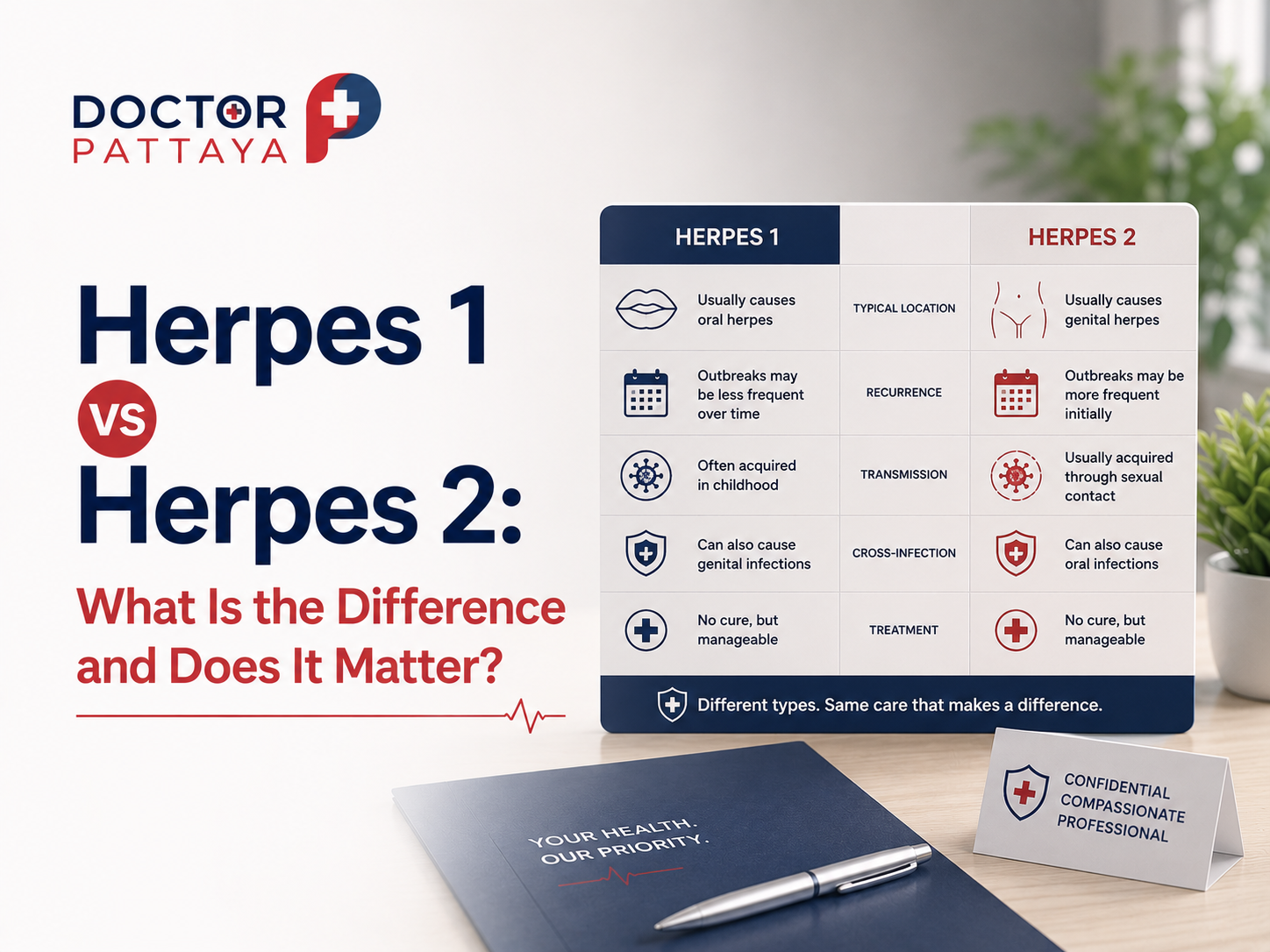
HSV-1 typically causes cold sores around the mouth, while HSV-2 typically causes genital herpes. But either type can appear in either location. The biggest practical difference is recurrence: genital HSV-2 comes back far more often than genital HSV-1. Knowing your type shapes your treatment plan and what you tell a partner.
You noticed something. A sore, a tingle, a blister somewhere it should not be. Maybe it showed up mid-holiday, a few days into your Pattaya trip. Maybe you have had something like it before and always pushed it to the back of your mind. Either way, you are now sitting with a question a lot of people have but very few ask out loud: is this herpes type 1 or type 2, and does it actually matter which one it is?
The short answer is yes, it does matter. The type you have affects how often outbreaks come back, whether daily medication makes sense, and what your transmission risk looks like to a partner. It also determines which test you need and when. Let us get into it clearly, because most of what you read online either buries the answer or skips it entirely.

The Quick Answer — How Herpes 1 and Herpes 2 Are Actually Different
Both are caused by the herpes simplex virus. Both cause sores. Both are managed with the same antivirals. But they are not identical.
| HSV-1 | HSV-2 | |
|---|---|---|
| Most common location | Mouth and lips | Genitals and buttocks |
| Can it appear elsewhere? | Yes, including genitals | Yes, including mouth |
| How it usually spreads | Skin-to-skin, saliva, oral sex | Sexual contact, skin-to-skin |
| Recurrence rate (genital) | Low — many people have one outbreak or none | High — often multiple times per year |
| Asymptomatic shedding | Less frequent genitally | More frequent genitally |
| Treatment drugs | Acyclovir, valacyclovir, famciclovir | Acyclovir, valacyclovir, famciclovir |
| Suppressive therapy | Less often needed genitally | Often recommended for frequent recurrences |
Symptoms — What Does Each Type Look and Feel Like?
Here is the honest truth: you cannot tell which type you have by looking at a sore. They look the same. Both cause small blisters or ulcers that may sting, itch, or burn. Both can make the surrounding skin feel tender.
What many patients do not know is that symptoms often start before any sore appears. You may feel a tingling, itching, or burning sensation in the skin one to two days before a visible blister shows up. If you feel that familiar tingle and you are already on antivirals, take your medication immediately. Early treatment cuts the outbreak shorter.
Both types can also cause a first outbreak that feels like a mild flu, with swollen glands, body aches, and a low fever. After that first episode, most people have milder recurrences or none at all, especially with HSV-1 in the genital area.

Transmission — How Each Type Spreads, Including the Part Most Tourists Miss
HSV-1 spreads through direct contact with the mouth or lips. Kissing, sharing a drink, or oral sex. That last one is widely underestimated: a person with a cold sore on their lip can pass HSV-1 to a partner’s genitals during oral sex.
This matters in Pattaya. Holiday encounters happen fast. People do not always know their own status, and a cold sore does not have to be visible for the virus to be present on the skin. The virus can shed without any symptoms at all.
HSV-2 spreads primarily through genital and anal sexual contact. It sheds from genital skin more often than HSV-1 does, which is a key reason it recurs more often and passes more easily between partners.
Does the Type Actually Matter? Key Clinical Differences
This is the question most websites dance around. Let me answer it directly.
If you have genital HSV-2, your recurrence rate is meaningfully higher than if you have genital HSV-1. Many people with genital HSV-1 have one outbreak and then very few after that. Genital HSV-2 tends to come back regularly, sometimes many times a year. That difference alone changes whether daily suppressive therapy is worth taking.
HSV-2 also modestly raises the risk of acquiring HIV if you are exposed. The skin disruption from outbreaks, or even from shedding with no visible sore, creates an easier entry point. This is a real clinical concern, especially if you are in Pattaya’s nightlife environment and not on PrEP.
If you are pregnant or planning to become pregnant, the type matters even more. Your obstetric team needs to know your status and your type. Neonatal herpes, where the virus passes to a newborn during delivery, is a serious condition and one your care team will want to plan around.
Testing — How Do You Know Which Type You Have?
Symptoms cannot tell you. A doctor’s eyes cannot tell you. A test can.
If you have an active sore right now, a PCR swab taken directly from the blister gives you the fastest and most accurate result. It confirms that herpes is present and identifies which type. This is the test to reach for first when there is a current outbreak.
If you have no active sores and you are testing between outbreaks, a type-specific IgG antibody blood test is the right option. This test is most reliable at least twelve weeks after a potential exposure, so timing matters. Testing too soon can give a falsely negative result.
At Doctor Pattaya, we can run both. If you are mid-outbreak, come in now. If you are testing after a recent exposure with nothing visible, we will talk through your timeline and point you to the right test for your situation. You can find full details about our STD testing and treatment in Pattaya on the clinic website.
Treatment — Is It the Same for Both Types?
The drugs are the same. Acyclovir, valacyclovir, and famciclovir all work against both HSV-1 and HSV-2. What changes is how and when you use them.
Episodic therapy means you take antivirals at the first sign of an outbreak. This shortens how long it lasts and reduces shedding during that episode. It works well for people who get outbreaks rarely.
Suppressive therapy means you take a low dose every day, whether or not you have symptoms. This is typically recommended for people with frequent recurrences, which is far more common with genital HSV-2 than genital HSV-1. Daily suppressive therapy also significantly reduces the chance of passing the virus to a partner.
If you are dealing with a current outbreak in Pattaya, we can prescribe antivirals the same day. No appointment needed. Walk in.
Living With Herpes in a Tropical Climate — What Pattaya Residents and Long-Stay Visitors Need to Know
Heat, UV exposure, and dehydration are all documented triggers for herpes reactivation. Pattaya’s climate delivers all three at once. A full day on Jomtien Beach without sun protection, getting dehydrated in the heat, and then drinking heavily that night is practically a recipe for triggering an outbreak in someone who carries the virus.
Travel stress and disrupted sleep are also real triggers. If you flew in from Europe, your sleep is off, your immune system is slightly suppressed, and your body is adjusting. That is exactly when the virus can reactivate.
Stay hydrated, use SPF, pace yourself with alcohol, and try to sleep properly. If you are already on suppressive therapy and a big week is coming, talk to your doctor about whether your current dose is right. Long-term expats managing HSV-2 in Pattaya often find that suppressive therapy makes a significant difference during the hotter months.
What to Do After a Diagnosis in Pattaya
Getting a positive result is a lot to sit with, especially if you are mid-holiday. Take a breath.
Herpes is a manageable, lifelong condition. It is not a barrier to a normal relationship, a normal sex life, or a normal life in general. What matters is knowing your type, understanding your recurrence pattern, and having a plan.
That plan usually includes knowing your triggers, having antivirals on hand for episodic treatment, and talking to any current or future partner about transmission risk. Partner notification is something every patient with a new diagnosis deserves to talk through with a doctor. It is not always an easy conversation, but it is the right one.
If you are an expat who has been managing this on your own for years without a proper type-specific test, come in. Knowing your exact type can change your management approach and give you clearer answers for your partner. Our herpes testing and STD treatment services cover full HSV workups, same-day antiviral prescriptions, and follow-up care whether you are here for a week or the long haul.
If you are dealing with a current outbreak, a recent exposure, or you have never had a type-specific herpes test and want to know where you stand, Doctor Pattaya is open 24 hours a day, seven days a week. Walk in to our South Pattaya clinic or ask about a doctor visit to your hotel in Jomtien, Naklua, or Pratumnak. We offer confidential HSV testing and same-day treatment for tourists and long-term expats alike. No appointment needed.
Can HSV-1 cause genital herpes, or is genital herpes always HSV-2?
HSV-1 can absolutely cause genital herpes, and it happens more often than people realise. The most common route is oral sex from a partner who carries HSV-1 orally, even without a visible cold sore. You cannot tell which type you have from the location of a sore alone — only a test will confirm it.
If the treatment is the same, why does it matter which type of herpes I have?
Because the type tells you what to expect going forward. Genital HSV-2 recurs far more often than genital HSV-1, which affects whether daily suppressive medication makes sense for you. HSV-2 also modestly raises HIV acquisition risk, and that is worth knowing if you are sexually active. Type matters for partner conversations too.
What type of herpes test should I ask for, and how accurate is it?
If you have an active sore, ask for a PCR swab from the lesion. That is the most accurate test during an outbreak and will confirm the type. If you have no symptoms, a type-specific IgG blood test is appropriate, but wait at least twelve weeks after potential exposure for a reliable result. At Doctor Pattaya, a doctor will assess your situation and recommend the right test for your timeline.
Can heat, sun, alcohol, or travel trigger a herpes outbreak?
Yes, all of these are real and documented triggers. UV exposure, dehydration, alcohol, sleep disruption, and physical stress can all prompt the virus to reactivate. In Pattaya’s climate and with the pace of holiday life here, these triggers stack up quickly. If outbreaks are frequent, daily suppressive therapy is worth discussing with a doctor.
I had cold sores as a child. Does that mean I can still catch genital herpes?
Yes. Having oral HSV-1 from childhood does not protect you from acquiring HSV-2 genitally. They are different strains and you can carry both. A type-specific blood test can confirm which strains are in your system and help you have honest conversations with a partner about transmission risk.
Can I get tested and treated at Doctor Pattaya on the same day?
Yes. If you have an active outbreak, we can swab it and prescribe antivirals in the same visit. If you are testing between outbreaks, we will take blood and walk through your results and management options with you. We are open around the clock and no appointment is needed for walk-in visits.

Dr. Pipat Finn is the senior doctor at Doctor Pattaya Takecare Clinic, a 24/7 walk-in medical practice on South Pattaya Road, Chonburi, Thailand. They provide primary care, travel medicine, sexual health, vaccination, minor surgery, IV therapy, and emergency outpatient services for tourists, expatriates, and Pattaya residents. Languages: English and Thai. WhatsApp consultations: +66 95 073 5550. Call: +66 81 668 5557.