Clinically reviewed by Dr. Pipat Finn, M.D., Senior Doctor, Doctor Pattaya.
Last reviewed: August 2026
Post-exposure prophylaxis (PEP) is emergency medication that can prevent HIV from taking hold after a potential exposure. It must be started within 72 hours, and the sooner the better. Doctor Pattaya offers 24/7 walk-in PEP consultations in South Pattaya, including a same-day rapid HIV test and a full 28-day prescription. Walk in at any hour. No appointment needed.
Something happened last night and now you are sitting with your phone, Googling at 3am, hoping you are overreacting. Maybe the condom broke. Maybe things went further than planned and the other person’s status is unknown. Maybe you are not even sure what the risk was, but your gut is telling you to do something. That is the right instinct. The window is real, and it is closing.
PEP, short for post-exposure prophylaxis, is a course of antiretroviral medication that stops HIV from establishing itself in your body after a potential exposure. It is not a guarantee, but when started quickly, the evidence for its effectiveness is strong. The single most important thing right now is not to wait. Come in, get tested, and let us take it from there.
Why 72 Hours Is the Hard Limit for PEP in Pattaya
After a potential HIV exposure, the virus does not enter your bloodstream immediately. It starts in local tissue. For a brief window, the right medication can still stop it from spreading further. After 72 hours, that window is gone.
Starting at hour 6 gives the medication more time to work than starting at hour 60. Both are within the window, but earlier is meaningfully better. Do not wait to see if you feel fine. You will not feel anything at this stage, and that is exactly why people wait too long.
Who Needs PEP
Most patients we see for PEP fall into one of a few situations. Unprotected sex with a partner whose HIV status is unknown. A condom that broke or slipped. A needlestick or sharp object injury. Less commonly, a splash of blood to the eyes or mouth.
If you are unsure whether your situation qualifies, come in anyway. A five-minute risk assessment will tell us more than any online checklist.
Pattaya’s nightlife, the easy access to casual encounters, the mix of tourists and longer-term residents: these are just the reality of the environment. A lot of the patients who walk through our door for PEP are tourists who had no intention of needing it. Some are expats who have lived here for years and know exactly what they need. We see both every week, and there is no version of this conversation that surprises us.

What Happens When You Walk Into Doctor Pattaya for PEP
Walk in and tell reception you need a PEP consultation. You will be seen quickly, because we understand this is time-sensitive. The doctor will ask a few straightforward questions about the exposure: when, what kind, and any relevant medical history. This is a confidential consultation. Nothing leaves the room.
Before we prescribe PEP, we confirm you are currently HIV-negative with a rapid test done on-site. Results come back within 20 to 30 minutes. We also check kidney and liver function on the same visit, since the medication is processed by those organs. Once everything is clear, you leave with your prescription the same day.
What You Are Given
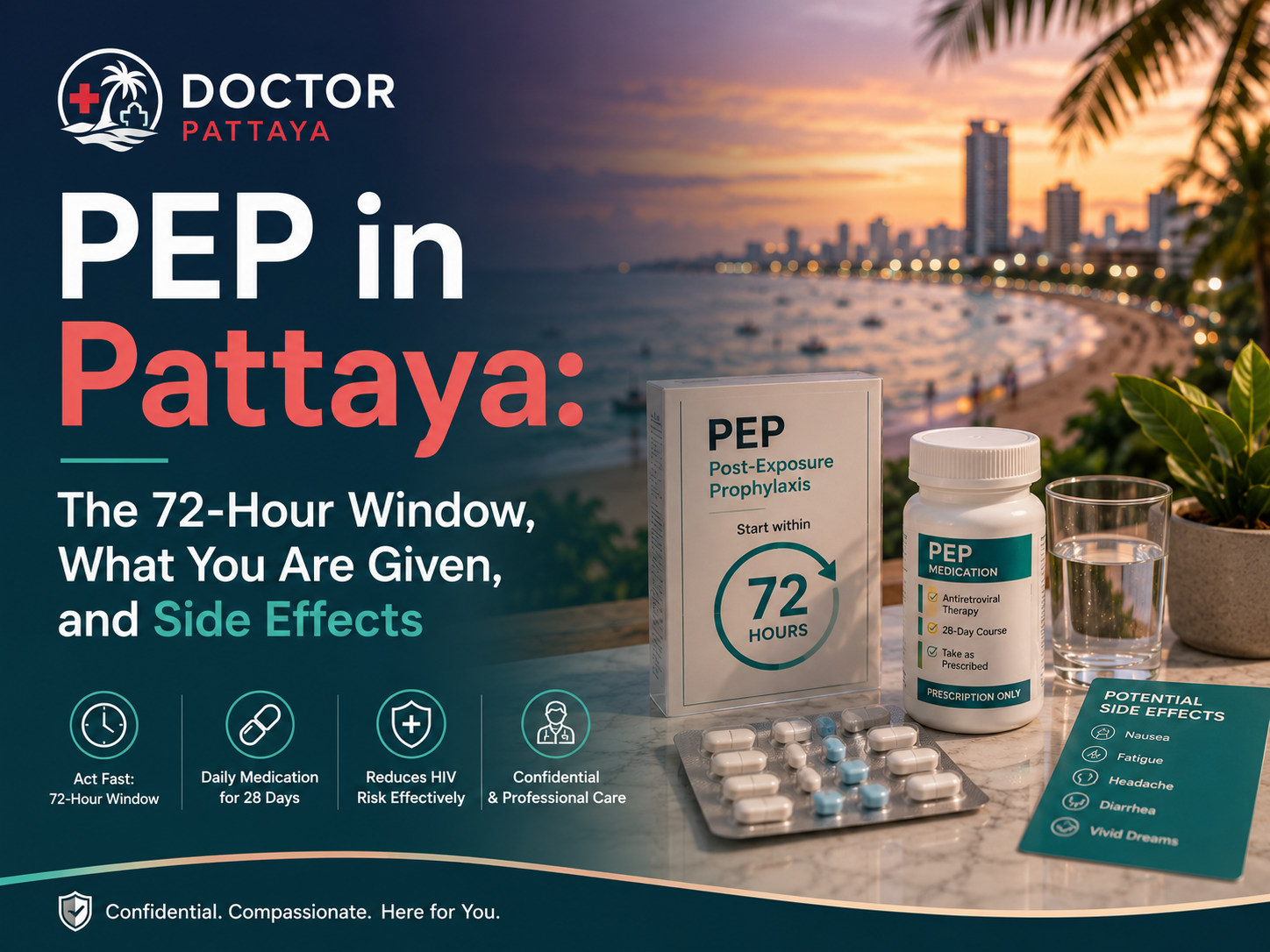
The standard PEP course in Thailand is a combination of antiretroviral drugs taken together once daily. The most commonly used combination at our clinic is tenofovir disoproxil fumarate with emtricitabine, paired with either dolutegravir or bictegravir. You may recognise these as the same drug classes used to treat HIV in people who are positive. Here, they are used to stop the virus before it can take hold.
You take them every day for 28 days. That is the full course, and stopping early significantly reduces effectiveness. The medications are generally well-tolerated, but they do have side effects, and it helps to know what to expect before you start.
Side Effects and What to Expect During the 28 Days
Most patients get through the course without anything severe. The most common side effects are nausea, headache, and fatigue, particularly in the first week. Some people notice loose stools or mild stomach cramping. These tend to ease off after the first seven to ten days.
Taking the medication with food helps with nausea for most people. If you are also taking recreational drugs or other medications, mention that at the consultation. Some interactions are clinically relevant, and the doctor needs the full picture to prescribe safely.
If you are flying home mid-course, let us know your departure date. We can provide the full 28-day supply and a letter explaining the medication for customs.
How to Take PEP Correctly
Take it at the same time every day. Set an alarm if you need to. Consistency is what makes PEP work, and missed doses are the most common reason it fails.
If you miss a dose and less than 24 hours have passed, take it as soon as you remember. Do not double up. If you have missed more than two consecutive days, contact us straight away so we can reassess.
Completing the course in Pattaya is straightforward. Completing it across time zones or back home in a different country takes a bit of planning. Tell the doctor your travel plans at the consultation and we will sort the prescription and any documentation you need.
After PEP: Follow-Up Testing and What Comes Next
Finishing the 28-day course does not mean you are done. You need a follow-up HIV test at around four weeks after completing PEP, and a further confirmatory test at three months. Most patients who complete the course correctly and test negative at three months can move forward with confidence.
At your follow-up, we will also talk about what happens next. If the circumstances that led you to need PEP reflect ongoing risk, PrEP is worth discussing. PrEP is a daily preventive medication taken before future potential exposures, and it is highly effective when taken consistently. Our sexual health services cover both PEP and PrEP, so that conversation can happen in the same place.
Transitioning from PEP to PrEP after a confirmed negative result is a common and sensible step for many patients in Pattaya. We can walk you through it at your follow-up appointment.
Getting PEP Tonight: Practical Notes for Tourists and Expats
Doctor Pattaya is open 24 hours a day, seven days a week, including Thai public holidays. There is no appointment system for PEP because there cannot be: the clock starts at the moment of exposure, not at 9am on Monday.
If you are in South Pattaya, Jomtien, Pratumnak, or Naklua, you can be with us within minutes. If you cannot get to the clinic, ask about a hotel visit. Bring your passport if you have it, but do not delay coming in just because you do not have it on you. The HIV test, the risk assessment, and the prescription can all happen in a single visit. You do not need to have everything figured out before you walk through the door. That is what we are here for.
Your PEP consultation at Doctor Pattaya includes everything in one visit: the risk assessment, the rapid test, and the full prescription.
If you need PEP in Pattaya, do not wait until morning. Doctor Pattaya is open 24/7 in South Pattaya, and we can complete your risk assessment, rapid HIV test, and prescription in a single same-day visit. Walk-ins are welcome at any hour. Hotel visits are available across Pattaya, Jomtien, Pratumnak, and Naklua. Contact us now through doctorpattaya.com or call the clinic directly. Every hour counts.
Frequently Asked Questions

Dr. Pipat Finn is the senior doctor at Doctor Pattaya Takecare Clinic, a 24/7 walk-in medical practice on South Pattaya Road, Chonburi, Thailand. They provide primary care, travel medicine, sexual health, vaccination, minor surgery, IV therapy, and emergency outpatient services for tourists, expatriates, and Pattaya residents. Languages: English and Thai. WhatsApp consultations: +66 95 073 5550. Call: +66 81 668 5557.