Clinically reviewed by Dr. Pipat Finn, M.D., Senior Doctor, Doctor Pattaya. Last reviewed: August 2026
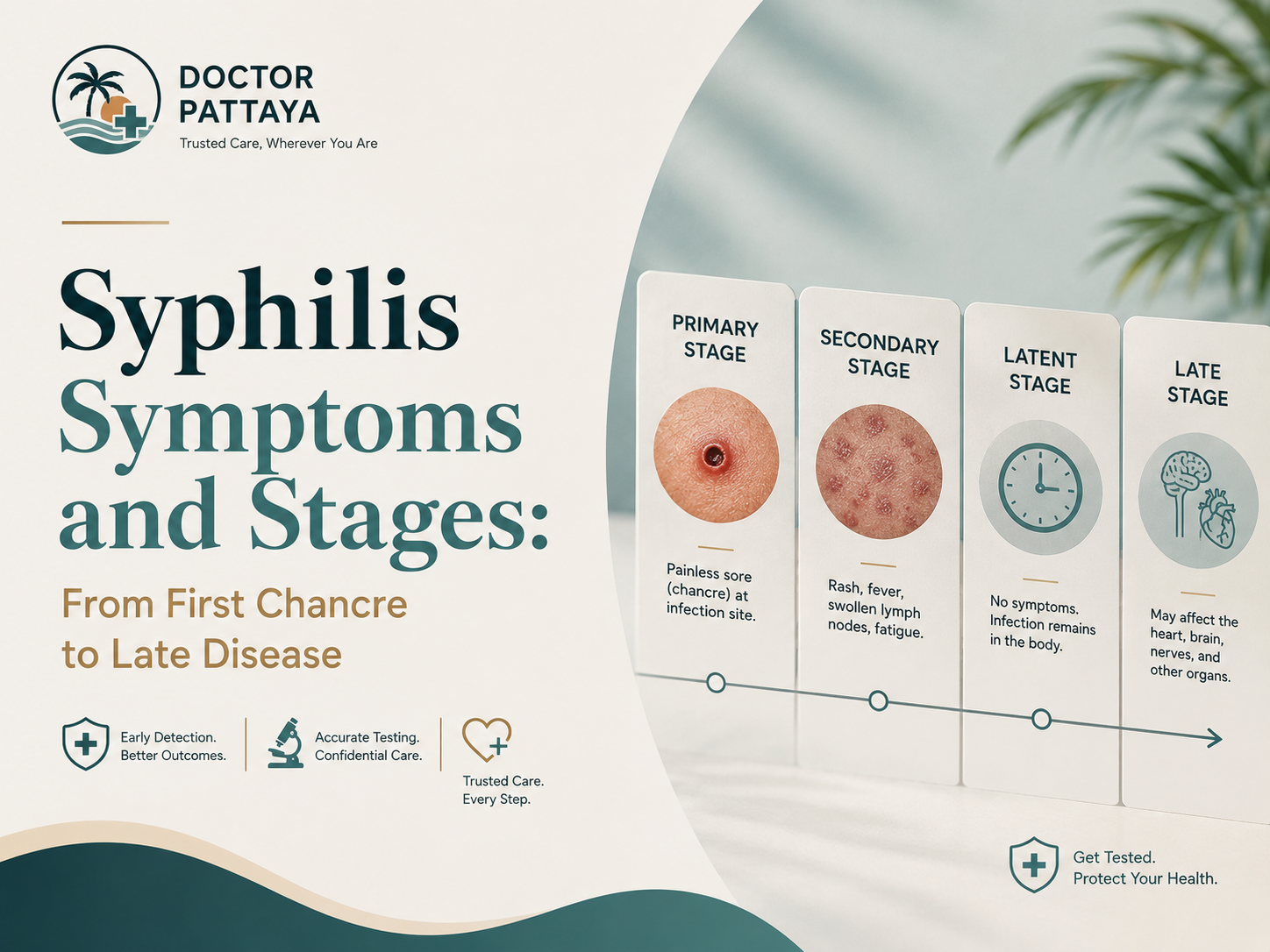
Syphilis moves through four stages: primary, secondary, latent, and tertiary. Each stage looks different, and symptoms can disappear on their own without the infection clearing. Early syphilis is fully curable with a single penicillin injection. Left untreated, it can damage the heart, brain, and eyes over years. If you have had unprotected sex in Pattaya and are unsure, get tested before the symptoms decide for you.
You found a sore somewhere it should not be. It does not hurt, which is oddly more worrying than if it did. Maybe it showed up a couple of weeks after an unplanned encounter and you have been watching it, half-hoping it would just disappear. With syphilis, it often does. And that is exactly the problem.
Disappearing symptoms are not the same as a disappearing infection. Syphilis is known as "the great imitator" because at every stage it looks like something else. Rashes that pass for heat rash. Sores mistaken for pimples. Fatigue that feels like a hangover that will not shift. We see patients at Doctor Pattaya who have been carrying this infection for weeks, sometimes longer, because nothing seemed alarming enough to act on. This guide walks you through what syphilis actually looks like at each stage, and when to come in.
Primary Syphilis: The Sore You Might Miss
The first sign is a chancre, a painless ulcer that appears where the bacteria entered the body. That usually means the genitals, anus, lips, or throat. It shows up roughly two to three weeks after contact. It is firm, round, and clean-edged, and because it does not hurt, most people miss it or write it off as nothing.
The chancre heals on its own within three to six weeks. But the bacteria do not leave with it. They are already moving through your bloodstream, and the infection is heading somewhere worse.
If you spot a sore like this after unprotected sex, do not wait for it to close and assume the problem is solved. Come in and get a blood test. A painless sore that heals on its own is not reassuring. It is one of the classic signs of syphilis at its earliest and most treatable stage.
Secondary Syphilis: When It Spreads and Gets Louder
Secondary syphilis arrives four to ten weeks after the initial sore, sometimes while the chancre is still present. This is when the infection is most active and most contagious.
The most recognisable sign is a rash across the palms of the hands and the soles of the feet. It does not usually itch, which is one reason people ignore it. Alongside the rash, patients often have flu-like symptoms: fever, swollen glands, fatigue, and sore throat. Patchy hair loss is also possible.
Mouth sores called mucous patches may appear at this stage, and they are highly infectious. You can pass syphilis through kissing.

Why Syphilis Is Called "The Great Imitator"
This is where most missed diagnoses happen. Secondary syphilis can look like almost anything. The rash gets mistaken for psoriasis, heat rash, or a drug reaction. The fatigue and swollen glands get blamed on a viral illness. The mouth sores look like common ulcers that anyone might get.
A lot of tourists and expats in Pattaya come in for something else entirely, and syphilis only surfaces when we run a full STD panel as part of a broader check. If you have had unprotected sex in the last few months and are feeling generally unwell without a clear reason, syphilis belongs in the picture. That is not alarmism. It is just practical thinking.
Latent Syphilis: The Silent Stage That Can Last Years
After secondary syphilis, the infection goes completely quiet. No rash, no sore, nothing. This is latent syphilis, and it can stay this way for years without the person knowing they are infected.
Early latent syphilis covers the first year after infection. Late latent is everything beyond that. The infection is not visibly progressing, but it is still present and can still be passed to a partner. Most cases of latent syphilis are caught through routine screening, not because someone noticed a symptom.
If you are sexually active in Pattaya and have not tested in the past year, latent syphilis is one of the main reasons a full panel matters even when you feel completely fine.
Tertiary Syphilis: What Happens If It Goes Untreated
Tertiary syphilis develops in a minority of untreated patients, usually many years after the first infection. By this point, serious organ damage has already occurred. The cardiovascular system, brain, and spinal cord can all be affected.
Inflammatory lesions called gummas can form in soft tissue, bone, or organs. Aortic damage and heart failure are possible. Neurological changes including memory loss, personality shifts, and loss of coordination fall under the category of neurosyphilis, covered below.
Tertiary syphilis is rare in places with accessible healthcare. It happens when people go undiagnosed for years, not because the treatment does not work.
Neurosyphilis, Ocular Syphilis, and Otosyphilis
This part matters and often gets left out of patient guides.
Neurosyphilis, where the bacteria reach the nervous system, can happen at any stage, not only in late disease. Symptoms include severe headache, stiff neck, confusion, vision changes, and in some cases, stroke-like events.
Ocular syphilis targets the eye and can cause pain, blurred vision, floaters, and in serious cases, permanent vision loss. Otosyphilis affects hearing. Sudden hearing loss, ringing in the ears, or vertigo after a possible syphilis exposure are symptoms that need same-day assessment. Do not wait to see if they settle on their own. Doctor Pattaya is open around the clock for exactly this kind of situation.
Syphilis Risk in Pattaya: Why Regular Testing Makes Sense
Thailand has seen a documented rise in syphilis cases in recent years, and nightlife areas carry elevated exposure risk. This is not a scare tactic. It is the same pattern flagged by the Thai Ministry of Public Health and international health agencies.
Co-infection with HIV is an important part of this picture. Syphilis sores make it significantly easier to transmit and acquire HIV. If you are testing for one, test for both. At Doctor Pattaya, a full STD panel covering syphilis, HIV, gonorrhoea, chlamydia, and hepatitis B and C is available as a walk-in with no appointment needed.
A lot of long-term expats in Jomtien and Naklua have made annual testing a routine part of living here. It takes around thirty minutes. For tourists who have had an unplanned encounter, same-day results mean you are not spending the rest of your holiday guessing.
When to Get Tested: Window Periods and What Your Results Mean
Blood tests for syphilis become reliable at around three weeks after exposure. Testing before that point may miss an early infection. If you test negative before three weeks, come back at the three-week mark for a reliable result.
At Doctor Pattaya, we offer a rapid finger-prick screening test with results in around fifteen minutes. A positive result is followed by a confirmatory blood test that gives us a titre, a number that tells us how active the infection is and guides treatment decisions. If you come in worried after a recent exposure, we will test you, advise on timing, and let you know exactly when to retest.
After a Positive Result: Treatment, Partner Notification, and Follow-up
Early syphilis, meaning primary, secondary, or early latent, is treated with a single injection of benzathine penicillin. It works, and there is strong evidence behind it. Late latent or tertiary syphilis requires three weekly injections. If you have a penicillin allergy, we have alternative antibiotic protocols and will go through the options with you.
After treatment, your titre needs rechecking at three, six, and twelve months to confirm the infection has cleared. Avoid unprotected sex until follow-up confirms a falling titre.
Partner notification matters here. Anyone you have been with during the relevant window needs to test and treat. Reinfection is possible if a partner remains untreated. We can help you think through how to handle that conversation discreetly. Doctor Pattaya manages the full pathway from same-day testing through treatment and follow-up, so you are not being passed around between services.
Noticed a painless sore, an unexplained rash, or simply overdue for an STD check? Doctor Pattaya is open 24 hours a day, seven days a week, with no appointment needed. We offer confidential syphilis testing, same-day results, and penicillin treatment on-site. Doctor hotel visits are available across Pattaya, Jomtien, Pratumnak, and Naklua if you cannot get to the clinic. Walk in today and leave with answers.
Frequently Asked Questions

Dr. Pipat Finn is the senior doctor at Doctor Pattaya Takecare Clinic, a 24/7 walk-in medical practice on South Pattaya Road, Chonburi, Thailand. They provide primary care, travel medicine, sexual health, vaccination, minor surgery, IV therapy, and emergency outpatient services for tourists, expatriates, and Pattaya residents. Languages: English and Thai. WhatsApp consultations: +66 95 073 5550. Call: +66 81 668 5557.