Clinically reviewed by Dr. Pipat Finn, M.D., Senior Doctor, Doctor Pattaya. Last reviewed: August 2026
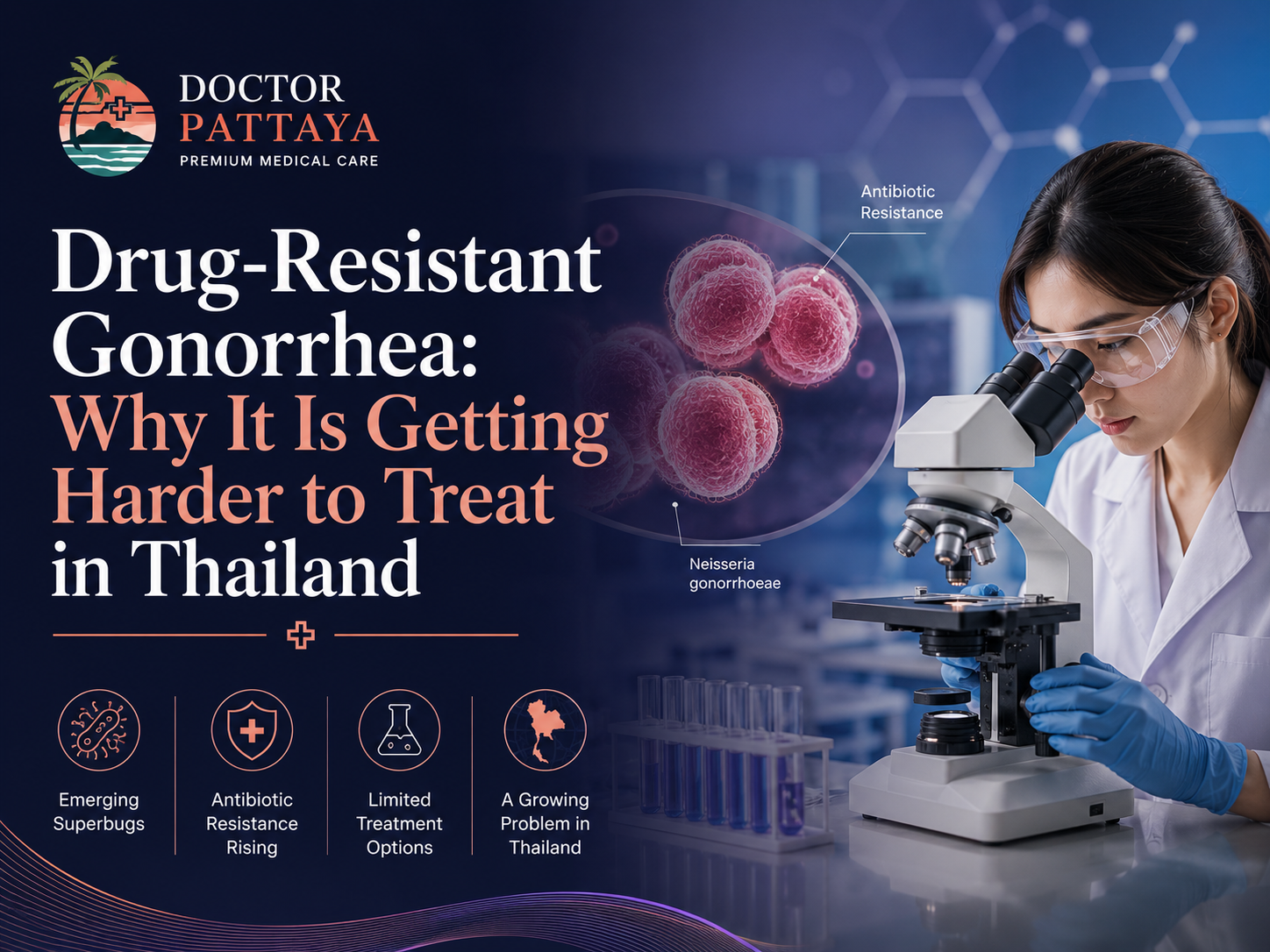
Drug-resistant gonorrhea is a real and growing problem in Thailand, where peer-reviewed research has identified resistant strains that have spread internationally. Standard antibiotics still work for most cases, but not all. Getting tested with culture and sensitivity analysis, not just a basic swab, is the only way to confirm your treatment has actually worked.
You had a good few days in Pattaya. Maybe things got a little unplanned one night. Now you are sitting in your hotel room reading this, either because something feels off or because nothing feels off and that is exactly what is worrying you. Either way, you are doing the right thing by looking into it now.
Gonorrhea is still treatable in most cases. But the picture has been shifting, and Thailand sits right at the centre of that shift. This is not a scare piece. It is a straight explanation of why drug-resistant gonorrhea is a bigger concern here than in most Western countries, what that means for your treatment, and what we do at Doctor Pattaya to make sure you leave genuinely clear.

Why Thailand Is a High-Risk Zone for Resistant Gonorrhea
Thailand is not a random data point in the global resistance story. It is an active WHO surveillance site under the EGASP program, which tracks resistant gonorrhea strains across countries. Research has identified ceftriaxone-resistant strains originating in Thailand that later turned up in Europe and North America. The bacteria travel with people.
Pattaya specifically has a patient mix that makes this more relevant here than almost anywhere else in the country. High tourist turnover, a significant sex industry, and a local population that moves between partners and sometimes across borders creates exactly the conditions where drug-resistant gonorrhea spreads before anyone knows it is there.
The Problem with Self-Treating in Pattaya
We see this constantly. A patient comes in, tells us they felt a burning sensation a week ago, bought some antibiotics at a pharmacy on Second Road, took half the course, felt better, and assumed it was sorted. It is not sorted. That pattern is one of the clearest drivers of drug-resistant gonorrhea in Thailand.
Over-the-counter antibiotics are easier to access here than in most countries. Taking the wrong antibiotic, the wrong dose, or stopping early does not cure gonorrhea. It gives the stronger bacteria the chance to survive and multiply. That is how extensively drug-resistant strains develop. It also masks your symptoms while leaving you still infectious.

Symptoms of Gonorrhea, Including When There Are None
The classic signs are discharge from the penis or vagina, burning when you urinate, and sometimes swelling or discomfort. Those do show up in many patients we see.
But the version that concerns us most is asymptomatic gonorrhea, where there are no symptoms at all. This is especially common with pharyngeal gonorrhea, a throat infection picked up through oral sex. You will not feel it or notice anything. Throat infections are harder to treat and account for a significant share of confirmed treatment failures. If you had unprotected oral sex in Pattaya and you are reading this, that alone is a reason to get a throat swab done.
Getting Tested for Drug-Resistant Gonorrhea in Pattaya
At Doctor Pattaya, gonorrhea testing is same-day and straightforward. We start with a NAAT test, a highly accurate molecular test. Depending on your history and risk, we may also recommend a culture and sensitivity test, which identifies exactly which antibiotics the strain you are carrying responds to. A positive NAAT tells us you have gonorrhea. A culture tells us how to treat it properly.
We test from all relevant sites: urine, urethral or cervical swab, and throat and rectal swabs where appropriate. If you are not sure what you need, just come in and tell us what happened. We ask the right questions and test accordingly. No judgment, no unnecessary delay. You can find out more about our STD testing and treatment service and what to expect when you arrive.
Treatment for Drug-Resistant Gonorrhea
For most patients, a ceftriaxone injection is still the first-line treatment and it works well. Current guidelines recommend it as a single agent rather than combining it with azithromycin, because azithromycin resistance has become too widespread to rely on.
For confirmed or suspected resistant cases, treatment becomes more specific. Culture and sensitivity results guide which antibiotic is right for that particular strain. At Doctor Pattaya, we follow current WHO and Thai Ministry of Public Health guidelines and update our protocols when they change.
A test of cure, a follow-up swab or urine test taken seven to fourteen days after treatment, is how we confirm the infection is actually gone. Symptom resolution is not enough with resistant strains. If symptoms clear but bacteria survive, you may still be infectious without knowing it.
New Treatments on the Horizon
For a long time there was nothing genuinely new in gonorrhea treatment. That changed in late 2025, when the FDA approved two new antibiotics: gepotidacin and zoliflodacin. These are the first new drug classes for gonorrhea in over thirty years. Because they work through entirely different mechanisms, resistance to current drugs does not automatically carry over to them.
Availability in Thailand may still lag behind Western markets, and these are not yet first-line options everywhere. But their approval means a resistant case is not a dead end. Doctor Pattaya stays current on guideline updates and can advise on what is actually accessible here.
Why Culture and Sensitivity Testing Matters More Here
In lower-resistance countries, a standard treatment and a follow-up check is usually enough. In Thailand, the chance of encountering a resistant strain is meaningfully higher, which changes the calculus.
A basic NAAT swab confirms infection. It does not tell you whether the strain will respond to the antibiotic you have been prescribed. Culture and sensitivity testing does. That extra step is not routine everywhere, but at Doctor Pattaya we recommend it for patients with gonorrhea picked up here, particularly for throat infections and for anyone who has already taken antibiotics before coming to see us. If you want to understand more about gonorrhea testing and treatment options in Pattaya, the full detail is on our services page.
If you are worried about gonorrhea after unprotected sex in Pattaya, or you have already taken antibiotics and are not sure they worked, come and see us. Doctor Pattaya is open 24 hours a day, seven days a week. We offer same-day testing including culture and sensitivity analysis, current treatment protocols for resistant strains, and test-of-cure follow-up to confirm you are actually clear. Walk-ins are welcome, and we can come to your hotel anywhere in Pattaya, Jomtien, or Naklua. Visit doctorpattaya.com to book or just walk in.
Frequently Asked Questions

Dr. Pipat Finn is the senior doctor at Doctor Pattaya Takecare Clinic, a 24/7 walk-in medical practice on South Pattaya Road, Chonburi, Thailand. They provide primary care, travel medicine, sexual health, vaccination, minor surgery, IV therapy, and emergency outpatient services for tourists, expatriates, and Pattaya residents. Languages: English and Thai. WhatsApp consultations: +66 95 073 5550. Call: +66 81 668 5557.