Clinically reviewed by Dr. Pipat Finn, M.D., Senior Doctor, Doctor Pattaya.
Last reviewed: October 2026
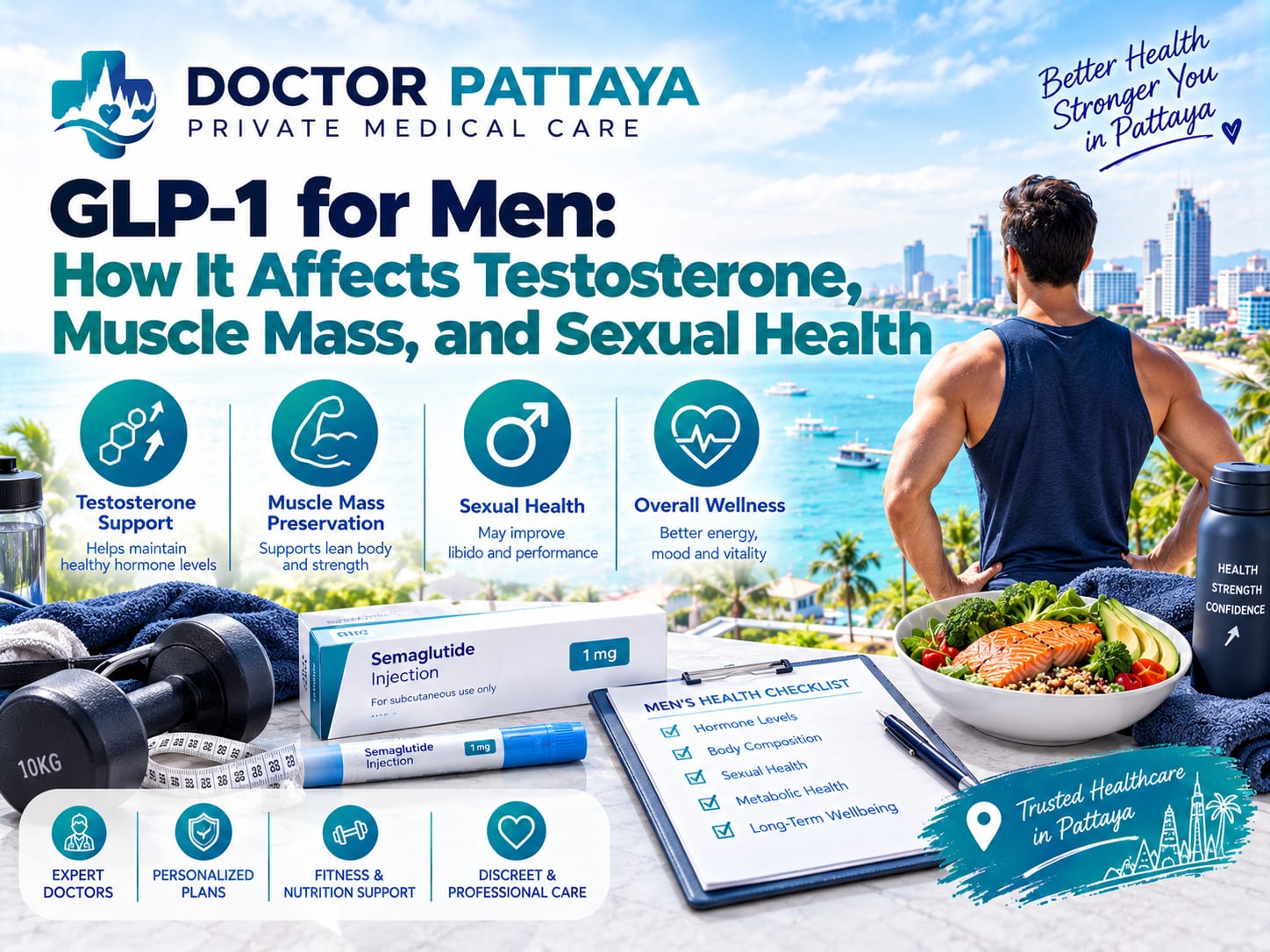
GLP-1 receptor agonists like semaglutide and tirzepatide can raise testosterone in men with obesity-related low testosterone, but the effect is indirect: it comes from fat loss, not from any direct action on your hormones. Muscle loss is a genuine risk during treatment and needs to be actively managed with protein intake and resistance training. Sexual health effects are mixed, with some men seeing improved erections and others reporting reduced libido, particularly early in treatment.
You have been carrying extra weight for a while, your energy is low, and your drive is not what it was. Maybe a mate mentioned GLP-1, or a doctor back home did. Now you are in Pattaya, either long-term or here for a stretch, and you want straight answers about what these drugs actually do to your body as a man. Hormones, muscle, sex: the things most articles either skip or bury.
The evidence is more interesting than the headlines suggest. Fat loss from GLP-1 therapy can genuinely shift your testosterone levels, and body composition changes are real. But there are trade-offs to understand before you start, and a clear plan to protect your muscle and monitor your hormones makes a real difference to the outcome.

Why Obesity Suppresses Testosterone and Where GLP-1 Fits In
Most men with obesity-related low testosterone do not have a problem with their testes or their brain. They have a problem with fat.
Visceral fat, stored deep around your organs, contains an enzyme called aromatase. Aromatase converts testosterone into oestrogen. The more visceral fat you carry, the more testosterone gets converted and the lower your free testosterone falls. Excess fat also increases insulin resistance, which signals your body to dial down testosterone production further. The result is a self-reinforcing cycle: low testosterone makes fat loss harder, and more fat drives testosterone lower still.
GLP-1 receptor agonists enter the picture by reducing appetite and driving significant weight loss. Men with a personal or family history of medullary thyroid cancer or a condition called MEN2 should not use these drugs, and anyone who develops severe abdominal pain while on them should see a doctor promptly, as pancreatitis is a recognised risk. That reduces the visceral fat driving the cycle. Testosterone does not rise because the drug stimulates your hormones directly. It rises because the aromatase burden is lower and the metabolic environment improves.
What the Evidence Actually Says About GLP-1, Men, and Testosterone
The most widely cited data comes from a retrospective analysis by Portillo Canales and colleagues, presented at ENDO 2025, the Endocrine Society’s annual meeting. In a cohort of men with obesity and low testosterone, around 77 percent showed testosterone normalisation after GLP-1 therapy, up from 53 percent at baseline.
Those are striking numbers. But the study design matters. It was retrospective, meaning researchers looked back at existing records rather than running a controlled trial. The sample was small. There was no post-treatment measurement, so what happens to testosterone if patients stop GLP-1 medication is unknown. The honest answer is that the evidence is promising but preliminary.
What the data does support clearly is the indirect mechanism: reduce visceral fat, reduce aromatase activity, and testosterone tends to recover. That is consistent with what we see in weight loss research broadly. GLP-1 just makes that weight loss more achievable for many men.

The Muscle Loss Risk on GLP-1 and How to Prevent It
This is the part that deserves more than a passing mention.
During any significant weight loss, some reduction in lean body mass is common. The concern with GLP-1 drugs is that appetite suppression can be so effective that men end up in a large caloric deficit without maintaining the protein intake and training needed to protect muscle. Progressive muscle loss becomes a real risk, particularly in men over 45 or those who were already undertrained before starting.
Protecting muscle comes down to three things. First, protein intake: current guidelines support a target of 1.6 to 2.2 grams per kilogram of body weight per day during active weight loss. Second, resistance training: progressive lifting two to three times per week helps preserve lean mass during a caloric deficit. Third, monitoring: tracking body composition, not just weight on a scale, tells you whether you are losing fat or muscle.
You need both the dietary protein and the training load to signal your body to hold onto muscle while it sheds fat. Neither alone is enough.
GLP-1 and Sexual Health in Men
The picture here is genuinely mixed.
For men with obesity or type 2 diabetes, the metabolic improvements from GLP-1 therapy can translate into better erectile function. A 2025 to 2026 systematic review found significant improvements in erectile function in some studies examined, particularly in men with obesity or type 2 diabetes. The likely drivers are improved blood vessel function, lower insulin resistance, and rising testosterone, not a direct effect of GLP-1 on sexual tissue. For men whose erectile difficulties are tied to metabolic health, the improvement can be real.
On the other side, reports submitted to the FDA’s adverse event database include cases of reduced libido and orgasm dysfunction, particularly in the early months of treatment. The mechanism is not fully established. Some researchers point to the appetite suppression and nausea phase reducing overall energy and mood. None of this is proof of causation from that reporting system, but it is a signal worth taking seriously.
If your libido drops or your sexual function worsens after starting a GLP-1 drug, raise it with your doctor. Do not stop the medication on your own. A full hormone panel, including total testosterone, free testosterone, and sex hormone-binding globulin, can tell you whether a hormonal shift is contributing.
Should You Combine GLP-1 with Testosterone Therapy?
For some men, yes. For many men, no. It depends on your baseline.
If your testosterone was genuinely low before you started GLP-1 therapy and remains low after significant weight loss, that changes the picture. Confirmed hypogonadism alongside significant weight loss creates a scenario where muscle loss risk is higher and metabolic recovery may be slower. In those men, a combined approach using GLP-1 for fat loss alongside testosterone replacement therapy is an emerging clinical strategy, though large controlled trials are still limited.
This is not a protocol to self-prescribe. Starting testosterone without a baseline assessment, without knowing your SHBG and LH levels, and without monitoring haematocrit and prostate markers is poor medicine. Combined treatment requires a doctor who can assess both pathways and adjust as you go.
Men already on testosterone therapy who add a GLP-1 drug should expect their dose requirements to be reassessed as body composition changes. Fat distribution affects how testosterone is metabolised, and significant weight loss will shift that.
Monitoring Your Hormones and Body Composition in Pattaya
Starting a GLP-1 programme without a baseline hormone panel is working blind. You need to know where your testosterone sits before treatment so you can judge whether it is genuinely rising or whether other symptoms need attention.
A practical monitoring panel includes total testosterone, free testosterone, SHBG, LH, and FSH, along with a standard metabolic panel. Body composition review, separate from weight tracking, helps catch muscle loss before it becomes significant. For men on or considering testosterone therapy alongside GLP-1, haematocrit and PSA are added to the picture.
For expats living in Pattaya long-term, scheduling these reviews every three to six months is straightforward. For men here for a few weeks, the time pressure is real but manageable. Doctor Pattaya offers same-day blood testing, with results fast enough to inform decisions before you fly out. Whether you are staying near Jomtien or Naklua, the clinic’s South Pattaya location and hotel visit service mean getting tested does not have to disrupt your schedule. The full GLP-1 programme for men is at doctorpattaya.com/glp-1.
What to Expect When You Come In
Walk in or book ahead. Either works.
The first visit covers your history, current symptoms, and a blood draw for the baseline hormone panel. If you are already on a GLP-1 drug started elsewhere, bring the brand name, the dose, and how long you have been on it. If you are considering starting, the visit will clarify whether you are a suitable candidate and what monitoring you need.
Doctor Pattaya handles both the clinical assessment and the testing under one roof. No referrals, no waiting weeks. For tourists making a short medical stop, the lab test services cover the hormone panels needed. For expats who want ongoing management, follow-up reviews can fit around your schedule in Pattaya. If you want a doctor to come to you, hotel visits are available across Pattaya, Jomtien, and Naklua.
Thinking about GLP-1 therapy, or already on it and unsure whether your hormones and muscle are being properly monitored? Doctor Pattaya offers same-day hormone panels, body composition review, and clinical assessment for men considering or currently using GLP-1 medications. Walk in anytime, or book a hotel visit across Pattaya, Jomtien, and Naklua. No referral needed.
Frequently Asked Questions
References
- Portillo Canales S, et al. Use of incretin-based therapies associated with testosterone normalization in men with obesity. Presented at ENDO 2025, Endocrine Society Annual Meeting. Press release, 2025.
- Bhasin S, et al. Testosterone Therapy in Men with Hypogonadism: An Endocrine Society Clinical Practice Guideline. Journal of Clinical Endocrinology and Metabolism, 2018.
- Wilding JPH, et al. Once-Weekly Semaglutide in Adults with Overweight or Obesity. New England Journal of Medicine, 2021.
- Morton RW, et al. A systematic review, meta-analysis and meta-regression of the effect of protein supplementation on resistance training-induced gains in muscle mass and strength in healthy adults. British Journal of Sports Medicine, 2018.
- Mahmood A, et al. The Impact of Glucagon-like Peptide-1 Receptor Agonists on Erectile Function: Friend or Foe? Journal of Sexual Medicine, 2025 (conference supplement abstract).
- Mirghani H, AlQurashi M. Glucagon-like receptor-1 agonists and impotence: A meta-analysis. World Journal of Methodology, 2026.
The information in this article is for educational purposes only and does not constitute medical advice. It should not be used to self-diagnose or replace a consultation with a qualified physician. If you have concerns about your health, contact a licensed medical professional. For appointments at Doctor Pattaya, visit doctorpattaya.com.

Dr. Pipat Finn is the senior doctor at Doctor Pattaya Takecare Clinic, a 24/7 walk-in medical practice on South Pattaya Road, Chonburi, Thailand. They provide primary care, travel medicine, sexual health, vaccination, minor surgery, IV therapy, and emergency outpatient services for tourists, expatriates, and Pattaya residents. Languages: English and Thai. WhatsApp consultations: +66 95 073 5550. Call: +66 81 668 5557.