Clinically reviewed by Dr. Pipat Finn, M.D., Senior Doctor, Doctor Pattaya.
Last reviewed: October 2026
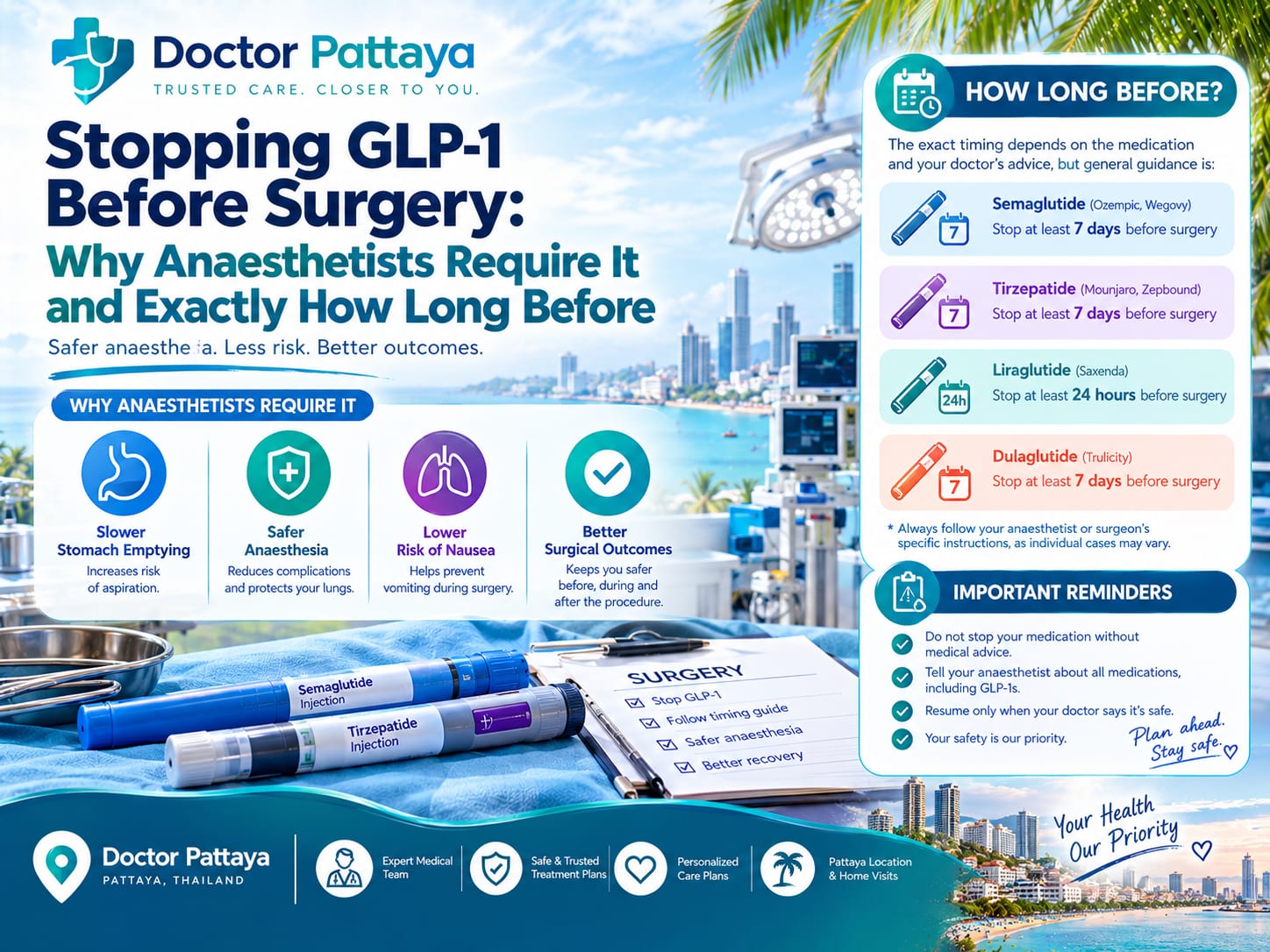
GLP-1 drugs like Ozempic, Wegovy, and Mounjaro slow the stomach down significantly. Under general anaesthesia, a full or slow-emptying stomach raises the risk of regurgitation and aspiration, where stomach contents enter the lungs. Current guidelines recommend stopping weekly GLP-1 injections at least one week before elective surgery, though 2025 guidance now favours individual risk assessment over a fixed rule. Always discuss this with your anaesthetist and prescribing doctor before any procedure.
You booked the operation weeks ago, your GLP-1 injection routine has been ticking along without a second thought, and now the pre-op paperwork is asking about your medications. Or maybe nobody asked at all and you are only reading this the night before. Either way, this is not a reason to panic. But it is a reason to act today.
The concern is specific and the solution is straightforward. GLP-1 drugs, including semaglutide (Ozempic, Wegovy), tirzepatide (Mounjaro), liraglutide (Victoza, Saxenda), and dulaglutide (Trulicity), all slow gastric emptying. Food and liquid sit in your stomach longer than usual. Under general anaesthesia, your normal airway reflexes are suppressed. If your stomach still holds contents when you go under, those contents can travel into your lungs. That is aspiration, and it is a serious complication. The fix is simple in most cases: stop the drug in time, tell your surgical team, and get a proper pre-operative review.

Why GLP-1 Drugs Are Different From Most Medications Before Surgery
Most medications do not directly change how fast your stomach empties. GLP-1 drugs do. That is partly why they work so well for weight loss and blood sugar control. Under anaesthesia, the same effect becomes a liability.
Standard fasting rules before surgery assume your stomach empties at a normal rate. If you are on a GLP-1, that assumption may no longer hold, even if you fasted for the required number of hours. Your stomach may still contain food or liquid from a meal eaten well before the usual cut-off.
Anaesthetic teams have reported finding gastric contents in patients who fasted correctly but were on GLP-1 medications. The risk is highest with weekly injectable agents because they stay active in your body far longer than daily ones.
How Long Before Surgery Should You Stop Your GLP-1?
The answer depends on which drug you take and how often you inject. Daily agents clear your system faster than weekly ones, and that changes the hold period.
| Drug | Brand Name | Dosing | Suggested Hold Before Elective Surgery |
|---|---|---|---|
| Semaglutide | Ozempic, Wegovy | Weekly | At least 1 week (one missed dose) |
| Tirzepatide | Mounjaro | Weekly | At least 1 week (one missed dose) |
| Dulaglutide | Trulicity | Weekly | At least 1 week (one missed dose) |
| Liraglutide | Victoza, Saxenda | Daily | At least 1 day; confirm with anaesthetist |
| Exenatide extended-release | Bydureon | Weekly | At least 1 week; confirm with anaesthetist |
These timings reflect the 2023 ASA interim guidance. Later multisociety guidance issued in 2024 and 2025 moved away from a fixed hold period toward individual risk assessment and modified fasting, so confirm the current recommended approach with your anaesthetist. They are starting points, not fixed rules. Your anaesthetist may adjust based on your individual situation.
One missed weekly injection achieves roughly a seven-day hold for drugs like Ozempic and Mounjaro. Do not take your usual injection the week before surgery. That is the practical step for most patients on weekly agents.

The Hold-Versus-Continue Debate: What 2025 GLP-1 Guidelines Actually Say
The 2023 ASA interim guidance recommended stopping weekly GLP-1 agents one week before elective surgery as a blanket rule. That was a reasonable starting point, but it has since evolved.
By 2025, a multidisciplinary consensus statement published in Anaesthesia (El-Boghdadly and colleagues, 2025) and guidance from the Australian Diabetes Society, ANZCA, GESA, and NACOS moved toward individualised assessment. The question shifted from "did the patient stop?" to "is the stomach empty right now?" Some patients can continue their GLP-1 with a modified fasting plan, particularly those whose surgical risk is low or whose diabetes is poorly controlled and cannot safely go without the drug.
This matters most for patients taking GLP-1 drugs for type 2 diabetes rather than weight loss. Stopping the drug may cause blood sugar to rise sharply before and during surgery, which carries its own risks. In those cases, the anaesthetist may prefer continuation alongside a low-residue or liquid diet in the days before the procedure.
The takeaway: there is no universal answer anymore. The decision should be made by your anaesthetist, with full knowledge of your drug, your dose, your indication, and your overall health.
What Anaesthetists Actually Do Differently When You Are on a GLP-1
When your anaesthetist knows you are on a GLP-1, they have several tools available. The most useful is a gastric ultrasound done on the day of surgery. This is a quick bedside scan of your stomach to check whether it still contains solids or liquid. It takes a few minutes and tells the team whether the standard anaesthetic approach is safe or whether something needs to change.
If the scan shows residual stomach contents, the anaesthetist may use rapid sequence induction. This is a specific technique designed to protect your airway faster than usual, reducing the window during which aspiration could occur. It is precautionary, and anaesthetists use it routinely in patients with higher gastric risk.
None of this replaces stopping your GLP-1 in time. Your anaesthetist can only manage the risk they know about, which is exactly why disclosure matters.
What Happens If You Forget to Tell Your Surgeon or Anaesthetist
This can happen, particularly with patients who source their GLP-1 prescriptions online or manage them independently while abroad. If you are in Pattaya for an operation and your GLP-1 is something you brought from home or picked up through an online pharmacy, there is no automatic system that flags it for your Thai surgical team.
If you have already been admitted and have not disclosed your GLP-1, tell the anaesthetist before induction. Not after. Not once you are in the theatre gown. Tell them at the pre-anaesthetic assessment, ideally the day before or the morning of surgery.
They can then order a bedside gastric ultrasound, modify the anaesthetic technique if needed, and document the risk properly. Disclosing late is always better than not disclosing at all.
The Risk of Stopping: What Diabetic Patients Need to Know
Most of the conversation around GLP-1 and surgery focuses on aspiration risk from continuing. Less discussed is what stopping can do to a diabetic patient’s blood sugar.
If you use a GLP-1 as part of your diabetes management, removing it before surgery may cause your blood glucose to rise. Elevated blood sugar around the time of surgery is associated with slower wound healing and increased infection risk. This is called perioperative hyperglycaemia.
This does not mean diabetic patients should never stop. It means the decision needs input from both your prescribing doctor and your anaesthetist. A pre-operative medication review, ideally a week or more before your procedure, gives both sides of the equation time to be considered properly. Do not make this call alone.
Practical Steps Before Your Operation
Stop your weekly GLP-1 injection at least one full week before your surgery date. If you are on a daily agent, discuss the hold period directly with your anaesthetist or prescribing doctor, as the timing differs.
Consider switching to a liquid or low-residue diet in the one to two days before your procedure. This does not replace the hold period, but it can help reduce the amount of solid matter remaining in a stomach with slowed gastric emptying. Several 2025 perioperative guidance documents reference this as a supplementary measure.
Tell every member of your surgical team: your surgeon, your anaesthetist, and the pre-op nurse. Put it in writing if you can. If you are travelling in Thailand and your usual prescribing doctor is abroad, a pre-operative review at a local clinic can bridge that gap with a clear briefing letter for your hospital team.
Getting a Pre-Operative GLP-1 Review in Pattaya
If you are living in or visiting Pattaya and have an operation coming up, getting a proper medication review before you arrive at hospital is straightforward. Doctor Pattaya offers pre-operative consultations that cover your GLP-1 medication, your surgical timing, and a written summary your anaesthetist can use on the day. You can walk in without an appointment or book a hotel visit across Pattaya, Jomtien, and Naklua.
Expats who self-manage prescriptions from overseas and tourists who brought their GLP-1 on holiday are exactly the patients who benefit most from this kind of review. There is no home GP in the loop and no automatic medication reconciliation between an international pharmacy and a Thai hospital. A pre-op consult at Doctor Pattaya fills that gap directly.
If your surgery is more urgent or you need same-day advice before presenting to a Thai hospital, you can reach us around the clock. You can find full details for booking at doctorpattaya.com/glp-1/. If you need minor surgical aftercare or wound management following your procedure, the minor surgery services page covers what is available in Pattaya. Patients staying near Jomtien Beach can also book directly through the Doctor in Jomtien Beach page.
Surgery coming up in Pattaya? If you are on Ozempic, Mounjaro, Wegovy, or any other GLP-1 drug, do not leave this conversation for the day of the procedure. Doctor Pattaya offers pre-operative medication reviews, available 24/7 by walk-in or hotel visit across Pattaya, Jomtien, and Naklua. We can review your drug and surgical timing and prepare a briefing letter for your anaesthetist. Find out more at doctorpattaya.com/glp-1/
FAQ
References
- El-Boghdadly K, Dhesi J, Fabb P, et al. Elective perioperative management of adults taking glucagon-like peptide-1 receptor agonists, glucose-dependent insulinotropic peptide agonists, and sodium-glucose cotransporter-2 inhibitors: a multidisciplinary consensus statement. Anaesthesia 2025;80:412-424. doi:10.1111/anae.16541
- Australian Diabetes Society, ANZCA, GESA, NACOS. 2025 Clinical Practice Recommendations on the Peri-Procedural Use of GLP-1/GIP Receptor Agonists. Anaesthesia and Intensive Care 2025. doi:10.1177/0310057X251355288
- Becker’s ASC Review. ASA no longer advises holding GLP-1 patients pre-op: 4 things to know. 2024.
- SonoSim. GLP-1 Receptor Agonists and Aspiration Risk: Why Gastric Ultrasound Is Becoming a Perioperative Essential. 2024.
The information in this article is for educational purposes only and does not constitute medical advice. It should not be used to self-diagnose or replace a consultation with a qualified physician. If you have concerns about your health, contact a licensed medical professional. For appointments at Doctor Pattaya, visit doctorpattaya.com.

Dr. Pipat Finn is the senior doctor at Doctor Pattaya Takecare Clinic, a 24/7 walk-in medical practice on South Pattaya Road, Chonburi, Thailand. They provide primary care, travel medicine, sexual health, vaccination, minor surgery, IV therapy, and emergency outpatient services for tourists, expatriates, and Pattaya residents. Languages: English and Thai. WhatsApp consultations: +66 95 073 5550. Call: +66 81 668 5557.