Clinically reviewed by Dr. Pipat Finn, M.D., Senior Doctor, Doctor Pattaya.
Last reviewed: October 2026
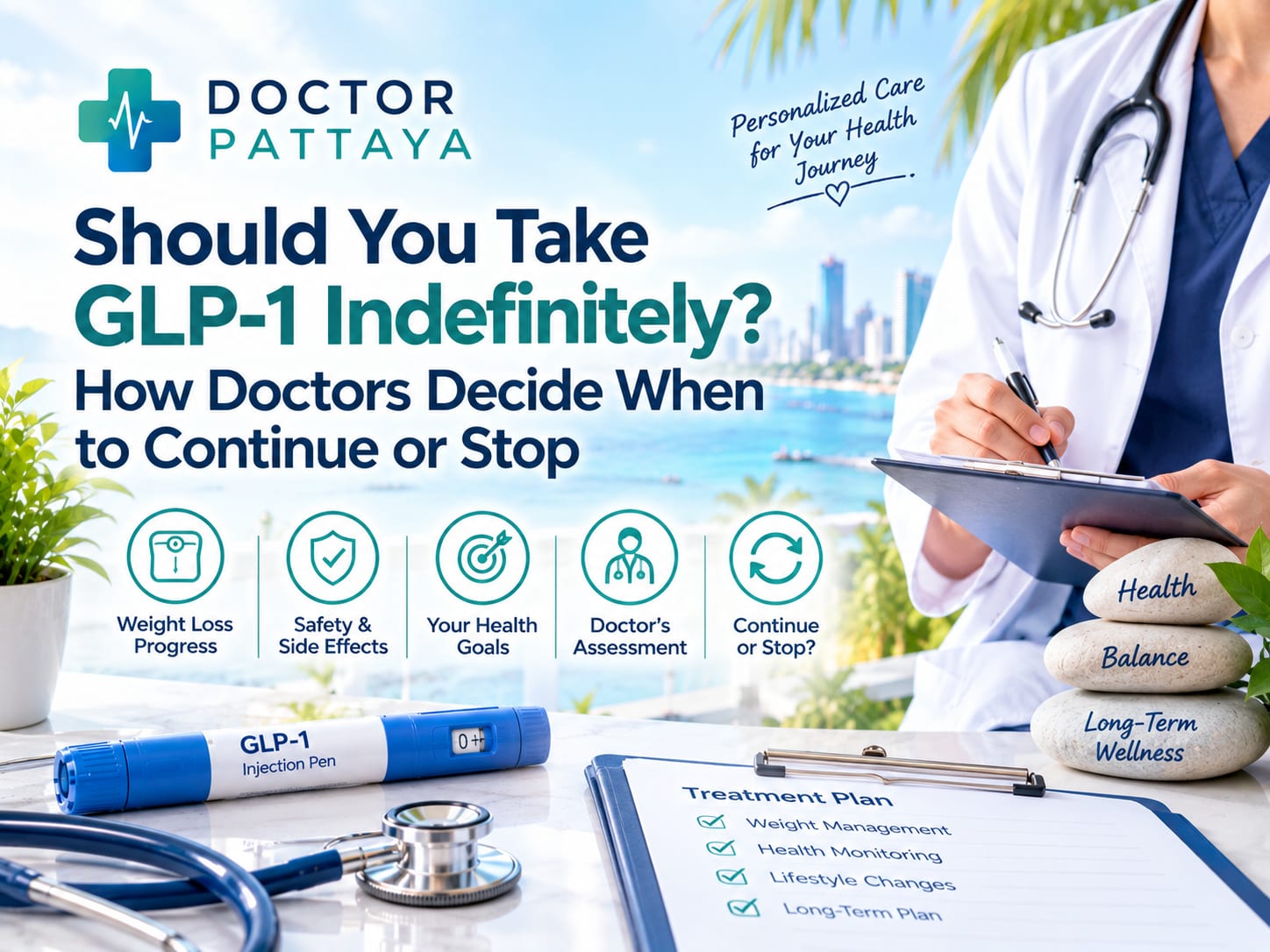
There is no universal stop date for GLP-1 medications like semaglutide or tirzepatide. For most people managing obesity or type 2 diabetes, long-term or indefinite use is clinically appropriate because stopping typically leads to significant weight regain and worsening metabolic health. Whether to continue comes down to your results, your side-effect tolerance, your underlying conditions, and regular monitoring by a doctor.
You set a goal weight. You hit it. The pen is running low and you are wondering whether you have done the hard part and can stop. It is one of the most common questions that comes up in GLP-1 consultations here, and the honest answer is: for most people, stopping is the riskier move. The clinical evidence on what happens after discontinuation is hard to ignore, and we will walk through it plainly.
A lot of expats in Pattaya have been on semaglutide or tirzepatide for a year or more, managed through a doctor back home, and they want to keep treatment going here without a gap. Tourists sometimes arrive mid-course with a pen that will not last the trip. Both situations come up regularly, and both are straightforward to handle. Here is how the decision actually gets made.
Is Obesity a Chronic Condition? Why That Changes the GLP-1 Question
If your doctor prescribed GLP-1 for weight loss, think of obesity the way you think of high blood pressure. You would not take blood pressure medication for six months, see your numbers normalise, and then stop cold and expect them to stay down. The underlying biology does not go away.
Obesity involves persistent changes in how your body regulates appetite, stores fat, and responds to insulin. GLP-1 receptor agonists work with that biology. When you stop, those regulatory signals shift back. The medication was not fixing a temporary problem.
This is why many clinical guidelines now support long-term, potentially indefinite use for patients with obesity. For type 2 diabetes, the case is even clearer: GLP-1 medications improve blood sugar control, HbA1c levels, and cardiovascular risk, and those benefits depend on continued use.
The Rebound Evidence, What Happens After Stopping GLP-1
The STEP 1 trial extension looked at what happened when participants stopped semaglutide after 68 weeks of treatment. Within one year of stopping, participants regained a substantial portion of the weight they had lost, and their cardiometabolic markers trended back toward baseline. This is not a worst-case scenario. It is the expected biological response.
Preliminary data presented at major cardiology conferences has suggested that gaps in GLP-1 treatment may raise the risk of major cardiac events in patients using the medication partly for cardiovascular protection. This data is not yet in final published guidelines, but it is taken seriously by clinicians, particularly for patients with existing heart disease or high cardiovascular risk.
The practical point: if you stop, have a plan. Tell your doctor, keep up your lifestyle habits, and book a review within three months to catch early rebound.

How a Doctor Decides, The Clinical Checklist for Continue or Stop
When a patient asks about stopping, here is roughly what a doctor works through.
First, why are you on it? If the original indication was type 2 diabetes or proven cardiovascular disease, the case for continuing is very strong. If it was weight loss alone, the conversation is more nuanced, though the biology still favours continued use in most people.
Second, where are you metabolically? A doctor will look at your current weight, your HbA1c if you have diabetes, your blood pressure, and your lipid panel. If everything is well-controlled and stable, that is a reason to continue what is working, not a reason to stop.
Third, how are you tolerating it? Persistent nausea, significant gastrointestinal side effects, or pancreatitis are legitimate reasons to reconsider the dose or the medication. Dose adjustment often resolves tolerability issues that can otherwise feel like a reason to stop entirely.
Fourth, are there practical barriers? Cost, access during travel, or storage challenges in a tropical climate are real factors. If a gap is unavoidable, a structured plan is better than an abrupt stop.
Dose Optimisation Over Time, Long-Term GLP-1 Treatment Is Not Static
Staying on GLP-1 long-term does not mean staying on the same dose forever. Some patients reach a stable maintenance dose that is lower than their peak titration dose. Others need a dose review if they have hit a plateau or if side effects became an issue at higher doses.
A doctor who is monitoring you properly will reassess dose every few months, not just renew the prescription automatically. This is also where lifestyle habits matter most. The medication works alongside what you eat and how you move, not instead of it.
What Monitoring Looks Like on Long-Term GLP-1 Use
If you have been on GLP-1 for more than a few months and no one has run blood tests, that is a gap worth fixing. Long-term monitoring should include periodic checks of your HbA1c, kidney function, liver function, and a full metabolic panel. Blood pressure and weight should be reviewed at every consultation.
For diabetic patients, HbA1c testing frequency follows standard diabetes management guidelines. For weight-loss patients without diabetes, a metabolic panel every six to twelve months is reasonable, though your doctor may advise differently depending on your individual risk factors.
At Doctor Pattaya, we run these panels on the same visit as a GLP-1 consultation. If you have been managing this mostly through repeat prescriptions without recent bloodwork, come in and we will catch up. You can find more detail on what a full review involves on our GLP-1 service page.
Getting GLP-1 in Pattaya and Thailand, Practical Guidance
GLP-1 medications including semaglutide and tirzepatide are legally available in Thailand by prescription only. You cannot buy them over the counter, and informal online sources carry real risks around product authenticity and cold-chain storage. As of early 2026, the Thai FDA has proposed reclassifying GLP-1 slimming pens as special controlled drugs, which may further restrict informal channels. A licensed clinic with a valid prescription is both the legal and the safe route.
If you are an expat prescribed GLP-1 by a doctor abroad, a licensed private clinic in Pattaya can review your treatment history, run any required baseline checks, and issue a valid Thai prescription. Bring documentation of your current prescription and recent blood results where possible. If you are a tourist who has run out mid-trip, the same process applies. Do not ration a pen that is running low. Come in and we will sort it.
Storage matters more here than it does in cooler climates. Most GLP-1 pens must be kept at 2 to 8 degrees Celsius before first use, and at room temperature below 30 degrees Celsius after opening, for a limited number of days depending on the product. Pattaya regularly hits 35 to 40 degrees Celsius outside. Never leave your pen in a car, a beach bag, or near direct sun. A small travel insulin cooler is a worthwhile investment. If a pen has been exposed to extreme heat, check with a doctor or pharmacist before using it.
Expats and visitors near Pratumnak Hill, Jomtien Beach, or Naklua can reach our clinic directly, and doctor hotel visits are available across Pattaya if coming into the clinic is not convenient.
Managing GLP-1 treatment in Pattaya, whether you need a prescription review, a monitoring blood panel, or continuity of care while you are in Thailand, Doctor Pattaya can help. We are open 24 hours a day, seven days a week, and we see tourists, expats, and local residents. Walk in or contact us to arrange a consultation or hotel visit across Pattaya, Jomtien, and Naklua.
Frequently Asked Questions
References
- Wilding JPH, et al. "Weight regain and cardiometabolic effects after withdrawal of semaglutide: The STEP 1 trial extension." Diabetes, Obesity and Metabolism. 2022
- World Health Organization. "Obesity and overweight." WHO Fact Sheet. 2024
- Davies MJ, et al. "Management of hyperglycaemia in type 2 diabetes, 2022. A consensus report by the ADA and the EASD." Diabetologia. 2022
- Lincoff AM, et al. "Semaglutide and Cardiovascular Outcomes in Obesity without Diabetes." New England Journal of Medicine. 2023
- Thai Food and Drug Administration. "Announcement on classification of weight-loss injectable drugs." Thai FDA. 2026
The information in this article is for educational purposes only and does not constitute medical advice. It should not be used to self-diagnose or replace a consultation with a qualified physician. If you have concerns about your health, contact a licensed medical professional. For appointments at Doctor Pattaya, visit doctorpattaya.com.

Dr. Pipat Finn is the senior doctor at Doctor Pattaya Takecare Clinic, a 24/7 walk-in medical practice on South Pattaya Road, Chonburi, Thailand. They provide primary care, travel medicine, sexual health, vaccination, minor surgery, IV therapy, and emergency outpatient services for tourists, expatriates, and Pattaya residents. Languages: English and Thai. WhatsApp consultations: +66 95 073 5550. Call: +66 81 668 5557.