Clinically reviewed by Dr. Pipat Finn, M.D., Senior Doctor, Doctor Pattaya. Last reviewed: September 2026
An HIV rash linked to early infection usually appears two to four weeks after exposure. It looks like flat or slightly raised pink-to-red spots and comes with flu-like symptoms: fever, sore throat, and fatigue. In Pattaya’s hot, humid climate, heat rash and dengue can look almost identical, so a clinical assessment and a 4th-generation HIV test are the only way to know for sure.
So you woke up this morning with a rash. Maybe it was a big night on Walking Street last week, maybe it was two weeks ago and you have been quietly counting the days since. Now you are sitting on the edge of the bed in your hotel room, phone in hand, and the rash is still there.
You are not the first person to walk through this, and you will not be the last. We see it regularly. A rash on its own usually does not tell us much. A rash with a fever, a sore throat, and swollen glands two weeks after a possible exposure tells us a great deal more. What follows is a plain account of what an HIV rash actually looks like, when it shows up, and what else could be causing the same thing in Pattaya. Read it, then come in.
What the HIV Seroconversion Rash Actually Looks Like
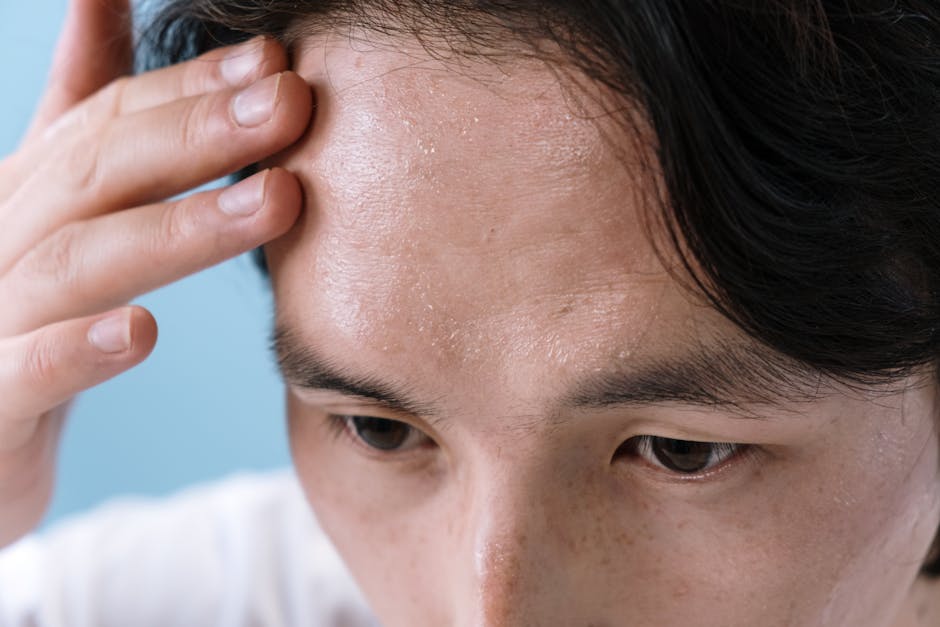
The rash that sometimes appears during early HIV infection is called the seroconversion rash. It is part of your immune system’s first strong response to a new infection.
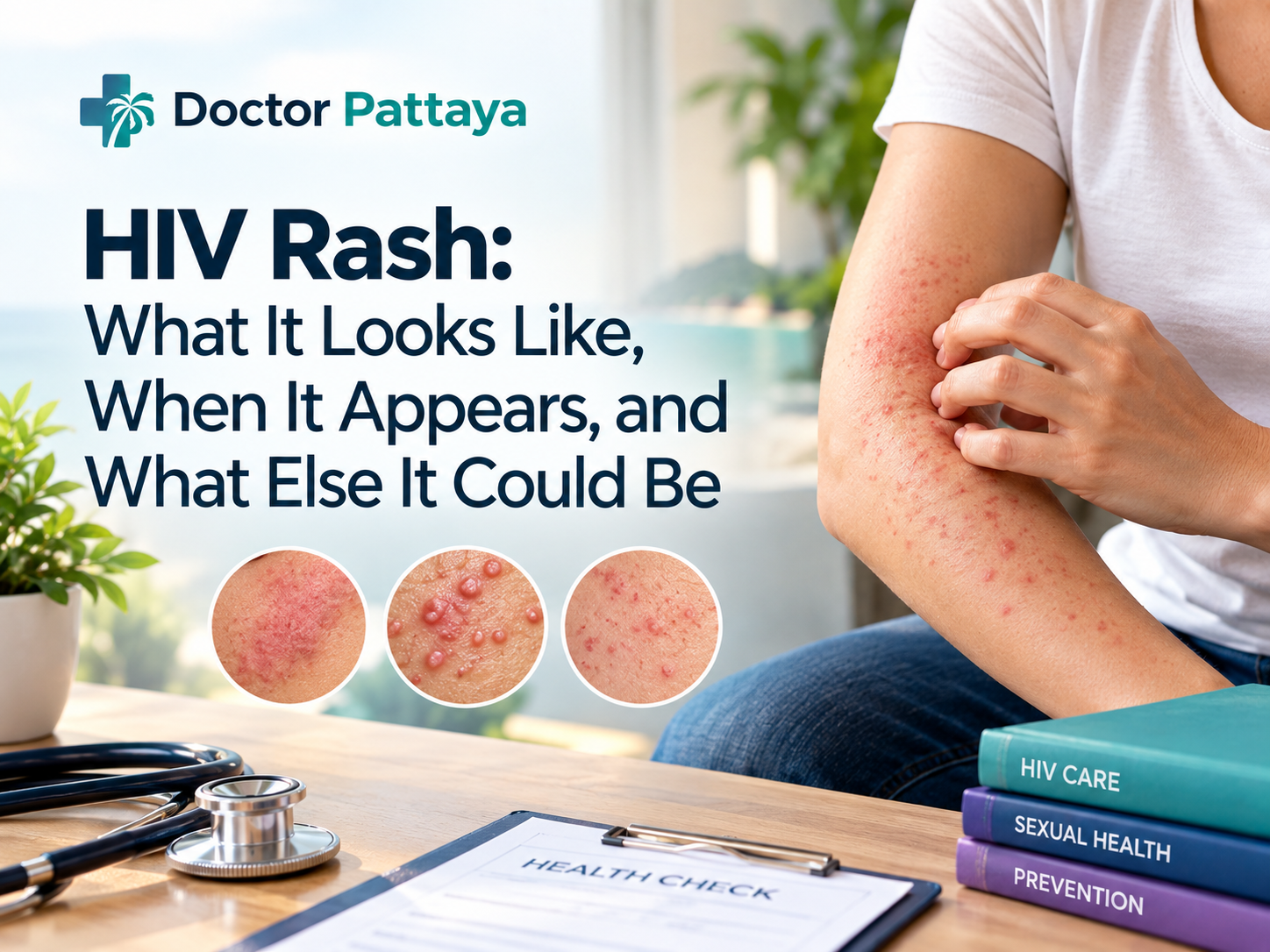
It usually looks like flat or slightly raised spots, pink to red on lighter skin, spreading across the chest, back, face, and sometimes the arms. It is not typically itchy. That detail matters, because itchiness is one of the first things that separates it from heat rash or an allergic reaction.
The rash usually appears two to four weeks after exposure and fades on its own within one to three weeks. Because it clears without treatment, a lot of people miss it or blame it on something else.
HIV Rash Appearance by Skin Tone
On fair skin, the seroconversion rash is usually clearly pink or red. On medium or darker skin tones, it can show up as darker flat patches or a subtle change in texture rather than obvious redness.
I mention this because patients from South-East Asia, South Asia, or Africa often tell me they felt reassured when they saw no redness. That reassurance can be misplaced. On darker skin, this rash is genuinely easy to miss.
If you have noticed any new skin change in the right timeframe, even something subtle that does not look like a classic red rash, it still warrants a clinical look.

HIV Rash vs Heat Rash — A Distinction That Matters in Pattaya
Prickly heat is one of the most common skin complaints I see in tourists here. Pattaya is hot and humid, and if you are not used to the climate, your sweat glands can become blocked within days of arriving.
Prickly heat clusters in areas of friction or high sweat: under the arms, across the back, around the waist. It is often itchy or stinging, and it improves quickly when you cool down and stay dry.
An HIV seroconversion rash does not improve with cooling. It is also rarely itchy. And it almost always comes with other symptoms: fever, sore throat, fatigue, swollen lymph nodes, sometimes body aches. Heat rash does not bring any of that with it.
If you have a rash and feel genuinely flu-like two to four weeks after a possible exposure, do not talk yourself out of getting assessed.
Other Rashes in Pattaya That Can Look Like an HIV Rash
This is where Pattaya specifically adds some complexity. There are several rashes I see regularly here that get mistaken for an HIV seroconversion rash.
Dengue fever produces a widespread red rash around day three to five of illness, often with small clear islands of normal skin visible within it. It comes with a high fever, severe headache, and significant joint and bone pain. Mosquito season in Thailand runs most of the year, so dengue is always on my list.
Secondary syphilis is one that surprises patients. The rash spreads across the trunk and, distinctively, involves the palms of the hands and soles of the feet. It is not itchy. Because syphilis and HIV share transmission routes, I test for both whenever either one is suspected.
Phytophotodermatitis shows up as streaky, blistering marks after lime juice or certain plant sap contacts the skin in sunlight. It is common after a beach day and cocktails in Jomtien. It looks alarming but has a completely different cause.
None of these can be reliably separated from an HIV rash without a clinical examination and blood tests.
Rashes Later in HIV — What Changes Over Time
The seroconversion rash is specific to early infection. With HIV that goes untreated over months or years, different skin conditions become more common.
Seborrheic dermatitis, a flaky condition affecting the scalp and face, becomes more persistent and harder to control. Molluscum contagiosum, small dome-shaped skin bumps caused by a virus, can spread widely. Kaposi sarcoma causes dark purple or brownish lesions that do not fade when you press on them.
A chronically itchy rash of small bumps, known as papular pruritic eruption, is also more common in people with poorly controlled HIV. These are not the same as an early seroconversion rash and appear in a very different clinical context.
If you are already living with HIV and have noticed new or changing skin symptoms, bring it up with your doctor.
Rashes Caused by HIV Medications
If you are already taking antiretroviral therapy, some medications can trigger drug hypersensitivity reactions that produce a rash. This is entirely separate from the seroconversion rash.
The reactions range from mild to serious. Stevens-Johnson syndrome is a rare but severe drug reaction that causes blistering of the skin, mouth sores, and eye involvement. If you develop any of those signs after starting a new medication, seek care immediately. Do not wait.
Do not stop your HIV medication without talking to a doctor first, even if a rash appears. Some reactions can be managed without stopping treatment.
When and How to Test After a Suspected HIV Rash
If the timing and symptoms fit, the most useful thing you can do is get tested. At Doctor Pattaya, we offer confidential 4th-generation HIV antigen/antibody testing, which detects both the virus proteins and your immune response.
The window period matters. A 4th-generation test is reliable from around 45 days after exposure. A test taken in the first two to three weeks may not yet show a positive result even if infection has occurred. I tell patients: test now for a baseline, then test again at 45 days if the first result is negative and the exposure was recent.
If the exposure happened within the last 72 hours and you are worried about HIV, contact us immediately. Post-exposure prophylaxis, or PEP, must be started within 72 hours to be effective. A rash at week two puts you past that window, but if you are unsure about timing, call us and we will work through it with you.
What to Do If You Think You Have an HIV Rash in Pattaya
Do not wait two weeks hoping the rash fades and takes the worry with it. Patients who do that arrive feeling worse and more anxious than if they had come in on day one.
Come in for a clinical assessment. We will look at the rash, take a history of any possible exposures, check your temperature and lymph nodes, and advise on which blood tests make sense. Same-day confidential HIV testing is available with no appointment needed, any time of day or night.
If you are staying somewhere across Pattaya, Jomtien, or Naklua and would rather not go out, that is covered too.
Seen a Rash and Do Not Want to Leave Your Hotel?
This is one of the most common situations we deal with. A tourist develops a rash mid-holiday, they are anxious, they do not want to sit in a waiting room, and they are not sure who to call.
Doctor Pattaya’s doctor hotel visit service covers hotels, condos, and serviced apartments across Pattaya, Jomtien, Naklua, and Pratumnak, around the clock. A doctor comes to you, performs a full skin assessment, reviews your exposure history, and advises on next steps. If blood tests are needed, samples can be arranged through the visit.
If you have a rash, flu-like symptoms, and a recent possible HIV exposure, this is not something to manage alone in your room. Reach out and let us come to you. You can find out more about our HIV testing and assessment process before you call if that helps.
Worried about an HIV rash in Pattaya? Doctor Pattaya offers confidential 4th-generation HIV testing and clinical skin assessments, 24 hours a day, with no appointment needed. If you would rather not leave your hotel, our doctor visit service covers all areas of Pattaya, Jomtien, Naklua, and Pratumnak. Walk in, call us, or request a hotel visit — we will take it from there.
FAQ

Dr. Pipat Finn is the senior doctor at Doctor Pattaya Takecare Clinic, a 24/7 walk-in medical practice on South Pattaya Road, Chonburi, Thailand. They provide primary care, travel medicine, sexual health, vaccination, minor surgery, IV therapy, and emergency outpatient services for tourists, expatriates, and Pattaya residents. Languages: English and Thai. WhatsApp consultations: +66 95 073 5550. Call: +66 81 668 5557.