Clinically reviewed by Dr. Pipat Finn, M.D., Senior Doctor, Doctor Pattaya.
Last reviewed: September 2026
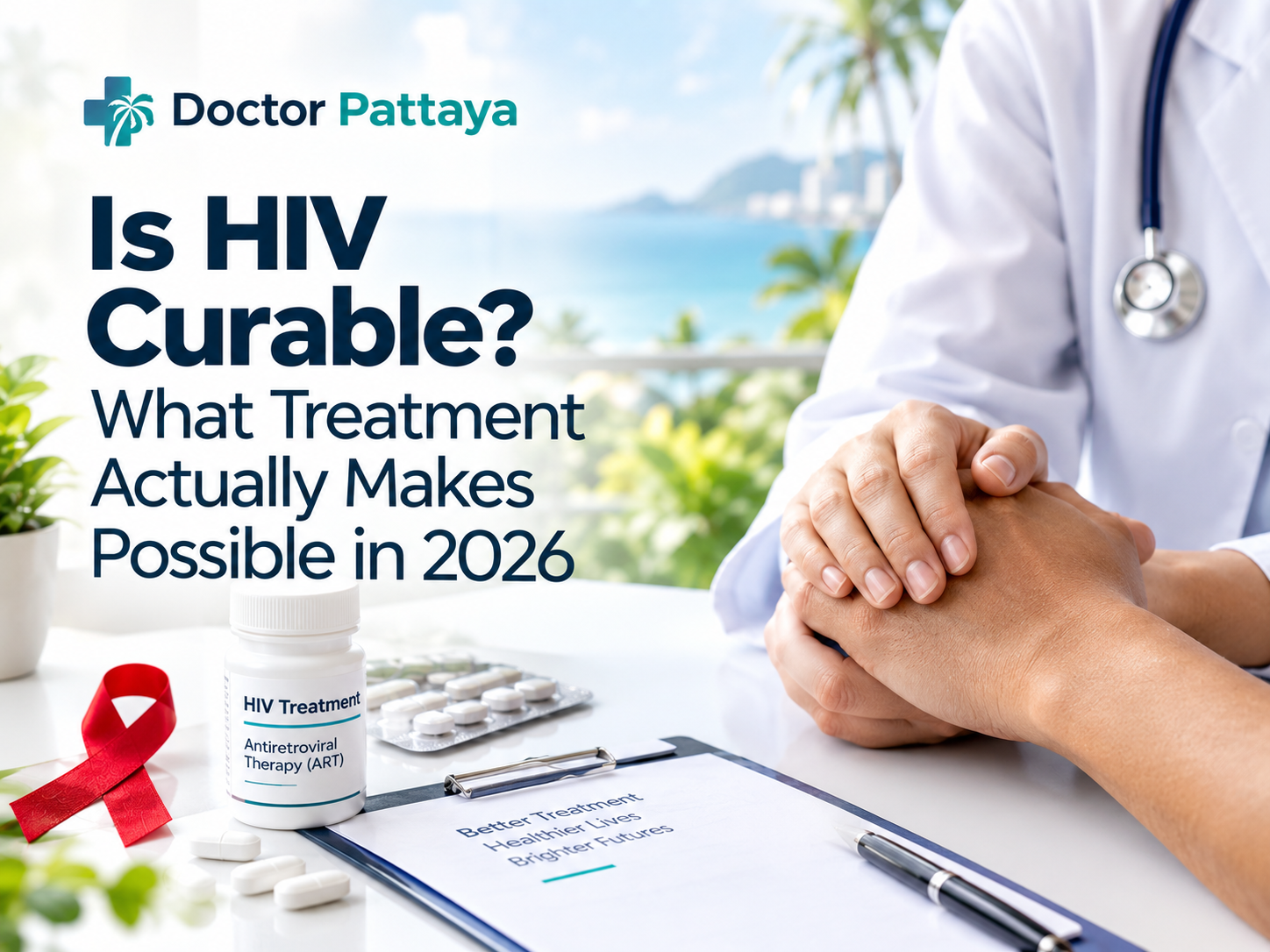
HIV cannot be cured for the vast majority of people in 2026. A small number of patients achieved remission through high-risk stem cell transplants, but this is not a standard treatment route. What modern antiretroviral therapy achieves is still remarkable: an undetectable viral load, a near-normal life expectancy, and a virus that cannot be sexually transmitted when suppressed. That is not a cure, but for most people it changes everything.
You searched this because something happened. Maybe you got a positive result at a clinic here in Pattaya and you are sitting in your hotel room trying to process it. Maybe you have been living with HIV for years and you want to know whether the science has finally caught up. Either way, you deserve a straight answer. So here it is: no widely available cure exists yet. But what treatment achieves today is far beyond what most people expect.
A diagnosis used to mean something very different. It does not mean that now. With the right medication started early, people with HIV live long, full lives. They keep the virus at levels so low it cannot be detected. They cannot sexually transmit it to a partner. If you are in Pattaya right now and you need to know what to do next, keep reading.

The Difference Between a Cure and What Treatment Actually Does
These two things get mixed up constantly, and the confusion causes real harm.
A sterilising cure means the virus is completely removed from the body. No ongoing treatment needed. That does not exist yet for most people. A functional cure means the virus is controlled so well that it causes no harm and cannot be transmitted, ideally without daily medication. We are getting closer to that second category, but not there yet for the general population.
What antiretroviral therapy, known as ART, does is suppress the virus. It does not remove HIV from the body. It brings the viral load, the amount of virus in your blood, down to undetectable levels. Stop taking the medication and the virus rebounds. That is the core reason a cure is so difficult to achieve.
Why HIV Is So Hard to Cure
HIV hides. Early in infection, it inserts itself into certain immune cells and goes quiet. These hiding spots are called reservoirs. Your immune system cannot see them. ART cannot reach them either. The virus just sits there, dormant, waiting. Stop ART and those hidden cells reactivate, flooding the body with virus again within weeks.
Until researchers can find and destroy every last hidden reservoir, the virus cannot be fully eliminated. That is the problem all current cure research is trying to solve.

The People Who Have Been Cured — What Their Cases Actually Mean
A handful of people have achieved what researchers call HIV remission. Some have remained off ART for years with no detectable virus. The Berlin patient, the London patient, the Düsseldorf and Geneva patients, a few others. These cases are real, and they matter scientifically.
Every single one of these patients also had blood cancer. They received bone marrow or stem cell transplants as cancer treatment, from donors who carry a rare genetic mutation called CCR5-delta32. This mutation makes cells resistant to HIV. The transplant essentially replaced their immune system with one HIV cannot infect.
This is not a route to a cure for a person without cancer. The transplant itself is dangerous, sometimes fatal. These cases prove that eradicating HIV from a human body is biologically possible. They do not mean a scalable cure is around the corner.
What Treatment Can Actually Achieve in 2026
This is the part that often gets buried under research headlines, so pay close attention.
ART taken consistently can suppress HIV to undetectable levels. When the viral load is undetectable, the virus cannot be sexually transmitted. This is not an opinion. It is scientific consensus, and it has a name: U=U, which stands for undetectable equals untransmittable. If you are on treatment and your viral load is suppressed, you cannot pass HIV to a sexual partner. That is a profound shift from where things stood 20 years ago.
Life expectancy for someone who starts treatment early and stays on it is now close to that of an HIV-negative person of the same age. People with HIV who are on treatment are not in a medical crisis. They are managing a chronic condition, the way someone manages blood pressure or diabetes.
One of the biggest practical advances right now is long-acting injectable ART. Lenacapavir, given twice a year by injection, and cabotegravir, given monthly or every two months, mean some patients no longer need a daily pill. That changes quality of life significantly, even if it does not change the underlying biology of the infection.
Cure Research in 2026 — What Is Actually Promising
The research is moving faster than at any previous point. That is the honest read of what has come out of major conferences in 2025 and 2026.
Broadly neutralising antibodies, known as bnAbs, have shown real promise. These target parts of HIV that do not easily mutate, making it harder for the virus to escape. In some trial participants, combinations of bnAbs maintained viral suppression for weeks after stopping ART.
Gene therapy approaches, including one called EBT-101, use gene editing to try to permanently disable HIV inside cells. Early safety data looks reasonable, but reliable prevention of viral rebound has not been demonstrated yet. Gene therapy for HIV remains experimental.
The honest timeline? A widely available functional cure is years away at minimum. But the direction of travel is clearer than it has ever been. Do not bet your health on a breakthrough that has not arrived. Bet on what works now.
HIV Myths That Still Circulate in Pattaya
We hear these regularly at the clinic, so let us address them directly.
"PEP or PrEP means you are fine." PEP, taken within 72 hours after a potential exposure, significantly reduces the risk of HIV if taken correctly for 28 days. It is not a morning-after guarantee. PrEP is highly effective when used as prescribed before exposure. Neither replaces testing. If you need PEP after an exposure in Pattaya, do not wait until morning.
"Undetectable means cured." It does not. Undetectable means the virus is suppressed by medication. Stop the medication and the virus returns. But undetectable does mean untransmittable, and that matters enormously for both partners in a relationship.
"HIV only affects certain types of people." It does not. HIV is transmitted through specific routes regardless of who you are. Unprotected sex, sharing needles, and certain other exposures are the relevant factors. Anyone can be at risk.
Getting Tested and Starting Care in Pattaya
If you had a potential HIV exposure in Pattaya in the last 72 hours, that is a medical situation that warrants action today. PEP needs to be started quickly to be effective. Doctor Pattaya offers same-day confidential HIV testing and can assess whether PEP is right for your situation.
If you tested positive and you are a tourist or expat here without your usual doctor, you do not have to work through that alone. A private clinic consultation gives you a confirmatory test, a clear explanation of your results, and a starting point for ART care. You do not need a Thai ID card to access private HIV care here. A passport is enough.
If you are an expat who has run out of ART medication while in Pattaya, treat this as urgent. Even a short gap risks viral rebound. Bring your most recent lab results and a list of your current regimen, and we can work from there. Our confidential HIV testing and treatment services cover exactly this situation, and we see it more than you might expect.
For anyone thinking about starting PrEP, that is also a conversation we can have at Doctor Pattaya. If you are sexually active here and not on PrEP, it is worth asking about. We do walk-in HIV testing and PrEP assessments any time of day, and we can also come to your hotel in Jomtien, Naklua, or Pratumnak if getting to the clinic is not easy right now.
Whether you have just had a potential HIV exposure, received a positive result, need your ART prescription reviewed, or want to start PrEP, Doctor Pattaya is open 24 hours a day, seven days a week. We offer confidential HIV testing with same-day results, PEP assessment within 72 hours, PrEP prescriptions, ART medication access for expats, and doctor hotel visits across Pattaya, Jomtien, and Naklua. Walk in any time or contact us to arrange a hotel visit. No appointment needed.
Frequently Asked Questions

Dr. Pipat Finn is the senior doctor at Doctor Pattaya Takecare Clinic, a 24/7 walk-in medical practice on South Pattaya Road, Chonburi, Thailand. They provide primary care, travel medicine, sexual health, vaccination, minor surgery, IV therapy, and emergency outpatient services for tourists, expatriates, and Pattaya residents. Languages: English and Thai. WhatsApp consultations: +66 95 073 5550. Call: +66 81 668 5557.