Clinically reviewed by Dr. Pipat Finn, M.D., Senior Doctor, Doctor Pattaya.
Last reviewed: August 2026
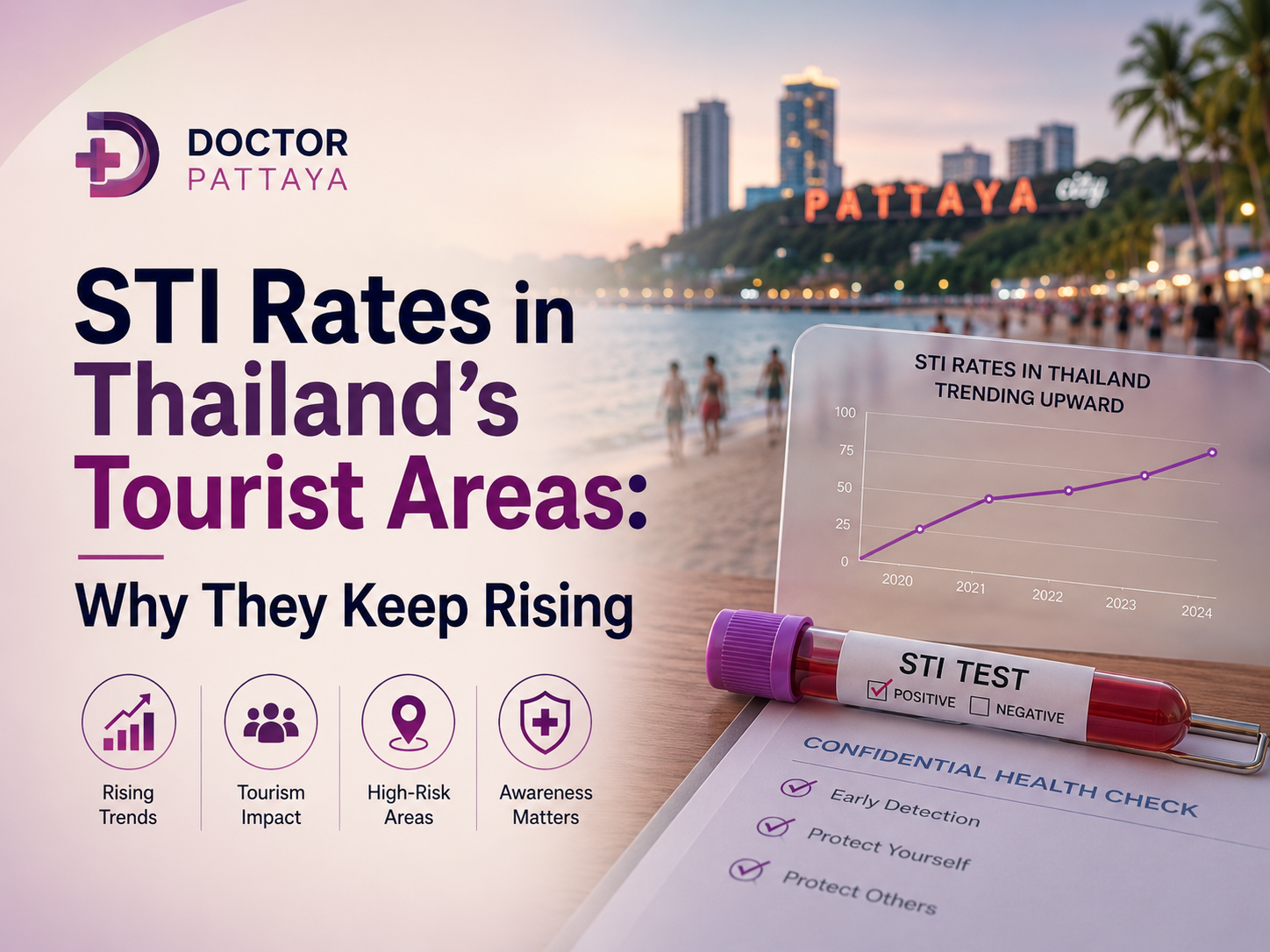
Thailand’s STD rate has risen sharply over the past decade, with syphilis cases more than doubling between 2018 and 2022 according to Thailand’s Ministry of Public Health. Tourist-heavy cities like Pattaya face particularly high risk due to high visitor turnover, a large nightlife economy, and widespread underreporting. If you have had unprotected sex in Thailand, getting tested promptly is the single most important thing you can do.
If you are reading this after a night out in Pattaya, or you are an expat who has been putting off a test longer than you should admit, you are not alone. I see patients in exactly that situation every week. Some have symptoms. Most do not. That is part of what makes this worth paying attention to.
The STD rate in Thailand is not just a headline statistic. It reflects something real that plays out in this city daily: a large transient population, a thriving nightlife economy, and a healthcare system that catches only a fraction of actual cases. Knowing what is driving the rise helps you make smarter decisions, whether you are here for a week or have lived here for years.

The Numbers Behind Thailand’s Rising STD Rate
Thailand’s Ministry of Public Health reported a national syphilis rate of 18.6 per 100,000 people in 2022, up from under 8 per 100,000 in 2018. Bangkok’s rate reached 96.87 per 100,000 by 2024. That is more than five times the national average.
Pattaya does not have its own separate reporting figure. Cases are logged under Chonburi province. But given the city’s visitor numbers and the density of its nightlife economy, local rates almost certainly reflect Bangkok-level risk, if not higher.
A cohort study tracking Pattaya sex workers between 2016 and 2020 found significantly elevated rates of both HIV and syphilis compared to the national average. That is the most locally specific data available, and it points clearly in one direction.
Gonorrhea and chlamydia figures tell a similar story. Chlamydia in particular is massively underreported because it causes no symptoms in the majority of people who carry it.
Why Pattaya Is Its Own Risk Environment
Most articles on this topic frame everything around Bangkok. Pattaya is not Bangkok. The risk profile here is different, and in several ways it is more intense.
Pattaya receives around 27 million visitors a year. A large proportion come specifically for the nightlife. Short stays, high partner turnover, alcohol involved in most encounters, and condom use that is far less consistent than people admit afterward. That combination creates conditions where infections spread quickly.
There is also the expat factor. Long-term residents often develop a false sense of familiarity with partners they have seen before. I hear this often: "I know her, it is fine." That reasoning does not hold up clinically, and I say that without judgment. It is just how transmission actually works.
Pattaya also draws visitors who may already have an untreated infection from elsewhere. High partner turnover means those infections circulate fast.

The Most Common STIs Circulating in Pattaya
Syphilis is the infection I am most concerned about right now. It can appear as a painless sore that disappears on its own, which patients often take as a sign things resolved. They did not. Untreated syphilis progresses silently for years and is fully curable with antibiotics when caught early.
Gonorrhea is common and increasingly hard to treat. Antibiotic-resistant strains are well-documented across Southeast Asia, and standard treatments that work in Europe or Australia may not be enough here. If you were treated for gonorrhea at home after a trip to Thailand and symptoms returned, resistance is worth discussing with a doctor.
Chlamydia is the quiet one. Most people with it feel nothing. No discharge, no pain, no obvious sign. It still causes damage over time, particularly to fertility in women. Testing is the only way to know.
HIV transmission in Pattaya is most concentrated in men who have sex with men and people who share needles, but it affects heterosexual tourists too. Modern HIV PCR testing can detect infection from as early as five to ten days, so you do not have to wait long to get a meaningful result.
Why So Many Cases Go Unreported and Untreated
Official numbers are the floor, not the ceiling. Real STI prevalence in Thailand is substantially higher than what gets counted.
Stigma is the main driver. Many patients, tourists and expats alike, avoid testing because they do not want to say out loud what happened. Some worry about what hotel staff or clinic receptionists might think. These are real barriers and I hear them directly from patients.
Language is another one. Tourists who develop symptoms mid-trip often cannot navigate a Thai government hospital, so they wait. Sometimes symptoms fade. The infection usually does not.
Then there is the fly-home problem. A tourist gets exposed on Wednesday. Their flight is Saturday. They feel fine. They leave. Three weeks later, symptoms appear at home, or they never appear and the person passes the infection on without knowing. No Thai data system captures that case at all.
When to Get Tested for STDs in Pattaya
This is the question I get asked most at the clinic, usually by someone who has already been waiting longer than they should.
For gonorrhea and chlamydia, a PCR test is reliable within one to two weeks of exposure. Syphilis antibody tests are most accurate at three to six weeks. HIV PCR can detect infection from as early as five to ten days. If your initial test comes back negative but your exposure was high-risk, a repeat test at six weeks gives you a clearer picture.
My practical advice: if you had unprotected sex in Pattaya and you are flying home within the week, get tested before you leave. Even an early screen gives us information, and we can advise you on what to retest at home. At Doctor Pattaya, we run STI panels with same-visit results for most tests.
If you are an expat, routine sexual health screening every three to six months makes sense if you are sexually active with new partners. Most people I see have not tested in over a year.
Prevention Beyond the Condom
Condoms remain the most effective widely available barrier. Use them. That part has not changed.
But there are additional tools that many tourists and expats do not know about or cannot easily access at home.
PrEP is a daily oral medication that reduces HIV transmission risk by over 99% when taken correctly, according to strong clinical evidence. It requires an initial HIV test and a kidney function check before starting. It is available at Doctor Pattaya and is a practical option for sexually active expats and frequent travellers at ongoing risk.
DoxyPEP is a newer option: a single dose of doxycycline taken within 72 hours of unprotected sex. It has shown strong evidence for reducing bacterial STIs including syphilis, gonorrhea, and chlamydia in high-risk groups. It is not a substitute for condoms, but it is a meaningful safety net. Ask about it when you come in.
Hepatitis B vaccination is something many expats have not completed. Hepatitis B is sexually transmitted and Pattaya’s transient population creates real ongoing exposure. If you are not vaccinated or not sure, we can check your immunity with a simple blood test and complete the course if needed.
Getting Tested at a Private STI Clinic in Pattaya
A lot of people assume STI testing at a private clinic is complicated, expensive, or somehow goes on a permanent record somewhere. None of those things are true here.
Doctor Pattaya runs a full STI panel covering HIV, syphilis, gonorrhea, chlamydia, hepatitis B, and hepatitis C. Testing is confidential. Private clinic records in Thailand are not connected to government health databases or travel insurance reporting systems. What happens in the clinic stays there.
Most results come back the same day or within 24 hours. If something comes back positive, we discuss treatment immediately. Syphilis and chlamydia are curable with antibiotics. Gonorrhea is treatable, though we check for resistance. HIV is manageable with antiretroviral therapy, and starting early makes a significant difference to long-term health.
Walk in any time, day or night. If you are staying in Jomtien, Naklua, or Pratumnak, doctor hotel visits are available across Pattaya. No appointment needed. The only thing that actually matters is that you know your status.
Concerned about STI exposure in Pattaya? Doctor Pattaya is open 24 hours a day, seven days a week in South Pattaya. We offer confidential STI testing and treatment for tourists, expats, and local residents, with same-visit results and no appointment needed. Walk in, or book a doctor hotel visit to wherever you are staying. Visit doctorpattaya.com or call us now.
Frequently Asked Questions

Dr. Pipat Finn is the senior doctor at Doctor Pattaya Takecare Clinic, a 24/7 walk-in medical practice on South Pattaya Road, Chonburi, Thailand. They provide primary care, travel medicine, sexual health, vaccination, minor surgery, IV therapy, and emergency outpatient services for tourists, expatriates, and Pattaya residents. Languages: English and Thai. WhatsApp consultations: +66 95 073 5550. Call: +66 81 668 5557.